Medusa
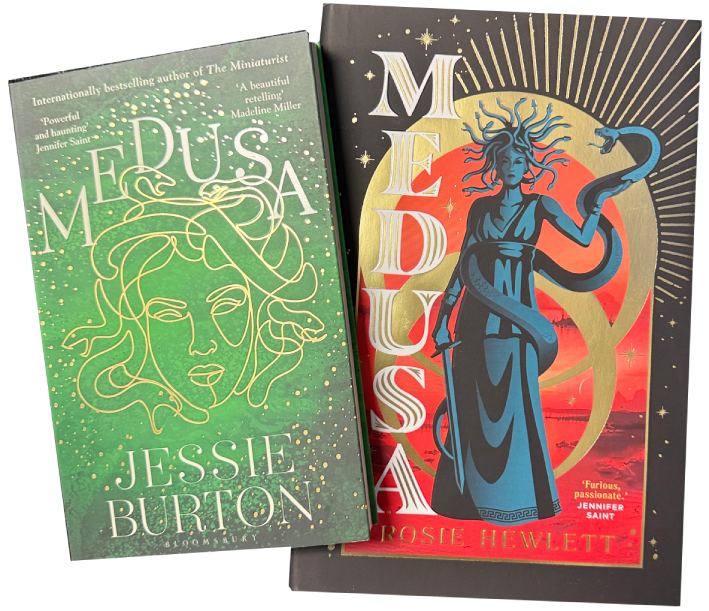
Jessie Burton
Bloomsbury Books
Medusa
Rosie Hewlett
Bantam Press
Medusa, violated by Neptune/Poseidon and transformed into a Gorgon by Minerva/Athena, according to Ovid.
Though prior Hesiod’s Theogeny describes Medusa as having been born a Gorgon, and in a meadow ‘lay’ with Poseidon, and not a word about Athena/Minerva condemning her.
Modern revisionists tell us that Medusa asked to be rid of her beauty so that no man or God would ever come near her again.
Let’s be clear however, taking from the source and not confluence, the earliest account of Medusa says (admittedly translated);-
“And the Gorgons, who dwell beyond famous Ocean, at the edge of Night, beside the clear-voiced Hesperides: Sthenno, Euryale, and Medusa who suffered a grievous fate. She was mortal, but the two were immortal and ageless. With her lay the Dark-haired One [Poseidon] in a soft meadow amid spring flowers. And when Perseus cut off her head, there sprang forth great Chrysaor and the horse Pegasus.”
— Hesiod, Theogony 270–283
Of course the story handed down to us came from later interpretations, research at leisure, including the Athena jealousy/conspiracy, the apotropaic use of her head to command over enemies was used, depicted and stamped upon coin and shield, but her head to petrify… the kraken? This being an entirely fabricated drama of the 20th century.
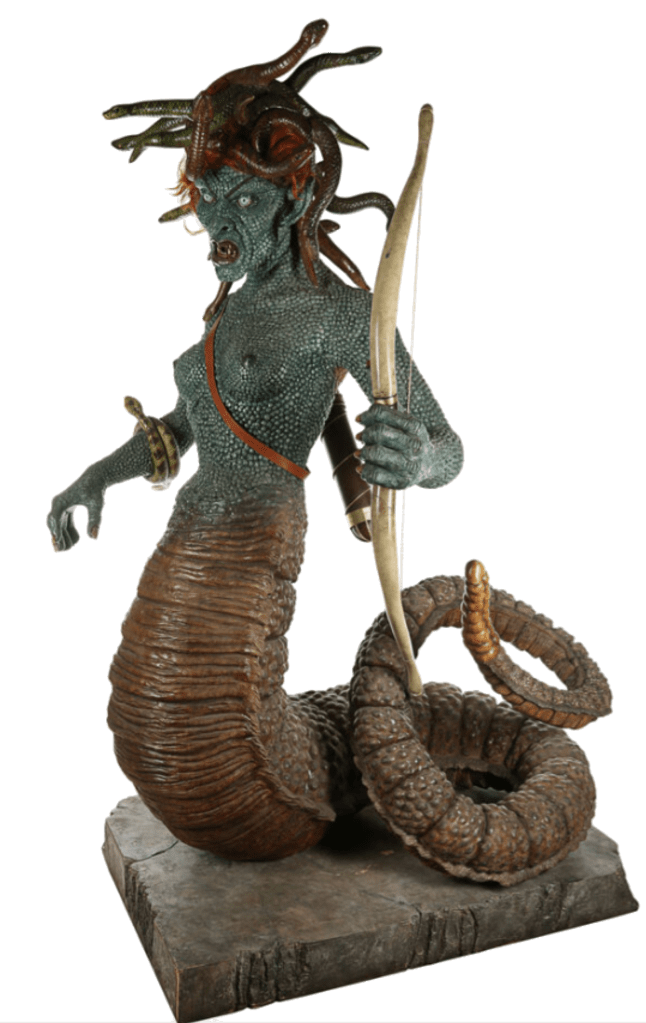
My first introduction to Medusa of course was Clash of the Titans~ Ray Harryhausen’s animation. She was depicted as a sinister menacing monster, Harryhausen’s intention was to fill us with – revulsion, fear and awe. I thought she was utterly magnificent and I could never forgive Perseus for cutting off her head.
I recently went to Waterstones Piccadilly and walked passed Hatchards bookshop nearby, this warranted a recce and return visit whereupon, amongst other treasures, I acquired two separate books on Magnificent Medusa.
Jessie Burton’s Medusa, is the slimmer of the two but both are modern retellings.
Jessie Burton gives us the retelling in the manner somewhat of Ovid. Medusa has been violated by Poseidon and exiled to an island with her sisters who were transformed into winged Gorgons, though the sisters didn’t have serpent dreadlocks like Medusa.
Along comes Perseus, bronzed muscular handsome etc… and Medusa, far from despising and being cautious to the last swoons, drools and becomes a rather pathetic lovesick Jane Austen character. The book then centres around their conversation, each with a secret~ Medusa that she is a gorgon and was abused by Poseidon, and Perseus that he has to behead the creature known as… Medusa. It doesn’t bode well in this Romeo and Juliette tragedy.
Of course, these little points of interest are not revealed until long after each has poured their heart out from a conversation where neither see each other, like a confession box, or gloryhole in a toilet block in Soho.
This isn’t the Medusa as I would recognise and is more portrayed in Burton’s book as a a fragile little flower. And Perseus is just a mummy’s boy. It reads more like a young adult Barbara Cartland, I assume, never having read the pink queens boudoir shlock.
Eventually they declare their undying love for each other, both it could be suggested catfishing, and when the screen is revealed to see what partner each has won Medusa turns our chiselled featured Adonis to stone. Good.
I don’t get it. The trauma that Medusa underwent just doesn’t come across, its more alluded to, and the fact that as a result she has to live in lonely exile with two shapeshifted sisters doesn’t seem to bother them. No trauma, just mental dreamy wanderings from Medusa, she is more akin to a Snow White lost in the woods waiting for loves first kiss. Nothing triggers, it doesn’t even illicit sympathy.
At the end of the book is a list of questions, presumably for anyone in a book club who’d like to engage in a conversation. Had I been in a book club entertaining this, I would be banished, like Medusa to exile on an island, with my own thoughts and brooding nightmares. That’s the issue, this isn’t a nightmare, this isn’t condemnation or outrage, it’s mawkish, even the serpents affixed to her head are regarded as a litter of puppy dogs.
I can understand how in some the best way to deal with an horrific event is ‘life goes on’ , denying trauma, but to this extent, unwavering trust in a stranger who comes from the sea, alike her vile rapist.
I guess the book is aimed at a younger clientele.
I want the psychology, the anguish, how an innocent broken reacts. Not like this? Really ?
It would have been better if there was a twist at the end, Perseus is turned into stone, and Medusa after all her pathetic lovesick aplomb acting smirks, her avenging heart satisfied, what she had planned all along.
Rosie Hewlett’s Medusa shows her formative years as being adopted by a priestess in Athena’s temple, the city itself long since demolished by Poseidon, jealous that the inhabitants worshipped Athena more than him. Poseidon, if I remember correctly was Zeus’s brother, therefore the Uncle of Athena. In classical history it was Athens, where Poseidon and Athena generally bitched about who was going to be adored by the mortals. Athena winning by gifting an Olive tree which the people enjoyed more than Poseidon’s Salty spring and a bonus horse. These details are not expressed within, suffice to say, it’s a run down city, where only Athena’s temple remains.
This Medusa isn’t as sickly syrup as Jessie Burtons. However the story is delivered as if Medusa reflects and talks directly to us, the reader, often patting our head to acknowledge a detail, “history is made by winners and men”,” ” did you know I was beautiful once”, “I was normal at first….did you know that?” pat pat. These little prompts questioning our knowledge can be a little trying, patronising, annoying.
Hermes the little gossip pops up as the story progresses, ambiguously needling Medusa with subtle hints that Poseidon is interested in her.
Interested.
By now, Medusa is told how beautiful she is.
Ingredi
Nowhere in this book or the previous are we to understand the nature of beauty, something Diotima taught Socrates, though she being a she perhaps should be dismissed?
What is beauty, subjective and organic, one moment buxom redheads rule the roost for favours of eager fickle men, and the next, stick thin emotionless clones with puffed up lips. I could digress (you have ), but Diotima states, in brief, beauty is the conscious evaluation of eternity. It resides in the visible form, is not understood, but lives forever. Oh, to behold infinity with thine eyes.
Agredi
The dread violation happens. Poseidon’s Interest become wanton lust and he takes Medusa. Poseidon coming across like a dirty lecherous predator. At least Athena will know what he’s like…. surely…….
Medusa tells us after this violation that other tales say she instigated ‘this’, that it was all consensual, and that these lies are easier to stomach.- We don’t have to face the horror of this tale.
That’s true, but what’s worse in this scenario is Athena’s subsequent actions.
Athena, a Goddess who is inherent with wisdom (apparently), decides Medusa has desecrated her temple. Bearing in mind Medusa has been the only priestess in that very same neglected temple , keeping the flickering candle flame fluttering.
It doesn’t make sense.
Athena refuses to listen to the protest, does not reason ( a standard in the engine of wisdom I would assume) with Medusa’s sisters, and turns them all into Gorgons.
In this tale, unlike the previous Medusa of Jessie Burton, Medusa also gets the benefit of wings and at least we don’t have to witness a long drawn out Medusa pity party as she finds her hardened heart reciprocally hardens the body of anyone she has eye contact with…literally, and goes on a wanton rage of vengeance.
Up pops snivelling tittle-tattling Hermes again who informs Medusa that she is with child thus ending the spiralling violence Medusa inflicts on man-notsokind.
Medusa flees to an island to save the child, but her own ‘narcissistic ‘ mother intent on living off the infamy of her daughter reveals her whereabouts to all the gallant warriors who end up being garden ornaments, except Perseus, guided and aided by Athena, he takes pity on Medusa, and agrees not to kill her until after the birth of her son. Athena, demands action, and the head is severed soon after the birth of her,.. twins.
Medusa, often epitomises the injustice that women endure, except here we have the Goddess she serves turning against her, through no fault of Medusa, and actually aids and abets her murder. The mother, who is some narcissistic evil bitch, Munchausen by proxy, wanting the infamy of her daughter. It isn’t sisterhood is it.
I liked Hewlett’s book, despite the annoying way Medusa speaks to us, the reader, now and then as if we’re children in school.
—
Afterword
The story of Medusa, is a myriad of tales. By reading all the different variations can we establish an archetype? and what is the symbology behind this, that if we accept the Goddess Athena condemned her, and a Goddess no less who is imbued with wisdom and synonymous with Justice ! What does that mean, what is it telling us?
I am unable in lucid dream to connect with Medusa, I’ve tried. The only time ‘she’ appeared somewhat in dream was as a symbol that looked like a small broadsword, she stood upright and ribbons flowed from her head, she was flanked by her sisters either side. At first I thought I was looking at the triform figure of Hecate, it was only soon after that it was clearly a recognisable Gorgon. Why the sword? The sword in my path represents both severity and mercy, To knight or behead as the declaration in initiation says. The vision of Medusa is in reflection. What we see, set in stone, it is our image we portray to the world, both in likeness and as our eulogy, of course neither of these are the real ‘we’ but condemned we are by what people perceive us to be.
We lose sight that we can not see our self because we view the manifest outwardly as an observer, rather than being that which observes.
The serpent, renowned as the image of wisdom, Asclepius, Nachash, and to have a crown full of serpents? I have always figured Medusa to be an Oracle of wisdom. In the regalia of the 52 Arcana tools of the cunning, Medusa is given to the Mirror, the scrying and reflecting, set upon a tripod~ The triangle upon which is sat the scrying glass. What we see in reflection is twofold. Our self staring back at us, that statue of stone as others condemn us by, and once we let go of our determining senses we view the scenery of nature we wish reflected, we scry.
Medusa, in some stories was, again ‘dobbed in’ by other women the – Graeae- Deino (“Dread”) Enyo (“Horror”) Pemphredo (“Alarm”), these three then, the triform. All things happen in threes, and these three share the same ‘seeing eye’. It’s a running stream of symbology.
Why did Athena, just and true, condemn Medusa? Medusa came from the lineage before the Olympians, her mother and father Phorcys and Ceto were ancient sea deities, whose parents were the primordial sea (Pontus), and Gaia- the Earth. They were from the older era. Medusa parents also gave birth to The Graeae. It is this context that Medusa was always going to be condemned by the new Olympians, especially that which stands as the template of order. And, Medusa was also beautiful? What existed before the new aeon, cannot be beautiful, or else there is no progression, the past is condemned, sacrificed, exiled. Lost.
For the craft, we do not seek the old demolished temples, the desecrated statues of stone, but as old souls, we live in the primordial realms as observers and what is eternal is beautiful.
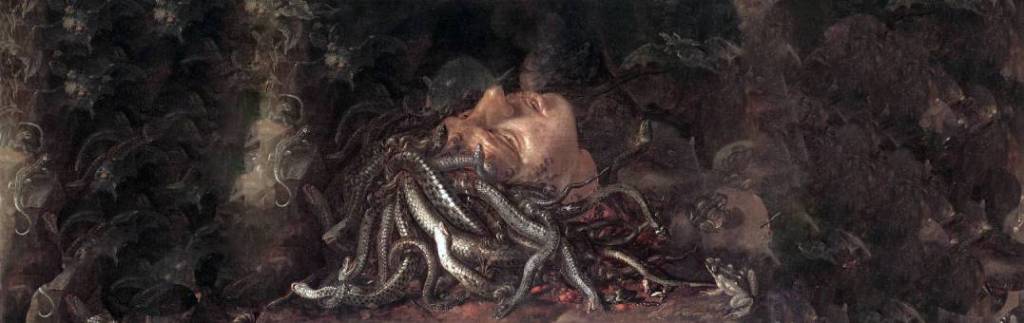
Header Image adapted from : Head of Medusa, Anon, 16th-century, Uffizi Gallery, Florence, Italy.


 The Western Gate
Leave a comment