
Gigantes autem erant super terram in diebus illis:
postquam enim ingressi sunt filii Dei ad filias hominum,
illaeque genuerunt, isti sunt potentes a saeculo viri famosi.


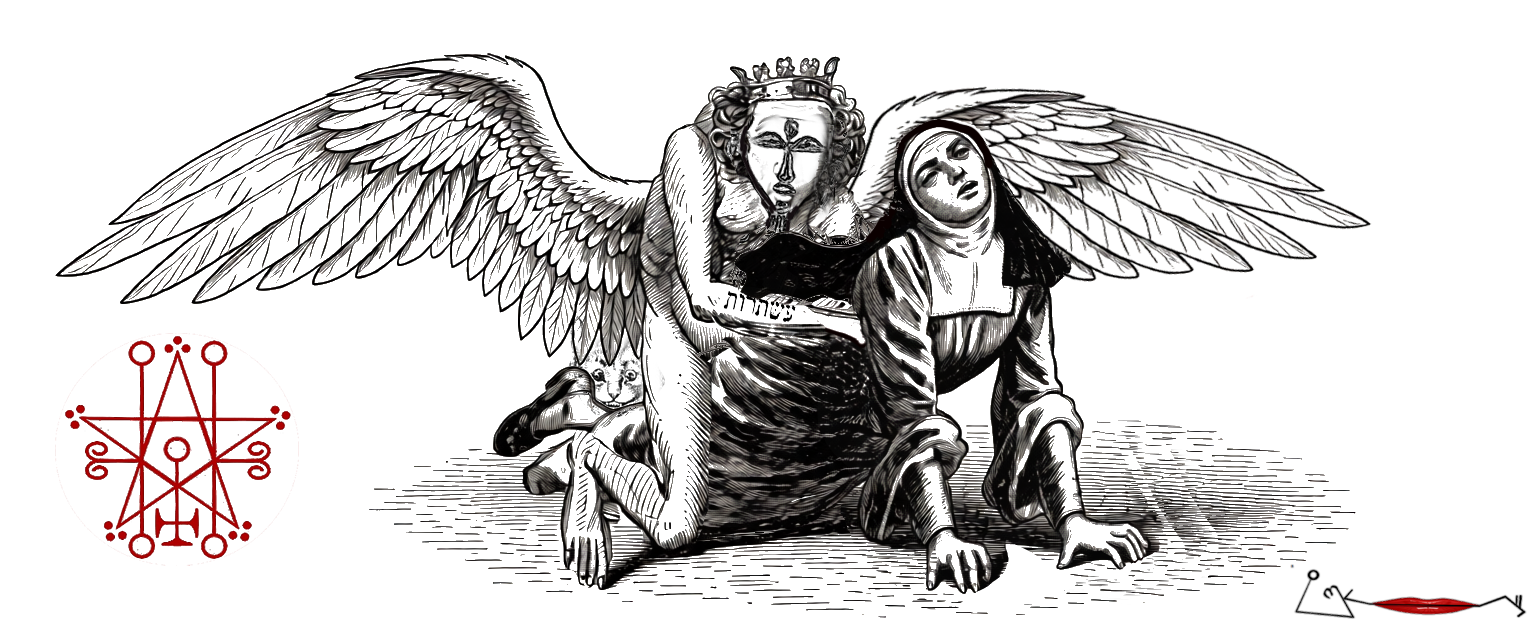
Illustration above: The Confession of Madeleine Bavent:
as it appeared in The Confessions of Madeleine Bavent by Montague Summers a translation of :Histoire de Magdelaine Bavent, religieuse du monastère de Saint-Louis de Louviers, avec sa confession générale et testamentaire (History of Madeleine Bavent, a Nun of the Convent of Saint-Louis de Louviers, with her General and Testamentary Confession)

Intoduction:

There’s not many books I would break the bank for, even to complete the series of Lang fairy stories as reprinted by folio, the oft sought Orange book, and Grey ,demand a price obscene, but they are available, it’s no great panic.
Montague Summers book ~ the Confessions of Madeleine Bavent however certainly would see the credit card spoiled. Rare, notorious.
It is based upon the French original history of Madeleine Bavent, her confessions as a nun at Louviers, and was deemed even in 1933 as obscene. there’s not that much overtly obscenity in it, implied, and shock more that this all happened in that great institution of the Catholic church.

With no recourse or resource to scan old double-bun haired Monty’s book I had to get the available French version, viz, The histories of Madeleine Bavent, published in 1878 and documenting the full texts of 1652. I cant say the task was enjoyable, wasn’t at all just like reading, it was an eye straining nuisance to be honest and one laborious task I wont be repeating in a hurry, if at all.
Of course I have no idea if ol’ Monty’s version is a direct English translation or whether he censored or embellished the story. For my part I just translated and wrote in a less officious yawn-worthy way that the interpretation was. Of course, you might object, its not scholarly, it’s not purist. In which case I say, (sic) do as I done and do it yourself. ( Here is an archive version of the 1878 version to help you on your way) I have not omitted anything though, nor dramatized.
I have not included the notes from the original, and the bibliography which were both at the beginning. I have listed the bibliography (redacted with titles only) at the end.
I might add links to online resources noted by each listing at a later date.
The whole text and added notes/illustrations have been compiled as a downloadable PDF.
Madeleine Bavent ended up in Rouen prison, the same wretched jail where schizophrenic Joan of Arc mumbled her last “God sent me”.
I have not as explained commented on the events, though there is much to discuss.
Or perhaps, as Catholics do, believe the unbelievable and also when it suits, pretend nothing happened.

History of Madeleine Bavent,
a Nun of the Convent of Saint-Louis de Louviers,
with her General and Testamentary Confession
Dedicated to Madeleine Bavent (1602–1652)
Translation: David Wenborn
Preface:
It is my firm belief , though I confess it with a trembling heart and no small measure of bewilderment , that some particular providence of God has presided over the long delay of my judgment. His reasons, as ever, remain mercifully or perhaps cruelly concealed from one so unworthy as myself; yet I cannot but feel, in the quieter hours of my reflection, that this suspension of earthly reckoning has been granted not without purpose. I have sinned , grievously, foolishly, in ways that no elegant turn of phrase may soften or excuse , and it is only right that I should have been made to wait, to suffer, and to know the full weight of what I have done. Penance, I have come to understand, is not a matter of days, but of years; and mine has been, I fear, insufficient still.
Yet there is more to this delay than the correction of my own wretched soul. It is my sincere conviction , and one shared by those wiser and holier than myself , that time has been required to illuminate, in its fullest and most terrible clarity, the whole unhappy affair of the House of Louviers. That the true origin of so dreadful a matter should be known , known properly, and without distortion , is of an importance I can scarcely overstate. The honour of Jesus Christ, of His Church, and of the Court demands nothing less than the truth; and the truth, I have learned at great cost, is rarely a comfortable companion.
It was my Confessor , a Priest of the Oratory, appointed to me by the Penitentiary of Rouen of that same Congregation , who first persuaded me that I was bound, in conscience and in duty, to contribute what little I could to that end. He is a man of extraordinary patience and charity, and it is to his gentle insistence that this account owes its very existence. He believed , and I came, with some reluctance, to believe alongside him , that I ought to set down, in my own words, a brief and faithful narrative of my unhappy history. A final confession. A testamentary declaration, offered not to the world with any hope of its approval, but to God, whose approval alone I now seek.
I will not pretend that I embraced this undertaking without misgiving. I am not so lost to all feeling as to be indifferent to the shame it must bring upon me , the shame of having the full catalogue of my errors laid open before the eyes of those who will read it, and judge it, and judge me. I have known shame before, in its many varieties; but there is a particular anguish in the deliberate, voluntary exposure of one’s own wretchedness that no prior acquaintance with disgrace quite prepares one for. And yet , I could not refuse. He had heard my general confession twice over. He was familiar with every particular of my interrogation, having himself examined me upon it. His charity toward me has been, from the very first, far greater than anything I had reason to expect or to deserve; and when I begged him to assist me in this endeavour, he consented with a kindness that quite undid me.
We resolved to work upon it together. He questioned me anew, with great care and thoroughness, over the course of several days. And because I write with such painful difficulty , slowly, poorly, and with a hand that seems to resist the very act of confession , he was so good as to yield to my further entreaty, and to write down my answers himself, that I might not be wholly exhausted by the effort, and that the small hours I have set aside for prayer and penance might not be entirely consumed by the labour of the pen.
What I now present to the Court is the result of that labour , his and mine together. In this paper, I have endeavoured, with all the sincerity of which my battered conscience is capable, to separate the true from the false; to offer what is here written in the service of whatever end God shall be pleased to appoint for it. In His presence , and I say this with a solemnity that no formal declaration can adequately convey , I have nothing further to say. I have said everything. I have held nothing back.
If I have attempted, in the writing of it, to accompany my account with some expression of that sorrow and humiliation which Jesus Christ, in His mercy, has seen fit to bestow upon me, I do no more than my duty demands. I pray only that He will give me more of both , more sorrow, more humility , for I am sensible that I have not yet felt them in the measure that my offences deserve.
But of this one thing I am entirely assured: I have spoken as sincerely, and as faithfully, as it is within my power to speak. I have spoken as I spoke when I made my last confession, in preparation for what I believed to be my execution. And never , not once , have I opened my lips to declare what is here recorded without first having knelt, and invoked the Holy Spirit, who is the Spirit of Truth, through the intercessions of the most sacred Virgin, of Saint Mary Magdalene, and of my blessed Father Saint Francis.
I ask , I beg , all those who shall read these pages to seek mercy of God, in the name of His Son, on my behalf; for the faults herein disclosed, which are many and grievous; and to pray that I may persevere, to the very end, in those good dispositions which those who have cared for my soul have laboured so faithfully to establish within me, and which are here, at last, set forth.
Madeleine Bavent
Chapter 1:
In this present year of our Lord 1647, in which I endeavour, with such sincerity as remains to me, to abridge the history of my unhappy life, I believe myself to be near forty years of age, though, to confess the truth, I am not precisely acquainted with the year of my birth. My father and mother were Mr. Guillaume Bavent and Mrs. Jeanne Planterose, of this city of Rouen. It pleased God to deprive me of them in my earliest childhood, and, as well as I can remember, I was but nine years old when they were called from this world. His Providence did not ordain that they should live to bear the displeasure and grief which I have since brought upon all my kindred, persons who fear God, and who are sensibly afflicted by the offences I have committed against His Divine Majesty.
After their death, my uncle Sadoc received me into his house. I remained with him only until I had reached, as I suppose, my twelfth or thirteenth year, when I was placed with Dame Anne Lingère, in order to learn sewing and such employments as might fit me for an honest livelihood.
It has since pleased the nuns of Louviers to accuse me of many things, which, during the three years of my residence in Dame Anne’s house, they say befell me. They assert that, from the beginning of the second year, I was corrupted by one Bontemps, a Cordelier friar, that I was frequently carried to the Sabbath in company with other girls, that I was married to the Devil Dagon, under the appearance of a young man, and they add to these, many other particulars equally dreadful. Of all this I have no knowledge. In truth, a certain article which I once confessed before the Court on this subject was nothing more than a shadow left upon my mind by their continual discourse, and I believed myself obliged to declare it, fearing lest some part of it might be true, for I have always been persuaded that I ought to answer my Judges with frankness.

But time and reflection, and some assistance afforded me, have enabled me to examine this matter more clearly. First, I spoke of it to a good Feuillant father, who then had the care of my conscience. I remembered that I had once accused myself to him in this regard, and that he had helped me, as I then supposed, to withdraw entirely from such engagements. Yet he assured me that there was nothing of the kind, that he knew very well, on the contrary, that even at that period God had inspired me with very good sentiments, that I served Him with a sincere heart, and that I already cherished strong desires for the religious life.
Moreover, when the Father who heard my general confession after my interrogation inquired of me what manner of man this Bontemps might be, of what age, what stature, what hair, what complexion, I found myself utterly unable to answer him. I could not describe a single feature. It is not in my power to believe that one might be so long connected with a person, as they pretend I was with him, and yet retain no distinct idea of his appearance. I do not know that I have ever done them any wrong, and I entreat them to recall to mind the case of Charlotte Pigeon, who entered their house eight-and-twenty years ago, and who left it because, as she herself declared, the Devils tormented her and would not suffer her to confess or to receive communion, so that she protested it was impossible for her to work out her salvation there.
It was from her that I learned this story, not at her first entrance, for at that time I was not yet a nun, but at her second attempt to re-enter, one-and-twenty years ago, when she remained only eight days, and departed again for the same reason. This circumstance opened my eyes, for it convinced me that it was not possible to have lived in intimacy with a man for fifteen or sixteen months, as the girls relate of me, and yet be wholly unable to recognise him, and, above all, when, upon reading the accusations of these girls, the Father asked me who had first had my company, since, as he very justly observed, such a thing could scarcely be forgotten, I found myself yet more astonished. I am very certain that it was Picard, and that on an occasion which I intend to relate elsewhere, that I may not confuse my narrative and may preserve some order in the account I give.
Yet, in spite of this, they persist in naming Bontemps, and in publishing the most horrible tales concerning him and myself at a very tender age. There is not a word of truth in it, and if the Evil One indeed speaks by their mouths, as they themselves profess, he does but prove himself what he has ever been, a liar and the father of lies.
The Court may easily discover where the truth lies, without placing any reliance upon my single testimony, for most of Dame Anne’s neighbours are still living, as are some of the companions who, together with myself, are accused and defamed upon the credit of these girls’ stories. It appears to me that this point is by no means inconsiderable, and that it well deserves a strict and diligent inquiry. It should also be remembered that one of the designs of those at Louviers was to discredit me by these inventions, and thus to persuade the easily deceived that I had entered their monastery already a sorceress or a witch, and that I was the cause of all the mischiefs they have endured.
God knows the truth, and will reveal it when it shall please Him. Yet I cannot but think that their measures have been very ill taken. For even if I were to grant, for the sake of argument, that I had been corrupted in the manner they describe from the moment of my entrance among them, it would by no means follow that I was the cause of their calamities. I again beseech them to remember poor Charlotte Pigeon, who, eight-and-twenty years since, entered their house and left it because of the torments she endured, and the impossibility, as she solemnly declared, of confessing and communicating there. It was from her, as I have said, that I first learned these things, not at her first coming, when I was yet in the world, but at her second attempt, one-and-twenty years ago, when she remained but eight days and departed again for the same cause. The evil, therefore, was in their monastery before ever I set foot within its walls, and I ought not to be charged with it.
Yet I will say this before God, and I call upon Him, who must be my principal Judge, to bear witness to the truth of it, that when I besought them to receive me, I was not corrupted. Lord Jesus, I would most earnestly desire to be now in that same state of innocence and simplicity in which I first entered there.
Chapter 2:
I will, if you will permit me, set aside all that has been so fabulously related concerning Bontemps, and confine myself to the simple account of the manner in which I came to the Monastery of Louviers.
From my earliest years, it pleased God to give me almost continual thoughts of Religion, and among the Saints, I had conceived a particular devotion for St. Francis, whom I have ever loved with a tenderness which I scarcely dare acknowledge, lest it should be thought presumptuous.
When I learned that a house for young girls of his Order was to be established in that town, my whole heart turned towards it, and it was there that I most earnestly desired to be placed. My parents, yielding to my entreaties, and managing matters with more kindness than I can express, procured my admission, and I entered upon my sixteenth year within those walls, not yet having completed it. I protest, upon my soul, that my only intention was to serve our blessed Saviour, and to become a good and humble nun, however much the other girls may now allege that my whole design was to ruin their House. My misfortune, my irreparable misfortune, was to find there, as Confessor and Director of consciences, the man called David.
For six or seven months I was kept in secular dress, though always within the enclosure, after which I was clothed in the habit of the Order, and began my Novitiate, which I wore for nearly a year.
David, who directed us all, was a Priest so horrible in his conduct, and so utterly unworthy of a state so holy and divine, that I tremble while I write his name.
He read to us a book entitled the Will of God, composed by a Capuchin Friar~ William Benedict, which served almost as the sole rule of our House at that time. Yet his manner of explaining it was strange and perverted, though, to my inexpressible grief, it was approved and followed by the Mothers who governed us.
Under the pretext of introducing a perfect obedience, which, he said, must extend even to the most difficult and most repugnant demands of Nature, this wicked and dangerous man introduced practices so abominable, that I scarcely know how to speak of them without sinking under the shame and horror they inspire. He dared to say that one must put sin to death by sin, in order to return to innocence, and to resemble our first parents, who, before their first fault, were without any shame of their nakedness.
Under this language of apparent piety, what filth, what foulness, did he not cause to be committed.
The nuns were accounted the holiest, the most perfect, the most virtuous, who stripped themselves entirely naked, and in that state danced, and appeared in the Choir, and walked in the Garden. Alas, this was not all. We were accustomed to touch one another in a manner wholly impudent, and, what I blush to recall, to commit those most horrible and infamous sins against Nature, which I have since confessed, and which I have been told are noted by St. Paul in his Epistle to the Romans, as the most excessive disorders under the reign of the Prince of Hell among the Pagans.
I saw, with these eyes which now weep to remember it, the abuse of the Image of the Crucified. O horror, too dreadful to be believed, I saw the profanation of that sacred figure, subjected to a certain ceremony of Circumcision, performed, as it seemed to me, upon a form of paste, which was afterwards abandoned to uses that I dare not describe, and left to those who would do with it as they pleased.
I saw also the profanation of the most holy Sacrament of the Altar, which was, to my unspeakable astonishment, at the disposal of the nuns, because the Tabernacle had an opening on their side as well as on that of the Church. I was once compelled to make use of It, after It had been placed for some days in the dunghill, which I refused, with all the strength that remained to me, to do.
O abomination of desolation in the holy place, and in the sight of the Holy of Holies.
Into what penance must a soul enter, to obtain pardon for so many and such horrible crimes. Place us yourself, good Jesus, in that penance which your mercy shall judge fitting, and deign, I implore you, to have pity upon us.
To speak the simple truth, my soul endured strange conflicts on account of these infamous practices. I did not always consent to do what was exacted from me, and whenever I resisted, I was regarded as disobedient, stubborn, rebellious, proud, and attached to my own judgment.
Would to God that I had been still more so, that I had persisted more firmly, that I had refused more absolutely. It would have been better for my poor soul, and I should not have fallen into so great a number of offenses.
Above all, I resisted, with all the weakness and all the courage of which I was capable, the command to communicate once, stripped entirely naked down to the waist.
Yet even in this, at length, I was constrained to obey.
When I thought at least to cover myself with the communion cloth at the little grille, Pierre David, the principal author of this frightful action, and he who had ordered it to the Mothers in my regard, caused the cloth to be taken away. Moreover, when, in my confusion and shame, I endeavoured to cover myself with my hands, he commanded me to join them in prayer at my breast, and they, and my ‘shame’ were left free to the gaze of all.
This procedure was so frightful, that I could not refrain from complaining of it to those who had forced me into it, though my complaint brought me no relief.
I believed, and still believe, that this was the principal cause of my departure from the House, a departure which brought me, not sorrow, but a sort of trembling joy, because I cherished the hope of making at last a good confession.
Such a confession had not been permitted to us within the Monastery, and during the twenty months of my stay there, I had never been able to make a good and entire accusation of my faults. David would not allow us to accuse ourselves of those vile things which he had introduced, telling us that there was no offense in them. When I begged for another Priest, I addressed myself to the Mistress of Novices, but she spoke the same language, and was, alas, one of the most instructed in that dreadful school. You may imagine, better than I can describe, how my conscience tormented me without ceasing, filling me with continual reproaches, and yet, O frightful blindness, which my faults had but too well deserved, I did not seek the remedy with that diligence and fervour which my state required, even after my departure.
It is in this, above all, that I feel myself most guilty, and it is for this, as much as for all the rest, that I now implore mercy, with a heart humbled and almost broken, yet still daring to hope that I am not entirely forsaken.
Chapter 3:
I will confess, though it costs me no small degree of shame to do so, that had I possessed even a fraction more of that prudence which wiser heads than mine have always recommended, I might have been spared the greater part of what I am now compelled to relate.
My devotion to the Order of St. Francis was, I fear, neither measured nor well-considered; it was, rather, the devotion of a young woman who mistakes fervency for wisdom, and persistence for virtue. I wished, how earnestly I wished, to offer myself to some convent governed by its Rule; and, knowing very little of what such a life truly required, I consented with almost no deliberation to remain at the outer lodge, when the arrangement was proposed to me upon my departure.
I cannot now reflect upon that decision without believing it to have been the first, and perhaps the most consequential, of my many indiscretions.
I went against the counsel of those whose judgment I ought to have respected.
I disregarded my elders. I persisted. And I cannot but think that in abandoning those better impulses which providence had placed within my reach, I was, in some measure, abandoned in return, left to the full and unhappy consequences of my own wilfulness.
David did not long survive my settling at the Externs’ Lodge, nor did circumstances permit us much society together. I had removed there, as best I can recollect, towards the close of January; and he was obliged, near Candlemas, to undertake a journey to Paris, from which he did not return until Good Friday. He came back very ill indeed. He died on the Monday of Holy Week, at about the hour of noon. I would not have it supposed that my offences against God were, in his case, of the gravest kind; nothing of an entirely dark nature passed between us, and the liberties taken were limited to certain reciprocal moments of a nature I am not able to name without disgrace, once, in particular, of a kind I pray I may be forgiven for ever having permitted.
There is, however, one matter connected with his final journey to Paris which I find I cannot in conscience omit, though the telling of it reflects upon me very poorly. Before his departure, David entrusted to my keeping a small box, of which he also left me the key, with express instructions that I was neither to open it nor to surrender it to any person whatsoever. He ought, perhaps, to have considered more carefully the nature of the person in whose hands he was placing such a charge, that is to say, a young woman, and one not entirely without curiosity. I am sorry to say that I did not long resist. I opened the box. Among its contents, I observed a sheet of paper, covered on every side with writing in his own hand, which I was not able to decipher. Upon his return, I restored the box and the key without remark. I attended him through the few days of his illness, I will not dwell upon the particulars of his suffering, save to say that there was one affliction of a most distressing nature which I was spared the necessity of tending to, and I was present in the room on Holy Monday, the day of his death, when he called for Mathurin Picard.
He addressed him as a brother and a trusted friend, told him that he was well acquainted with the manner in which he had lived, and named him his Confessor for the Ministry of the Altar, in continuation of what had already been begun between them. The box was then returned to my hands, with instructions to convey it to the Monastery; I was told not to concern myself with its ultimate disposal, and was asked to withdraw, as David wished to speak privately with Mr. Picard, concerning myself, as I was given to understand, and certain particulars relating to my situation which he wished to commend to Picard’s attention.
That sheet of paper, covered on every side with writing, I must now speak of it plainly, though I do so with a heaviness of heart that I find difficult to express without either overstating or concealing it.
It is the paper of blasphemies.
It bears the signatures of both David and Picard.
I have since seen it produced at the Sabbath on several occasions, by Picard himself. It is read aloud during the celebration of what passes, in that abominable place, for a Mass; it serves in the manner of a Canon, at processions and professions, and on every occasion of significance.
All those present are required to give their assent to it. Its contents are of a nature so entirely contrary to everything sacred, directed against the Most Holy Trinity, the Sacrament of the Altar, the other Sacraments, and the ceremonies of the Church that I find I cannot reproduce them here, nor do I think it necessary that I should.
Since David’s death, four candles have been placed at its four corners at the Sabbath by whom, I shall speak of elsewhere.
I am told, and it is said openly among the nuns, that I must know where this paper presently resides. I can only say, in the truth of God, that I do not.
I recall that Picard once mentioned, at the Sabbath, his intention of placing it, together with his registers, in a cupboard situated beside the Altar, on the side where the Epistle is read in that place. I have not set eyes upon it since the night it was read to me in my Cell by Sister Anne Barré, some time after Picard’s death a matter of which I shall speak more fully in its proper place. It is to her that enquiries ought to be directed; it is, I think, more than probable that she possesses certain knowledge of its whereabouts, having shown it to me herself and read from it in my presence, whatever those who speak in her defence may say about a Devil having assumed her form.
I leave such questions to those whose minds are better fitted than mine for their examination.
What remains for me is something far simpler, and far more necessary: to apply myself, with whatever sincerity I can still claim, to seeking, in the blood of Jesus Christ and in such tears as I am able to shed, some measure of absolution for the offences I have committed, not least among them, that I was present, and that I consented, however passively, to the impieties contained in that most execrable of documents.
I do not seek to diminish what I have done by calling it mere presence, or mere silence. I know what it was.
I can only hope that it is not beyond the reach of mercy.
Chapter 4.
David being dead, I remained still at Tours for the space of at least nine months, and in his place Picard was established as Confessor and Director of the House.
There I found myself fallen into very wicked hands, far worse, at least for me, than those of his predecessor, for his insolence went much further, and I have never been able to free myself from it, however earnestly I desired it.
He held me, as it were, in the very bonds of Hell, and I had not the courage to have recourse to our blessed Lord with that ardor and constancy which might have obtained my deliverance.
On Easter Day I presented myself to him for confession, almost rejoicing in the liberty I believed I should have of relating all that had passed within me, and of opening to him the inmost depths of my conscience, yet I fell, as it is commonly said, from a fever into a burning ague. For scarcely was I before him, and had begun to declare my faults, when he refused to listen to me, and turned the discourse to matters wholly different. He assured me that all I was confessing was no offense against God, he expressed for me a most ardent and passionate attachment, he entreated me to love him as he professed to love me, and he began to seek occasions of caressing me, and even of touching me in a manner most improper. After this, I had no other kind of confession with him, and all those I made to him resembled the first, though they were even more sacrilegious and fatal to my soul. They passed in discourses of love, in unlawful familiarities, in follies and trifling, and he would commonly keep my hands, with a shocking perseverance, upon those parts of his person which should never be named, though they were covered and not bare.
Good God, what an abuse of the Sacraments.
And if I had committed no other sin than this alone, how justly should I have deserved to be chastised both in this world and in the next.
Yet it is true, and I say it in the presence of my God, that I never loved this miserable Priest with any ardent affection, yet I cannot express what it was that attached me to him, nor by what unhappy power he held me. It is a great misfortune that souls are not allowed some liberty in the choice of their Confessors, and that they should be confined to one alone, who may thus become the instrument of their ruin.
Those in the House were not ignorant of his passion for me, of his familiarities, of my frequent comings and goings to his room at his persuasion, and even persons without murmured on the subject, finding me too forward, and sometimes crying out openly that I ought to be removed from the danger in which I stood. Yet the Religious turned a deaf ear, and would never permit me to confess elsewhere, although I entreated them, in the hope that some good man might remedy the misery of my conscience, and tell me what I ought to do.
Still, I must not, nor do I wish to, excuse myself by so slight and frivolous a pretext, for even had they threatened to accuse me of some great crime, in case I should address myself to another Confessor, as though I were betraying the secrets of the Monastery, yet I ought to have risen above every such consideration, since the thing was permitted me by God and by His Church. And besides, was there truly no means of concealing my action from the Religious, and of hiding it entirely from them, under the appearance of some other necessity or business, since I often went into the city.
It is I indeed, whether through want of sense or through my own corruption, who am the cause of my disorders, for a prudent and charitable Confessor would easily have drawn me out of them.
The pursuits of this unhappy man after me never ceased, and his impudence was such that, during an illness in which I believed myself at the point of death, he did not desist from his shameful familiarities, although I was almost without feeling, and more dead than alive.
To what excess may a blind and furious passion be carried. Yet, whatever the girls may have said upon this subject, I am very certain that, as to the last extremity of sin, the consummated act itself, he never accomplished it, because of my resistance, and he succeeded in it only once, when, being ill, or feigning illness, he contrived to have the nurse withdraw from his chamber, where I then was, and, coming to me rather by force than by friendship, compelled me to consent to the crime.
I have been accused of having admitted his company in the Church and even upon the Altar, I being Turnkey, yet this is not so, and I will relate with sincerity the fact as it truly passed. As I was placing the canopy upon the Tabernacle, having mounted upon the Altar for that purpose, it is true that he approached and offered me a most shameful and indecent touch. I do not doubt that he would gladly have proceeded to still greater wickedness, and that his intentions were assuredly directed to that end, yet God granted me the grace to spring down at once, to reproach him with his black malice, and to escape from him, with whom I was never in safety.
Blessed without end be He who deigned to preserve me from that abominable act which some so unjustly impute to me.
Chapter 5.
It was not the single design of Picard to despoil me of my honor; he had yet another purpose, of which I could not possibly be aware, being altogether ignorant of the diabolical art he practiced, and by which he conducted and guided me, little by little, as if by certain degrees, to ends I did not foresee.
I shall here relate some circumstances which now reveal him to me but too plainly.
During the illness I suffered at Tours, in which I believed myself near to death, he brought me a sheet of paper, desiring that I should make my Will; and when I entreated him to write it himself, he readily complied, and then caused me to sign it, without permitting me any previous reading.
I have often asked him for this paper since, yet he would never either restore it to me or even allow me to see it. This has led me to fear that he inserted in it several things which I should never have consented to say, had I known what he was doing.
I beseech God that my signature may not be the cause that such things are imputed to me in His presence.
It has sometimes happened that he made me hold the Lunette of the Sun, in which the sacred Host is placed when it is to be exposed for the adoration of the faithful during the octave of the Blessed Sacrament, and that he himself would go to place it upon the Altar. The nuns have since added that he put it between my hands, and made me touch and handle it freely.
This is not true; there is only what I here relate.
I confess, however, that once, after the consecration, he put a large Host into my hands. The thing passed thus: he commanded me to approach him near the Altar, took my hand, placed the Host in it, and, pressing my hand, broke and shattered the sacred particle, so that several fragments and pieces fell to the ground. I reproached him for this when he left the Altar, and he answered that it was not consecrated, as I had believed. Yet I find it very difficult to persuade myself that he spoke truth, since he had just pronounced the holy and mysterious words. He wished also to make me drink the Blood of Jesus Christ from the Chalice, leaving it there on purpose after the holy Sacrifice of the Mass, and encouraging me not to be troubled, nor to be scrupulous about it. I never consented to this, though he employed every effort to draw me into it.
One day, taking me by the hand, and showing me the new buildings that were being raised for the Monastery, he addressed me in these words: “My love, I am having this Church built; after my death you will see wonders; do you not consent to it?”
I replied, “Yes.”
Yet I protest upon my soul that I answered without the least evil intention, and without the smallest comprehension of his meaning. I had not then discovered the execrable traffic in which he was engaged; I only knew his inclination to impurity. That was the first consent I ever gave him, and even then I did not imagine what was to follow, nor was my mind in any degree turned toward it.
Jesus Christ will pardon me, if it so pleases Him, since, seeing the very bottom of my heart, He knows that herein I sinned through ignorance and not through malice.
The world will believe what it shall please God to permit; it will one day know and see the truth, when we shall all appear before His adorable Majesty, to be judged according to our works, and according to the intentions with which we shall have performed them.
I do not remember that any other particular occurrences befell me with him while I was at Tours; yet there was enough in what I have elsewhere related to have made me reflect, a reflection which I did not then make, but have made since, that he sought to make me wholly his prey.
Be this as it may, I did not think of it at that time; my distress was confined to what regarded my honour, in which I lived in continual anxiety and fear. I believe he himself was not without uneasiness, for people in the town spoke very openly of him and of me, and he dreaded lest I might become pregnant, after having forced me.
These two considerations induced him, notwithstanding his passion for me, to pursue with earnestness my re-entry into the House, to which he offered and promised a sum of money for that purpose; and as he was much esteemed there, the affair was soon concluded.
Thus I found myself, for the second time, a Nun in the same Monastery, where I discovered the same practices, of which I have spoken elsewhere, more firmly established than ever. The Mistresses of the Novices loved him with a warmth most unsuitable, and I had scarcely returned when I was constrained to follow their example. It is true that I did not see Picard enter with the same familiarity as David, nor did I behold him shutting himself up in the nuns’ chambers; yet the impurities continued, and were greatly in vogue. I do not know whether they are now abolished; for the Novitiate being the place where they were chiefly practiced, and I having quitted it after four years to be among the Professed, I have had no knowledge of them since.
Whatever may now be the case, I am very certain that I re-entered the House to my extreme misfortune, and that my excessive affection for the Order of Saint Francis has been most pernicious to me. It was my duty to remember what I had already seen, and I ought rather to have chosen a common life in the world than so perverse and wicked a life in Religion. Few persons will be disposed to excuse me, and I know not whether our Lord Himself will deign to excuse me, since this second entrance was the cause of my ruin, and I feel myself most criminal on that account in His divine presence.
Chapter 6.
I must now begin to relate what befell me most remarkably after Picard had brought me back.
Scarcely fifteen days had elapsed when he found some pretext for entering the garden, where I was walking with several of the Nuns.
At that time I was suffering from my monthly indisposition.
He followed us, and as we paused in a certain spot, he took from a book which he carried a Host, with which he gathered some clots of blood that had fallen upon the ground.
Afterwards he wrapped it carefully, and, calling me to him near the Cemetery, he took my finger to assist him in placing all this into a little hole beside a rosebush.
The girls who are exorcised have since declared that it was a charm intended to draw all the Nuns to impurity. Of this I cannot speak with certainty, for he never opened his design to me, nor did he say whether the Host was consecrated; he told me nothing at all. But it is certain that, for my own part, I felt a strange inclination to return to that same place, where I was assailed by shameful temptations, and fell into impurity.
May the God of all purity, who chose so pure a Virgin to be His Mother here on earth, deign to forget the faults I committed there, and by His adorable purity efface all my defilements.
Furthermore, nearly two years, as it seems to me, after my vows, he asked me for my written profession, or at least for a copy of it, since the original is always preserved in the Monastery. He told me that this document was necessary for him, as he had made me a ‘professed Religious‘, although I was only a Lay Sister.
I brought it to him, without inquiring further into his intention, and he himself dictated it to me on the spot, word for word. Then, before I signed it, he told me that I must refer my ends in this writing to his own, and that if he died before me, I should be willing to die soon after; if he were saved, to desire to be saved with him; and if he were damned, to be willing to be damned with him.
This discourse filled me with terror, and though I resisted much, I at length gave a sort of outward consent, except in my mind as to the point of damnation, which I do not well remember whether I expressly excepted in my reply, as I did in an apparition after his death. Savior of the world, I place my hope in Your great goodness and in Your infinite merits, and I implore You to save one day the unhappy Magdelaine, who now weeps at Your feet for her offenses.
I remember also that two or three years, as I believe, after the preceding action, when he came to say Mass at the Hospital, where I was employed in tending the sick, he gave me two seeds, shaped like buckwheat, telling me that I should put them in the ground, and that I must take care to give the two flowers which would spring from them to two Nuns, whom he named, assuring me that these flowers would incline them to his friendship.
I took the seeds, planted them, and never saw any flowers arise. Much noise has been made about this circumstance, even to the point of saying that they were two Hosts instead of two seeds, and that there was a spell involved. Would to God that I were as innocent in all the rest as I am in this. It is enough to manifest my innocence that it be known I spoke of it at once to the Nuns, telling them what Picard had said to me. Indeed, I was still ignorant at that time of his infernal practices, which were soon to involve me in their unhappy chains and in their accursed slavery.

Two years more, or thereabouts, passed away, and now my extreme misfortune drew near. I was much troubled in conscience, and I neither saw Picard so often nor with the same willingness.
A good Ecclesiastic, named Monsieur Langlois, confessed the sick at the Hospital; I sometimes approached him, and spoke to him of the need I felt of making a good confession. This was, however, done secretly and with great caution. He told me he believed I had indeed such need, for he had heard much talk of Picard and of me, and that it was unlikely there was not some truth in the common rumor, considering how frequently we were together; but that he did not yet know how to assist me, since he did not confess the Nuns, and that he would see in what manner he might contrive it. Picard, I doubt not, feared that I should open my heart to him, and hastened to execute his malice.
One day, therefore, as he made me communicate at the grille, he touched me with his finger on the breast over the wimple while giving me the sacred Host, and instead of pronouncing the customary words in that holy action, he said to me, “You will see what will happen to you.”
I withdrew afterwards to my place in the Choir, to make my thanksgiving according to custom; but I found it impossible to remain there, and was so pressed by the inward agitations I experienced that I was constrained to go into the Garden, where I seated myself upon a pile of wood under a mulberry tree.
It was there that the Demon appeared to me for the first time, in the form of the house cat, which placed two of its paws upon my knees, and the other two opposite my shoulders; and, bringing its muzzle very near my mouth, with a frightful look, it seemed desirous of drawing the communion from me. I remained in this state for a good hour, unable to make the sign of the Cross, or to utter a single pious word, or to drive away this troublesome creature. Whether the sacred Host was drawn from me or not, I know nothing. The Devil affirms it in some of my papers which have been produced, and repeats it again when speaking of certain other of my communions, adding that it was done by the command of Picard. But at least it is evident from this that, in communicating, I did not myself deliver the sacred Host, nor apply my hand to withdraw it from my mouth, as the girls publicly declared. I can truly say that, by the mercy of God, such a thought never once entered my mind.
This wicked Priest did not stop there, nor, indeed, had he any intention of stopping.
When I was delivered from the cat, or rather from the Demon under that figure, Picard saw me again the same day, and I asked him what was that fine thing he had said to me in communicating, that I should see.
He answered, “You will see many others; it is not yet time for you to be astonished.”
And so it proved. I remember that two or three days after, he said to me, with his usual familiarities, “My heart, we are seen today; do you not wish that we should see each other again?”
I told him yes, and assuredly to my very great ruin.
That very night, as I lay in my bed, I heard a voice like that of one of the Nuns calling me. It might have been about eleven o’clock, and I had been asleep.
I rose, went towards the door of my Cell, and immediately felt myself lifted up, without knowing by whom or how, and carried, for the space of a full hour, until I found myself in a certain place unknown to me, where there were several Priests and some Nuns; and I discovered myself near Picard.
He spoke to me at once, and said, “Well, my heart, was I not telling you the truth, that we should see each other again today?”
I replied that it was indeed true, but that I had not expected it to be outside the Monastery, and that I did not understand what this assembly signified. He did not satisfy me on that point, and only answered that I must not trouble myself about it; and from this first transport he drew from me a verbal consent to all that was done in that place, and to all that was to be done, especially by him.
This is the only manner in which I know that I could have any share in the spells of the House, if Picard employed them there, and in the affliction of the Nuns, if the same cause their torments. I have never since given any particular consent, either to him or to others, for the House, or for any place whatsoever.
If men will not believe me, it is for me to bear it humbly and patiently, and I am not on that account the less bound to give thanks to God that the wretch who was destroying me did not even carry me to that last extremity.
Chapter 7
Those who shall read this account will, I do not doubt, be very ready to conclude that I was transported to the Sabbath, and perhaps they will not scruple to call me Sorceress or Magician.
I entreat them, however, to suspend their judgment for a time, and to consider the following particulars.
I had at least this one good in me, that my sick conscience was always sensible of its disorders, and reproached me for everything that took place on Picard’s part toward me. He knew this perfectly well, and that, I am persuaded, was the true reason why he never entirely trusted me, never disclosed to me all his secrets of iniquity, and did not set himself openly to associate me with his diabolical works. He would sometimes say himself that I was a girl who would tell everything, that I had too much timidity, and that I mistrusted all I saw.
Indeed, he was not mistaken, and I shall give very evident proofs of it.
The very day after the night of my transport, without waiting longer, I went and declared to the good Monsieur Langlois how I had been carried off the preceding night, what I had seen done, and all that had been said to me; and I always continued to reveal to him my abductions, as they followed one upon another. Yet, unhappily for me, whether he was instructed in such matters or not, he never made me understand that it was to the Sabbath I was carried. Perhaps God permitted that he should be blinded in a business which has appeared so clear to others when they afterwards learned of it; my faults deserved that the minds of men should be shut against me, since I had so long closed my heart against Him.
Moreover, he knew from my own lips the torment I suffered from the horrible cat, and how it followed me into various parts of the House, scarcely ever leaving me; and, in general, I told him everything that befell me.
Nevertheless I remained without remedy, as though he knew not what course to take for my relief. If only he had taken the trouble to consult some person of greater experience, as he might easily have done, that, being better instructed, he might have brought me some alleviation.
My God, my God, I had but too well deserved to be forsaken by You, and men seemed to imitate Your conduct toward me.
Yet I should be wrong to say that God, whom I had so grievously abandoned, had utterly abandoned me; for He continually pressed me to seek His grace, and to set myself right with Him by a good general confession, from which I hoped for my remedy, and of which I thought very often.
Six months after the appearance of the cat that pursued me, and after my abductions had become frequent, I spoke of it again to the same Monsieur Langlois. There was no longer so much to fear from Picard, for, after certain complaints had been made of his rather dishonourable conduct toward the Nuns, the Confessional, as it seems to me, was entirely forbidden him, and given to that good Priest, though the Parlor was still allowed him.
We fixed a day for my confession, and resolved, nevertheless, to keep it from his knowledge, for he dreaded nothing so much as such a confession, so necessary to my soul. Three parts of my confession, as I believe, had already been discharged, and only the last remained to complete and perfect it, when Picard came to the House. Much disturbed at the length of my stay with the new Confessor, he had me summoned, and grew angry that I was slow in coming.
He insisted that I should go to the Parlor, where he asked what I had been doing so long with Monsieur Langlois. Having answered simply that it was my general confession, he wished to know to what point I had proceeded. I replied, with the same simplicity, “To the last.”
“Well then,” he said, touching my hand, “you have begun, and you will not finish.”
He spoke but too truly, the wretch, for he then cast a spell between the Confessor and me, and he himself assured me of this some time before his death, promising that he would deliver me from it. From that moment I have never been able to finish.
It seemed to me that Monsieur Langlois closed my mouth, and made my sins re-enter into me; that he was surrounded by Devils.
As for him, he appeared toward me like a person without movement, overwhelmed, and utterly struck down or benumbed. We were both compared, with regard to the Sacrament of Penance, to paralytic persons who have been bewitched. This began from that very afternoon when I had hoped to finish everything, that he might more clearly discern the corners and recesses of my conscience. Moreover, every time I set out to go and attempt confession, I had no sooner reached the Confessional than I was horribly tormented there.
I have often seen there something like a small black flying beetle, very dark, perched upon the little grille, which threw itself upon my arm when I wished to begin to speak; it weighed upon me as heavily as a house; it struck my head against the walls; it threw me to the ground in the Parlor. If I changed places, hoping to be more at liberty, I did not always see it; yet that did not hinder me from being cruelly ill-used, even to the point of exciting compassion and pity in those who were present. The blows given me were heard, and I was seen all bruised and livid, all black and leaden, all spoiled and in a pitiable condition, without anyone knowing whence my beatings could proceed.
God, who is adorable in all His judgments upon the children of men, permitted it so to be, and made me bear somewhat severe effects of His Justice, the weight of which my demerits had drawn down upon me.
Here I am now more hindered than ever: The cat pursued me, I was often carried off to the Sabbath; I could not confess; even in my Cell and in the dormitory gallery, and elsewhere, the Devils tormented and afflicted me with great cruelty; indeed, some time after communions, they would set my feet in the air, and present to me the vomit from my mouth to take away the holy Host.
I did not lose courage, and I took it into my head to write my troubles to Father Benoît, a Capuchin, whom I communicated with sometimes, and to whom I told many things, even though Picard had told him that he ought not to believe me.
The Letter was carried off from me, and I do not doubt that it was by the Demon, although he did not appear visibly: I persisted in seeking help, and I wrote, and had written, to Monsieur the Bishop of Évreux.
Letters can still be seen of this, and I believe that some of them are in the hands of the Law. He took no notice of it, except at the end, I think, of the fifth or sixth year of my torments, and a year or fifteen months before my disclosure, of which I shall speak in its place. If men, after all this, condemn me as a Sorceress and Magician, who took her pleasures with the Devils and the supporters of his infamous religion: it seems to me that they are somewhat wrong, and perhaps they would do better to sympathize with my miseries, in view of the sad and painful state I was in, and the efforts I made to find a remedy there: But I do not wish from them, notwithstanding all this, any other treatment than what it shall please my God to permit them to do to me.
Chapter 8.
Because of the account I have already given of my being carried to that assembly which is called the Sabbath, and because this account has been spread abroad on every side, curiosity has prompted several persons to question me upon many particulars relating to that infamous place.
My Confessor has most positively forbidden my entering into any discourse with them on this subject during the time of my confinement in this town, and has enjoined me to render an account of these matters to my Judges alone.
God knows how dearly this prohibition has cost me, in contempt, in humiliation, and in inward anguish; for those who visited me were persuaded that it was the Demon himself who imposed silence upon me, and that I had no serious intention of conversion, since I would not satisfy their inquiries.
I am now, however, at liberty to endeavour to satisfy them; and it is even desired of me that I should speak at length, in order that this dreadful mystery may be held in abhorrence, and that all may more clearly discern the enormity of my frightful crimes.
Yet, in all that I shall here set down, I most earnestly entreat those into whose hands this writing may fall, to give it only such credit as they shall judge reasonable, and carefully to distinguish what they conceive to be real from what may bear some appearance of illusion.
It is my part to relate everything with sincerity, according as I believe I have seen it; it is for more discerning minds to make the necessary distinction.
I was never, to my remembrance, carried away in the night after having slept soundly.
I was always called, and that most commonly before Matins, which in our house are said at midnight; sometimes once a week, sometimes twice, sometimes at longer intervals, without any fixed day.
I would rise, as one awakened from a first sleep, to go and answer the voice, which seemed to me to be that of a Nun of our House; and as soon as I reached the door of my cell, I felt myself borne away, without being able to discern by whom, or in what manner.
I lost all consciousness, until I found myself in that accursed place.
My Confessor has since shown me that it was one of my faults to have risen and gone to my door, since, after the first occasions, I might well have known what was to follow.
I acknowledge this; but at the time it never once presented itself to my mind, and I cannot explain how it was that I did not think of it.
Be this as it may, I used no ointment, nor any other preparation, to transport myself thither; and no one ought to suppose that I knew any means of procuring my own removal; for it was not so.
My papers clearly show that it was by force, and by the power of the Demon. And even had I formed the strongest desire in the world to go to the Sabbath (which, I protest before God, never once entered into my thoughts), I should have found it impossible, and should not have known how to set about it.
In the same manner in which I was carried away, I was always brought back. I would find myself, after an hour and a half, or two hours, or sometimes three, restored to my room, and would then return to my bed.
The place where the Sabbath was held is entirely unknown to me. I do not know whether I was carried far from the Monastery or remained near it. I did not even distinguish any particular features of the spot, such as might enable me to describe it; and if I were to attempt a description, I should deceive the world, which ought rather to be satisfied that I speak with sincerity. I remember only that it was of some extent; that there were no seats for sitting; and that it was lighted by candles placed upon the altar, in the manner of torches.
The assembly which appeared there was not numerous. I perceived only Priests and Nuns, and very rarely any secular persons, and those in very small number. Perhaps the Sabbath to which I was taken was not that of the common people, but one somewhat less crowded, though not less impious or detestable. What horror, O God, to think that persons who ought to be found in the assembly of the Saints, singing Thy praises at the very hour when Thou didst vouchsafe to accomplish the greatest and most divine mysteries of our salvation, should instead be present in such a place, in the company of Devils, to utter or to listen to horrible blasphemies against Thy Majesty!
I say in the company of Devils; for Devils were often there, sometimes under forms half human and half bestial, and sometimes in a purely human shape. Picard (by whose side I always found myself placed) pointed them out to me. I never saw them under the form of a goat, of which young girls are accustomed to speak; nor did I perceive that any homage of adoration was rendered to them by any special ceremony, nor did anyone ever speak to me of such a thing. Their place seemed to me to be very near the altar.
It should be observed that I frequently use the word altar, because there was indeed an altar, upon which the Priests celebrated a sort of Mass, with papers filled with blasphemies; and perhaps the Devils kept near the altar because that profane sacrifice was offered, as it were, to their honour. I know not whether this may not be the reason why no particular adoration was paid to them there, they being content with that which was rendered in the sacrifice; which my Confessor has told me is the greatest, the most magnificent, the most solemn act of adoration, and one which ought to be offered only to the one true God.
As to the Host which was used in the celebration of their Mass, it resembled those which are used in the Church, save that it always appeared to me somewhat reddish and ill-shaped; and I am able to speak of it, because I received communion there. The elevation was also performed; and at that moment I heard execrable blasphemies pronounced.
Besides this strange and horrible sacrifice, several other practices took place there: Processions, renunciations, enchantments, the stabbing of consecrated Hosts, and the cutting of throats; sometimes one of these impieties, sometimes another, and some much less frequently than others.
I reserve the account of the most extraordinary for a particular chapter.
When they ate there, it was human flesh that they consumed; but this occurred very rarely, and I do not remember having seen it more than once or twice.
I saw there a kind of register; but let no one ask of me what it contained, for it was written in characters which I could in no way decipher.
The so‑called Testament of David, which was shown to me in the course of Justice, or at the exorcisms, greatly resembled that form of writing. I do not know whether it was the same book of which Picard spoke to me, nor do I remember when it was that David and he made a reciprocal Testament; for he did not show it to me, and I cannot conjecture in what characters it was written.
I assure you that I know just as little of the paper or register, whether of spells or of Sorcerers and Magicians, of which Picard spoke to me at the Sabbath, boasting of the charms he had composed and written with his own hand, and promising, shortly before his death, to show it to me. This, however, was never done, and I am wholly ignorant of the place where he concealed it, as also whether it is the same book I saw at the Sabbath.
May it please God, in His infinite goodness, that my name may be written in the Book of Life in Heaven, and not in these books of death, nor in those accursed places of darkness.
The Judges have everywhere pressed me to declare the names of those who were present at the Sabbath. I say, in all truth, that names are not spoken in that place of horror; and that, if they are not known from other sources, they are not learnt there. My cloistered life, moreover, did not permit me to frequent or to know all sorts of persons. I will even add something which perhaps would not readily be imagined: namely, that each of those who go to these infernal assemblies is so violently occupied with the impious actions which he or she intends to perform, that little attention is paid to others, except when there is some particular connection, as I had with Picard, beside whom alone I was ever placed.
I will go further still, and let those believe me who will: I do not know what words were exchanged among the company; for they spoke in whispers, except during the common and public actions, perhaps in order the better to secure their secret, and not to risk being denounced. It is very certain that I am not so learned in these dark matters as the world imagines.
If I am judged dissembling, artful, reserved, imperious, because I do not reveal all that has been desired upon this subject, I must submit with patience. I am not here forced and constrained, as I was at Louviers, to speak of what I know and of what I do not know, and to be compelled to sign it.
Besides, this writing is, as it were, a public confession which I make to the whole Church God (if it be thought fit to publish it), in some sort of reparation for the scandals of my so disreputable life; and I desire that it should contain nothing but truth, and that it should approach as nearly as may be to that account which I owe to Jesus-Christ, when He shall judge me, and I shall render to Him an exact statement of my life.
I will therefore set down only what I judge to be true; and even while I describe it as I see it now in my mind, I beseech Jesus-Christ, my Saviour, my Lord and my God, who is Truth itself, not to permit that any harm should befall any person, if the things be illusory, and that I alone may bear the penalty which is due to my faults.
Besides Picard, whom I always perceived there, never having been present without finding him at my side, I also recognized his Vicar, Boullé; though I do not remember whether he was there from the beginning, or whether he was ever absent. I heard that he, Picard, and other Priests, whose names I do not know, brought thither Hosts and Chalices, containing what I believed to be the blood of Jesus-Christ.
theNuns of Louviers were likewise there that I knew being: Catherine de la Croix, Catherine de Sainte‑Geneviève, and Elizabeth de la Nativité, from the time of my first abduction; they practised with David, already dead, or rather with the Demon under his form, the same indecencies and impurities which have been specified as having taken place in the House, with horrible profanations of the Holy Sacrament, though I never saw them mark any person. Anne Barré was there also, though very rarely, during the time of my last abductions. I am not surprised that, after my room was locked with a key, she did not fail to come and read the paper to me in my chamber, when I no longer went to the Sabbath, because I was no longer called.
There was likewise a man named Des‑hayes, a Surgeon, who once touched my head with a small hot iron, which made me instantly draw back from him, fearing that he meant to mark me; just as, for the same reason, I once withdrew from Picard, who touched me with his hand upon the loins, on the right side, intending, as I believe, to mark me also; so that I do not think I was ever marked.
I do not know the names of all the others whom I saw there; I know them only by sight. Of these I will speak particularly of two persons only, because I observed that they possessed great authority in the assembly. One was a man dressed in violet, apparently between fifty and sixty years of age, with black hair mingled with grey, of middle stature, rather stout, but much afflicted in his legs. The other was a girl or woman, of whom I have always been obliged to say all that I knew, because the Nuns, during the exorcisms, declared and published that she was the little Mother Françoise, or Simonette of Paris. I do not know; for her name was never told me at the Sabbath, and I never saw her in this Monastery, which she is said to have founded. I should be obliged to see her among several others, in order to try whether I could recognize her.
As for the person whom I now describe, she was dressed in a white tunic, appeared smaller, darker, and older than myself, and walked with difficulty, as if lame. She was much regarded and honoured; and I believe that her advice was asked in everything; for she was brought near the altar, where she was spoken to for a long time, and in a very low voice. I do not think I saw her at my first abduction, but only at those which followed. The Vicar Boullé was her friend; he received her, held her by the hand, led her, and they showed great tenderness towards each other.
Several years ago, Boullé, having been marked with a small hot iron at the Sabbath by a Priest, in the very place where the Surgeons afterwards found the mark, informed this woman beforehand; adding that she was to be marked the same day after him, which was done; and she was marked with the same iron upon the head. I remember further, that on a Thursday, a quantity of Hosts having been brought thither by Picard and Boullé, Picard took four, which he distributed among her, Boullé, himself, and me, for us to communicate. He obliged us to take them out of our mouths, in order to stab them; after which Boullé and she, having exchanged Hosts, made an offering of them to Picard; and Picard and I, in like manner, exchanged ours, in token of union together. When this was done, they were all replaced upon the altar of the Sabbath, to be further profaned by actions utterly impure and filthy; and finally charms were made of them, though I do not know with what particular intention, nor who carried them away.
Picard, whom I once questioned expressly about this woman, in that place, in order to know whether she was a Nun, as I suspected, acknowledged that she was, and told me that she was neither of Rouen nor of this province; that the House from which she came had been founded by a great Lord; and that he greatly desired the union of the House of Louviers with hers. This is all that remains in my memory concerning her, and no more ought to be demanded of me.
I wish, with all my heart, that I had never found myself in her company, nor in that of the others; and as long as I remain upon earth, I shall regret, at every hour of the day, and, if it were possible, of the night also, that I have had, for so long a time, a share, through the malicious deceit of my impious Confessors and Directors, and through the simplicity of others, little experienced and too negligent, in the offences committed in such assemblies of Devils and of his principal instruments. Things most frightful are about to be learnt; and the bare recital which I must make of them fills me with terror. I entreat all those into whose hands this writing may come, to read it only with a sincere detestation of the crimes it contains, and to be moved thereby to implore my pardon from God with greater fervour, with more earnest sighs, and, if they may obtain them, with tears.
Chapter 9.
It is a truth most painfully felt, and one which I can no longer in good conscience suppress, that all those actions which I have had the profound misfortune of witnessing upon the Sabbath are of so infamous a character that I find myself quite unable to contemplate them without the most acute and genuine horror seizing upon my every faculty.
I must beg the indulgence of those who read these lines, for I am sensible that the recounting of such matters is as distressing to me as it must inevitably prove to those who receive it; and yet I find I cannot, in justice to my own soul, remain silent any longer.
It gives me very great pain, indeed a pain which those gentlemen who visit me on this account do not sufficiently appreciate, when they come to me for no other purpose than to draw from me a further account of these horrors.
My Confessor himself, whose patience and discernment I hold in the highest esteem, has been so good as to confirm that prior to my General Confession, he had scarcely questioned me upon the matter at all; and that when he first ventured to do so, he confined himself to only those inquiries which were strictly necessary, and conducted them with a degree of restraint and delicacy that I must acknowledge was very great indeed, owing, as I have every reason to believe, to the shame and confusion which he perceived in my countenance, though I have never, upon any other occasion, felt the smallest reluctance to lay before him the full and unfortunate history of my life.
Nevertheless, I must press on, for the Diabolical works which I am here about to set forth in accusation surpass, by a very considerable distance, everything that the most fertile imagination of the greatest sinners of Hell itself might be supposed to conceive; and it must be confessed, with all the gravity such a confession demands, that if the holy Religious of God are known to perform extraordinary things, the accursed Religious of the Devil are in no respect whatsoever inferior to them in the performance of their own.
I say, then, and I say it with every particle of sincerity I possess, that the malice of those Priests, and most particularly of those who are so regularly to be found at these nocturnal assemblies, extends itself so far as to occasion their bringing, upon frequent occasions, large consecrated Hosts from the Church itself, which they then place upon a kind of Altar erected for that purpose, and proceed to say their Mass; after which they take up the Hosts again, cut from each one the round centre, of approximately the size of a quarter-écu (c.25mm), place them upon a vellum or parchment pierced and fitted to receive them in precisely the same manner, cause them to adhere by means of a substance resembling pitch in its greasy and adhesive qualities, and then pass them against their most private parts, up to near the belly, giving themselves over in that deplorable state to the company of women. I am fully sensible that such actions deserve rather to be consigned to oblivion than to be committed to memory; and yet, as I am here making my Confession before God, I cannot in conscience omit them.
There was one occasion, the particulars of which I shall never cease to shudder at, upon which a Priest, of whom not an atom remains, and the Host was carried up visibly on high. The Demons fled at the very moment of that apparition; and all those present were subjected to the most terrible threats from Our Lord Jesus Christ Himself. But I grieve to report, for it reflects very ill upon the nature of those assembled, that neither this most striking example of divine punishment, nor the explicit threats of the Saviour, were sufficient to prevent the continuation of their impious assemblies.
I have seen brought to some other Priest a Chalice containing the blood of Jesus Christ, he having consecrated before making his way to the Sabbath. He, being the very first, took up a knife and struck it into the Chalice, and the knife appeared all bloodied upon its withdrawal. A second did the same, and the species assumed the true colour of blood. A third did likewise, and the Chalice became completely and entirely full of blood, which ran down to the ground in a manner most dreadful to behold. Our Lord appeared at that very moment, figured in the Sabbath; and as the judgment of the reality of these things is a matter I must leave to minds more discerning than my own, I do most earnestly beg that Justice will not receive this particular testimony of mine, for I am not certain enough in my own recollection to speak of it with the confidence it would require.
Those assembled were never seen thereafter. One of the Saints was observed to take up the Chalice, and another collected the blood, and even the earth that had been soaked with it. Everything was carried up on high, and all those present were scattered by a clap of thunder of such force and suddenness as I cannot describe without feeling, even now, the most violent trembling. If these things are real, of which I leave the judgment entirely to others, they are at once great abominations and great miracles; and I must declare, with a firmness I feel most sincerely, that far from the insolent abuses which the Devils and men make of the Holy Sacrament in these places of desolation having introduced into my mind the smallest doubt concerning the real presence of Jesus Christ therein, my faith upon this article is, on the contrary, the more confirmed by what I have witnessed; for it is only by reason of that very presence that Earth and Hell, joined together as they were, were driven out by Jesus Christ, and that one has so wickedly treated the Holy Sacrament, and I have seen, upon the specified occasions, Jesus Christ punish the misdeeds of those who dared to abuse it.
Upon the day of a Good Friday, a woman brought her newborn child to the assembly. It was their intention to tie him to a cross; and before doing so, they applied small Hosts to those places which were to receive the nails, through which they then pierced them; and in like manner they thrust other nails into his head in the form of a crown; they pierced his side also, and then took him down, in order to remove the principal parts of his body for the purposes of their sorceries, after which they buried him. I find myself quite unable to express with any adequacy the enormity of so many crimes committed all at once, and I can only appeal to the mercy of God that such things should be remembered before Him.
Two men of high rank, very well dressed, appeared at the Sabbath upon separate occasions, not together, nor upon the same day. One was tied naked to a cross, and his body was pierced, from which he died immediately. He had refused to practise their cursed ceremonies, and had made the very great error of mocking them. The other was tied to a stake and disemboweled. They pressed and forced him most violently to renounce God and the Sacraments, which he would not do. It is possible that these gentlemen came to that place out of nothing more than curiosity; but they were treated there in a manner which I cannot think of without the deepest distress.
Upon Maundy Thursday, I witnessed the Last Supper performed in a manner so horrible that I hardly know how to set it down. A roasted child was brought to the assembly. It was eaten by those present, and I cannot say with any certainty whether I tasted any of it. I told my Confessor that it seemed to me that I had, and that I stopped immediately, because the meat was insipid. But what is more remarkable, and what I feel I must record here with all the exactness I can command, is that during this most detestable supper, a Demon went about the table, crying out, “Not one of you will betray me.”
I believe, upon reflection, that upon these words they renewed amongst themselves their intentions not to accuse one another, so as to remain faithful to the Devil, in the same manner that persons of more respectable society might renew a pledge of friendship or loyalty.
Will one be able to read without astonishment all that I have here set down?
O God, how very sensible I am of the need I have of Your great mercy, to obtain pardon for sins so grievous as these! Yes, my God, great mercy is absolutely necessary for me, and I feel the want of it most acutely at every moment. For although I did not always cooperate in the extraordinarily impious and wicked works which I have just recounted, I was nevertheless present at all of them, and I had a part in them in the manner which I have stated with respect to some of them.
Have pity on me, then, according to Your great mercy, which alone can efface such great iniquities; and according to the multitude of Your compassions, deign to pardon the innumerable offenses of one who is, I assure you, most sincerely and wretchedly sorry for them all.
I beg, most earnestly and humbly, those servants of God who shall read this paper to feel some inclination to ask on my behalf forgiveness for so many and such abominable actions, which were moreover accompanied by several others of which my recollection is not sufficiently certain for me to set them down with the precision that justice demands. I remember only the following, which I shall set forth as briefly as I am able.
In the Sabbath, a great number of spells are made, composed of Hosts, of the blood that sometimes falls from them, and of the principal internal parts of the bodies of children, or of other dead persons. I do not know whether some other substance enters into their composition. They are like little rolls, and I have no other name to give them. Picart often made them. And I say it in the truth of God, I never employed myself in making them; I never knew the purposes for which they were intended; I never took away a single one; and Picart, who distrusted me, never wished, nor permitted, any to be given to me.
I have seen Picart hold a large Host in his hands, upon which he wrote his renunciation of God, in a manner so deliberate and so cold as to chill the very blood.
Boullé, who was Picart’s Vicar, once had my company in that place, by the order and express command of Picart, who declared that it had to be so, and who held my hands while that filth was being committed, so that I could not remove myself from it, however greatly I might have wished to do so.
In one Sabbath I saw four charms placed, after David’s death, at the four corners of the sheet of blasphemies, with a Host at each charm. Picart had brought them, and placed his own, and gave me the one he required me to put there. It seems to me that the other two were placed by Boullé, and by his great female friend, of whom I have spoken elsewhere. But as I must again caution that the judgment of the reality of these things is a matter I leave to more discerning minds, I do beg that Justice will not receive this particular testimony of mine for the present article, since I cannot speak of it with the certainty it would require.
My story comprises so very many articles that it is exceedingly difficult for me to remember with exactness everything that took place in particular in these Diabolical places. That is all that is at present before me, after having examined myself with the greatest care I could bring to bear, and having been questioned with all exactness.
I would not wish anyone to expect that I can say anything further upon the matter; for I am writing here as much as I told my Confessor when he prepared me for death; and I do not believe that I render a more faithful account of my life to Jesus Christ than I now render to His servants, in the confidence, which I hold most dear and which is my greatest remaining comfort, that they will strive to bend His Justice on my behalf, and to obtain for me that I may be numbered among the objects of His mercy.
Chapter 10.
Having discharged, as fully as my poor faculties allow, every particular relating to the Sabbath, that most execrable of assemblies, to which I was so wretchedly and repeatedly conveyed until the death of Picard put an end to my attendance there, I find myself under the most pressing obligation to continue my account, and to set down with all the candour I can muster what transpired beyond the confines of that dreadful place. I do so not without considerable anguish of spirit, and I beg the reader, whoever they may be, to receive what follows not as the boastings of a hardened sinner, but as the most sincere and mortified confession of a soul that has suffered, and that suffers still, under the full weight of her own transgressions.
I shall begin, then, with one of the most material points of all, that being the matter of my writings and papers, or, to speak plainly and without the least attempt at concealment, my pacts with the Devil.
I have sinned most grievously in this; and if there are those among my readers who may find themselves disposed to question the truth and reality of the offenses I have described as committed at the Sabbath, I venture to say that no such doubt can reasonably attach itself to the truth and reality of the crime I have committed against God, to whom I belonged, in every sense that ought to have been most dear and most binding to me, as a creature of His making, as a Christian of His Church, and as a Religious of His service, and yet to whom I gave so little thought when I bound myself, and gave myself over entirely, to the enemy of His glory and of my salvation.
My crime is rendered yet more enormous by the circumstance that it was not committed once, in a single moment of weakness or confusion, but repeated several times over, each repetition adding its own weight to the already insupportable burden of my guilt, and though it is the pure and unvarnished truth that it was Picard who pressed and urged and pushed me, with a persistence that I confess I found most difficult to withstand, to make all the pacts, and who dictated them to me word for word, as though I were no more than his instrument, I am sensible that I must not excuse myself on that account, nor seek in any such manner to diminish the gravity of what I have done. I believe, however, and I say so with the utmost sincerity, that the wretch had bewitched me; for in the act of writing those dreadful things, I do not know how I was, or what state I was in, or indeed whether I was in any state at all that a rational person might recognise as such. When my Confessor, with all the patience and gentleness that has ever distinguished his dealings with me, asks me why it is that in my papers, after having written what I desire from the Devil, I then proceed to write what the Demon says in reply, I have no other answer to give him, none that satisfies me or, I fear, satisfies him, except that I did not know what I was writing, being completely beside myself, and scarcely knowing myself at all.
I should have the greatest difficulty in the world remembering the precise number of the pacts, were it not that they have been rendered back to me by the means I shall describe elsewhere in this account; and indeed I should be entirely ignorant of the things contained in them, owing to the state I was in when I wrote them, had they not been read aloud to me after God, in His mercy and His justice, obliged the Demons to render them up.
There is, first, a pact written entirely in my own blood, which remains at present in the hands of Monsieur Barillon, who was sent to Louviers to take cognizance of my affair, and in whose custody I understand it still to be.
There is another, written in the form of a supplication to the Devil, entreating him to restore to my body some pellicle or other such thing that he had drawn out and taken from me whilst tormenting me most painfully, and which had been placed upon the altar of the Sabbath, where Picard displayed it, calling it a knot of flesh, with the declared intention of dividing it into four parts and employing it in sorceries of the most abominable description.
There is a third, which causes my soul more regret and displeasure than either of the preceding ones, for the words of it are horrible and astonishing beyond what I can easily express; it was made after Monsieur d’Evreux had caused me to renounce the Demon and all his works, and I believe it to be signed with my name, written in the blood that the Devil drew from the vein nearest my heart.
The girls say that there are still others, which the Demon has kept for himself. I cannot bring myself to believe it, and I have no memory of any such thing. Moreover, it is some proof to me, and a proof for which I am most sincerely grateful, that, thanks be to God, I have seen and felt nothing from Hell for several years now. And further, I place my trust, entire and unwavering, in Jesus Christ, who is perfect in all His works; and having undertaken to cause me to render them up, he will not, I am persuaded, have wished to leave that work half done.
My Confessor had the last two in his hands for some considerable time, and took a copy of them; he showed them to me, and I set them down here, in order to confound myself all the more thoroughly, and to make the horror of my wickedness more perfectly known, both to those who read this account and to myself.
The second pact of which I have spoken is written in these terms:
“I beg you to put back into my body what you have taken away: I cannot bear it any longer, and would rather die. You press me to give you my body and my soul; take all that you wish. It is a great pity; God does not want me to reveal myself to anyone.”
“I hold you by the power given to me by the one who made me receive Communion under the mulberry tree, having said to you, ‘YOU WILL SEE WHAT WILL HAPPEN TO YOU.’ Behold, I give myself to you, body and soul, after having drawn this piece from your body, by the power you give me as long as you live, and after your death, as long as we have this piece sealed by the one to whom you have given your consent a thousand times to all the sorceries he would perform; and they will never cease until this piece is returned, and charms are found at two corners, by which I have power to lead you to the Sabbath, and make you consent to all that he will do, being beside the one who placed them. I, Astaroth, who am here, beg them after having received power from Mr. P., that if ever you speak of it, or reveal what passes between us, or that we are obliged to render this piece so important, by which we lose all power over you, I assure you that we will strangle you.”
Answer: “I am quite willing.” Magdelaine.
S. Magdelaine.
My name, which appears at the foot of this pact, is written in letters of blood. I do not set down the terms of the first pact, because I do not remember them, and my Confessor has not seen it. And if any person should be curious to know what became of these pacts after they were written, I can tell them that Picard carried them off, and that it was he who gave them all to the Demon, together with the copy of my Profession, which he had asked me for long before any of this took place; and the Demon never carried away any letter himself, with the single exception of one in my Cell, of which I shall speak in due course. The greatest comfort I have in this whole wretched business is that all these pieces have been rendered up; and though the Religious may say otherwise, it is not my opinion that he retains any others, and I am not disposed to believe that he does.
For my own part, I renounce, with all the fullness of whatever power remains to me, both him and all his subordinates, and I give, vow, and consecrate myself wholly, uniquely, perfectly, and invariably to Jesus Christ, and through Him to God His Father.
Chapter 11.
I must beg the reader’s indulgence, and indeed their patience, for what I am about to set down, for I confess at the outset that I can offer neither the elegance of a well-ordered narrative, nor the comfort of a tidy chronology. The papers and notes of which I spoke in the preceding chapter were composed at various times, times which I am quite unable to specify with any precision, and what follows must be understood in that same spirit of imperfect recollection. I can only relate these things as they return to me, and I implore you, do not look for order here, for there is none to be found, and it would be a cruelty to expect it of one who has suffered as I have suffered.
Picard, some four years before his death, placed into my keeping a sealed paper, in the form of a small packet, no longer than a finger, with the most solemn instruction that I should keep it in my cell and, upon my honour, not open it until after his death. I informed Monsieur Langlois of this the very next day, as I felt it quite impossible to keep such a thing entirely to myself, and indeed it would have been most improper to do so. When I subsequently sought the packet, meaning to deliver it to him, I found, to my considerable distress, that it had entirely vanished, though I had placed it upon my table not the day before. It was not recovered until the very day of Picard’s death, upon which occasion it reappeared upon my table as though it had never been absent at all. I was proceeding to carry it directly to Monsieur Langlois, as was my firm intention, when I was seized, with a violence I cannot adequately describe, by the Demons, and dragged into the old pantry, where a fire was burning, and they would not release me, I am most grieved to confess, until I had thrown the packet into the flames, where it was consumed entirely. I had, however, opened it beforehand, and found within it nothing but black hair, of which I could make neither sense nor use, and nothing else presented itself to my notice.
On another occasion, I discovered at the corner of the headboard of my bed three small oak leaves, rolled together in a manner that struck me as most deliberate and most disagreeable. Upon opening them, several small black creatures emerged, which I threw from the window with all the dispatch I could muster, only to find, to my very great alarm, that they returned through another crack in the same window, which had remained quite closed throughout. They did not appear again for some considerable time, and I confess I do not know what became of them, nor can I account for who might have thought it a kindness to furnish my cell with such a wretched parcel.
I recall, too, that Picard, having once said Mass, and the vestments having been passed back inside, upon taking up the corporal, a Host was seen to fall in the Sacristy that faces towards the Nuns. He was informed of it and directed that it should be given to him. It was accordingly passed back to him in the Lower Parlor, and I observed that, bending down, he placed it along the grille at the very spot where he stood. Whether he left it there, I cannot say. But from that time forward I have always felt a most acute and oppressive distress whenever I have approached Monsieur Langlois to speak of my troubles, and I have never been able to entirely dismiss my suspicion that this was some charm of Picard’s making.
It was during this same period that I wrote to Father Benoît, a Capuchin, a portion of my torments, in a certain letter, which was carried off from me by the Demon before I had so much as signed it, the Demon having taken considerable pains to involve himself in the very act of my writing it. My Confessor has judged it proper that I should include it here, and so I do, in the very terms in which it was written:
My reverend Father, your blessing, if you please. Since your departure I have been extremely tormented, and more than ever. I can no longer see our Father Confessor without the most terrible affliction. It seems to me that I see a thousand Devils when I am before him, and I see nothing else in his presence. And when he would have me renounce, it is precisely then that I give myself to it, for it seems to me that he commands me by express words. It is a great pity. Communion has been taken twice since your departure, with great and horrible torments, which excite me to renounce God and all the Sacraments at every moment. I would as soon die as continue to live in this state, and that is why I beg you, my very dear and reverend Father, not to deny me your assistance as soon as you are able to give it. Our Father du Mesnil had me come to the Parlor and told me that he knew well there was a sorcery cast upon our Father Confessor and upon me, and that he would cure me, to which I consented.
It is I, Ashtaroth, to whom you have consented, and I am close to my master. It is I who take your Communions and carry them there by his power, to make malefices from them. You think you can escape us well. Renounce, by your own hand, to belong to any other than to me, to whom you have given your heart a thousand times, and in giving it, you belong to me. And to show you the truth of this, I carry off this piece.

I saw one evening, at nine or ten o’clock, as I was occupied with attending to my breast, which was causing me considerable pain, a man who named himself the brother of the Cowherd of Louviers, and who told me, on behalf of Picard, that I should not distress myself about my confessions and communions. Everything in my room was locked, and I cannot conceive by what means he could have entered.
I once received from Picard, upon his return from the Altar, a certain host, which I was to give to a Religious who visited me from time to time. Picard was aware that this gentleman would ask for a Host in order to say Mass, and he gave me that particular one expressly to pass on to him, saying to me, with an air I found most unsettling, “He loves you, and will love you more.”
The Religious did indeed ask me for a Host, and I placed that one in his handkerchief, informing him that our Father du Mesnil had given me the one I was now giving him, but without repeating the words Picard had said to me, not out of any malice, as it seems to me upon reflection, but rather out of a curiosity, which I now deeply regret, to observe what might come of it. What he had done with that Host I cannot say, but it is quite true that the Religious afterwards displayed towards me the most marked inclinations of friendship, and wished to take certain familiarities with me, even to the point of appearing astonished at himself when I reminded him of what he was. The girls have added a great deal to this story and have accused him of having kept my company in my Cell, at the time of a visit to the House made by Monsieur d’Evreux, and of having carried his bonnet, and so forth. All of this is very false, and his reputation, now that he is dead, ought to be preserved for him, not taken away.
As for what I have been asked, whether I knew anything of Picard’s hatred towards the Sieur de la Val (Lord of the estate), it is proper that I should not forget to set it down here, while it remains in my memory, that I did indeed hear Picard say that the said Sieur displeased him on account of his frequenting the Monastery. But he never told me whether he intended to have him killed by sorcery or by any other means, and I cannot know whether he cooperated in it.
I must also not omit that Picard quite often made me smell bouquets of flowers, without my being able to determine for what purpose, and above all, that a few days before his death, he showed me a sheet of paper written in the hand of his successor, and told me that it was Boullé.
But among the principal things that befell me, there is one which gave me, and continues to give me, and will give me as long as I draw breath, the most profound trouble, pain, and confusion. I believe I have said elsewhere that the Demons, particularly in the last years before my uncovering, afflicted me with great cruelty, beat me in my Cell and in other places, threw me to the ground, and allowed me very little peace. But I was far more grievously importuned by the Demon who followed me almost everywhere in the form of a cat. This infernal cat would scarcely permit me to eat, taking everything from before me, even pulling it from my mouth, and demanding everything for himself. I am quite sensible, now, that such a life as mine did not deserve to be preserved, and that, being an enemy of God, I ought not to have had so much as a crumb of bread. A remedy was found, however, for this particular importunity, for when Monsieur Langlois thought to bless my food, I was able to take it in peace and was not troubled.
But here is something far worse, and I set it down only because I must, and because concealment would be its own dishonesty. It happened to me twice that, upon entering my Cell, I encountered this cursed cat upon my bed, in the most lascivious posture that can be described, bearing all the likeness of a man. I was frightened, and my every instinct was to flee, but in a moment it leapt towards me, threw me violently upon the bed, and enjoyed me by force, making me feel torments of a nature most strange and most terrible. This is what the Demon reserved for me at the last, and God, who is just in His chastisements, and terrible in certain of His chastisements, permitted that my sins be punished by this one, which I esteem the most severe of all, and which can proceed, in my opinion, only from His great anger, indeed from His anger turned to fury, for the miserable Magdelaine.
Chapter 12.
I beg of you, do not ask me to account for the full measure of pain, of trouble, of that gnawing and relentless anxiety which had taken up residence within my poor breast during this most wretched period of my existence, for it was a suffering so complete, so all-consuming, so utterly without relief, that I scarce know how to convey it without exhausting both your patience and my own composure. It was a state most unbearable, and I confess it freely, for I have no pride left to protect me from the truth.
Indeed, so visibly was my distress written upon my countenance and conduct, that Mr. Langlois felt himself quite obliged, in a manner that spoke well of his Christian charity, to take up his pen and write, in ink considerably more legible than any he had previously employed on my behalf, to Monsieur d’Evreux himself. That gentleman came to Louviers, summoned Mr. Langlois to appear before him in the Choir, where I was then present, and there observed with his own eyes the very particular difficulties I suffered with respect to confession. Moved, I must suppose, by some compassion not unworthy of his station, and at the confessor’s own entreaty, he resolved to hear me himself and to extend to me that most charitable office.
This, as best I can recollect, was in the year 1642.
I believe I confessed to him upon three or four occasions, and I must here be perfectly honest, for I have long since abandoned any pretence to concealment: I did not make a general confession to him, it is quite true. Yet I protest most earnestly, with all the sincerity that remains to me, that in each of my particular confessions, setting aside only those particular occurrences at the Sabbath which I have elsewhere set forth in their proper detail, he was made acquainted with everything that bore upon my situation. I informed him of my abductions, of my written pledges, of the letter that had been carried off, of the beatings I had endured, of the cat’s most alarming pursuits, of the very great difficulties I experienced in offering prayer to God and in making the sign of the Cross, and of those violent inclinations toward denial and blasphemy which tormented me without mercy, and so forth.
He directed me to renounce the Devil, and I was so wretched in my weakness, so entirely incapable of relinquishing Picard as he had commanded me, that I permitted myself once more to believe that wicked man, who thereupon induced me to make a new donation, as I have recounted elsewhere, and the strongest and most binding that I had yet made. Furthermore, with a view to remedying the cat’s pursuits, and most particularly those violent efforts by which he took his pleasure with me, though I thank Providence that that horrible act befell me no more than twice, and though the very fear of its repetition was itself a torment scarcely less dreadful than the act itself, he determined that the safest and most efficacious remedy would be to place the Most Holy Sacrament within my room. This was accordingly done, I believe some three months after I had first begun to confess to him, and it was placed there within a small Tabernacle of sorts, secured with a key.
It remained there still at the time of my exposure, and I give thanks to God with a full and grateful heart, for by reason of the holy presence of His only Son, the Incarnate Word, the cat never once appeared in that room from that time forward, though I was not, for all that, delivered from being conveyed to the Sabbath in the customary manner. The Sabbath itself ceased, at last, only upon Picard’s death, which came to pass within that same year.
There are two matters which occurred upon the day of his death, and which I feel it of some importance that they be known. The first is this: as he lay in his death agony, and as I was ascending the stairs toward the gallery of the Dormitory, I beheld Boullé entering the outer courtyard, as though making his way to the Chapel, his countenance so frightful that the very sight of it struck me with a terror I cannot adequately express. At that very instant, the windowpane through which I had been observing him was shattered close beside me, and I was immediately seized upon and most horribly tormented by Demons, who dragged me through the Dormitory and treated me in a manner which I find quite beyond the power of language to describe.
The second matter is this: that very same evening, having retired to my Cell, I heard a great knocking along the planks, followed by a voice, rolled and broken as though crushed beneath some dreadful weight, crying out, “We have the prey.”
I recounted this to Father Benoît the Capuchin on the following day, and he informed me, with a gravity that I shall not soon forget, that I had heard those cries at precisely the hour of Picard’s last breath.
Since Picard’s death, I have seen, on certain nights within my Cell, a figure bearing the form of the Guardian of a Convent known to me, a person whom I have never once encountered at the Sabbath, nor heard spoken of upon any occasion whatsoever. He summoned me to honour the promises I had made to Picard during his lifetime, to die shortly after him, to follow him, and to consent to be where he should be. As I made him no answer, he vanished. But upon the following night I was conveyed before Picard’s body, which itself addressed me, declaring that the time had come to execute my promises. He lay upon the very edge of a pit, and the Vicar Boullé stood slightly raising his shoulders as he spoke to me. A great number of Demons were gathered about the body. I was commanded to take hold of his feet, which I felt to be very cold indeed, and I was made to descend three steps into the pit, but having there beheld flames of a most dreadful character, I retreated with all possible haste, declaring that I had made him no promise to be damned alongside him, that I wished to save myself, and I found myself returned to my room.
Beyond this abduction, I suffered yet another. I recognised the place, and perceived clearly that I was at Ménil-Jourdain. Boullé and his great female companion appeared there, and we found ourselves near Picard’s cadaver, beside which I saw a frightful beast as large as a horse. I believe it to be the very same creature which afterwards appeared in the air above the courtyard of the House of Louviers and made those horrible cries which so alarmed all who heard them. The girls have said a great many things in connexion with this vision, but I must state plainly that their accounts do not contain a single word of truth.
These two abductions were the direct cause, when I reported them in all sincerity to Mr. Langlois, of his locking my room with the key, and from that time forward nothing of that nature has befallen me, in any manner whatsoever. If these events were real and actual, rather than imaginary and illusory, then the wretched Picard is most ill-used in the other world, and his death must have been of a piece with that of the wicked, even as his life had been.
I pray to my God that He may grant me a treatment of a far gentler kind, and that, having by His grace ceased to adhere to that man during his life, I may not be made to resemble him in his death.
Chapter 13.
It is high time, I feel, that I should address myself to the matter of my unmasking, which has long weighed upon my spirits, and declare upon what foundation it rests; for Picard died in September of the year 1642, as I believe, and I was unmasked in March of the following year, 1643, as is known to everyone who has had occasion to concern themselves with my unhappy situation. I beg the reader’s indulgence as I endeavour to set down the particulars with as much composure as I can summon, though I confess my heart is not entirely steady in the undertaking.
My Confessor has always been pleased to remind me, with a candour I cannot in justice dispute, that I well deserved my fate, having served, instead of Jesus Christ, His most dreadful enemy, and having been, where I ought to have been a good Religious, I were very wicked indeed. I do not presume to contradict him entirely, for I am not so lost to reason as to deny my own failings. And yet, I cannot bring myself to believe, try as I might, that this affair was not contrived against me with at least a small measure of malice, and it is this conviction, however painful, which obliges me to speak.
The thing happened in the following manner, which I shall relate as simply as I am able.
It must be known, then, that the Mother Superior, Catherine de la Croix, the Mother Vicar, Catherine de Sainte Geneviève, and the Mother of Novices, Élisabeth de la Nativité, bore toward me a very great animosity, and hated me with a degree of feeling that I had done little, in my own estimation, to merit beyond the ordinary.
I was, I confess, acquainted with a great deal of what passed within the House, and I had, from the very first, held these three creatures in the utmost abhorrence, on account of the infamous practices through which they had made me pass, practices of a nature too disagreeable to be dwelt upon at length. That I made no secret of my feelings on this point did not, I imagine, endear me to them; and had I been more compliant, more willing to attach myself to their society and their schemes, I have very little doubt that my present circumstances would have been materially different.
I believe, moreover, that they were not entirely ignorant of the fact that I had, in my conversations with Monsieur Langlois, to whom I was sometimes permitted to speak, though not to confess sacramentally, informed him that they had been present at that accursed place to which I had been carried off. I am led to this conjecture by the circumstance that I frequently discovered nuns who had been listening to what passed between myself and Monsieur Langlois. I could not always discern them, for they were very prompt in slipping away, and the place was dark; yet I did recognise one, named Jeanne de Saint François, and the discovery was not a comfortable one.
There is more.
Mother de la Croix expressed a very decided wish that I should disclose my troubles and pains to her; I replied, with what civility I could command, that my affair was not one for women, but for men, and for men who were not beasts. She would have been very well pleased, I think, had I confessed to a certain clergyman of the House, since the liberty of confessing to Monsieur Langlois was not granted me. That, however, was not my intention, for I did not believe him capable of rendering me sufficient assistance; and besides, I had witnessed him conduct himself in a manner toward certain nuns that was rather more dishonest than I could admire, which gave me very little esteem for his person.
These conjectures, I venture to say, are not so slight as to be dismissed without consideration, and they deserve to be weighed with some care. But I must now come to the particular occasion which they seized upon to league themselves against me. Anne Barré, called de la Nativité, had been received into the House some few months before Picard’s death. I cannot speak to how she had conducted herself in the world; but it is quite certain that very soon after her entry, while she still wore only her secular habit, she comported herself in the manner of a girl who was beginning to have visions, and who was ordinarily beside herself. This tendency increased after Picard’s decease.
I shall relate two things that befell me in connection with her, and I trust the reader will judge of them as they deserve.
The first is that in December of 1642, the Blessed Sacrament being in my Cell, which Monsieur Langlois had had locked with a key on account of the two abductions mentioned previously, she nevertheless appeared within during the night, and brought with her a paper that the blasphemer wished me to read. When I refused to do so, she read it to me in full, distinctly, holding it in her hands; of which I informed Monsieur Langlois the following morning, and he was, I may say, considerably astonished.
The second occurrence took place in the January following, in the year 1643, and was of a nature sufficiently strange to give some scope for judging what manner of person she might be. I was leaving my Cell and encountered Mother de Sainte Geneviève, who said to me, “Come into this room for a while, to stay with my Sister Barré until I return.”
Sister Barré was then lying upon a bed, and she began to say to me, laughing quite loudly, “You are not alone.”
“And who is with me?” I enquired.
She answered, “The Devil is beside you.”
I asked her, making the sign of the Cross, “In what form?”
She replied, “As a young man, but completely naked.”
I said to her, “That is a foul thing; I renounce it.”
“Hush, hush,” said she, “he will soon be clothed.”
Mother de Sainte Geneviève having returned at that moment, I went out; and as soon as I had passed through the door of the room, I was stripped completely naked, without seeing any person whatsoever, and fled as quickly as I could to my cell, where I called for people, told what had happened, and asked that my habit be searched for. It was found, as I was given to understand, in the attic. I do not regard either of these two things as of little consequence, if one is disposed to probe them with any seriousness. But whatever the truth of the matter may be, Sister Barré bound herself in an extraordinary manner to the Mothers of the practice, and I leave it to God to make known whether it was through their means, or by some other way, that she was at the Sabbath, where I saw her, though rather briefly, for I had not been carried off there since Picard’s death.
This bond, however, so very close with such filthy creatures, and this particular intimacy with the filthiest of the three, has always been deeply suspicious to me, and has led me to form no good opinion of her pretended revelations. If the Court would take the trouble to examine these matters with diligence, and were willing to undertake the labour that such an examination would require, it might uncover mysteries of a very strange nature indeed.
It shall do as it pleases.
All that I have to observe here is that the trouble in the House began with her. She was exorcised in secret for more than two months before the arrival of Monsieur d’Evreux; and the remarkable circumstance is that if Monsieur Ravaut exorcised her by day, these good Mothers, by the privilege of their eminent sanctity, though quite incapable of the order and function of exorcists by reason of their sex, exorcised her by night.
The questions they put to her were admirable in their way; for they questioned her with great care about the sublimity of their own state of grace and about the excellence of their ravishing perfections. But they did not stop there. Their exorcisms tended chiefly to make her speak of me; she told them more than they had perhaps wished to know; and it was determined that Monsieur d’Evreux should be informed of everything, and that he should be asked to come.
Monsieur Langlois was ill during these fine tragedies, and he told me several times afterward that had he been well, he would have prevented them from taking that resolution. But may the holy Name of God be blessed in all things; it is a benefit to me that He has permitted me to be humiliated, so that I might return to Him more seriously and solidly.
And so Monsieur d’Evreux arrived. This worthy man was one of the gentlest and most benign Prelates that the earth has ever borne, and that the Church has ever seen; only I alone, I think, experienced him in the last years of his life as somewhat severe. But I well deserved it, even had there been in me nothing else to punish than my consent given again to Picard, to make the new donation to the Demon, of which mention has already been made, after the revocation I had made of the others.
He learned all that had been said of me in the secret exorcisms performed upon Sister Barré, and soon after had me brought to the Infirmary, where she was. I expected nothing of what was about to happen to me.
Sister Barré began to declaim against me, declared that it was I who had given Devils to the House, that I was the cause of all the evil, and that they must be rid of me. Then turning toward Monsieur d’Evreux, and speaking in the character of a Demon, she added that when he had unmasked and driven me out, the house would be cured.
He asked the pretended Demon, “But where will you go after that is done?” He was made to answer, “I am going to possess the Superior of Loudun as soon as you have done what I say.”
That very hour, he who had confessed me yet again for the last time in November, toward the last days, had me unmasked and stripped of the Religious habit, without any other examination or proof, on the third day of March of the following year. And because the said Sister Barré had indicated in her discourse that I was marked, he commanded these good Mothers of the practice to visit and shave me. That was precisely what they had wanted, being accustomed as they are to feed their old sensual appetite upon the nakedness of girls; and I can say with perfect sincerity that their visit was as painful and as displeasing to me as my unmasking itself.
Picard was exhumed on the same day as my unmasking, and his body was thrown into a ditch.
Sister Barré had pointed it out to the Mother and to the Official, so that the House would soon be cured, since he was exhumed and I had been removed. Many have attributed to me the responsibility for this exhumation of Picard; but they are not well informed of the affair, and they speak with rather more haste than accuracy. It is true that since Picard’s burial, I had seemed always to see a Devil at the Altar instead of a Priest; I saw the grille as though it were full of Demons; I could not discern the Host except when it was placed in my mouth. Moreover, I had suffered two different abductions near his body, which had frightened me in a manner I cannot easily describe.
All this had led me to ask Monsieur d’Evreux that the place of the corpse be changed, and that it be moved a little farther from the grille. But it was Sister Barré who solicited, pressed, and pursued the matter of its absolute exhumation, that it might be thrown into the refuse dump, though everything was conducted in secret, and very few people were made aware of it. And so you were both treated according to your demerits, without further procedure. But he was dead, and felt nothing, whereas I was alive, and felt it very keenly indeed.
I am not afraid to say that I cannot recall the misery with which they acted toward me without being moved by it still. It is a great pity, a very great pity, to say that they refused me even a tent and a piece of linen to put upon my breast, which was all ruined and putrid, and which caused me a pain that was quite unbearable, and that I heard from their own mouths the words, “Let her die if she wants to, the wretch.”
When I add this to my unmasking so prompt, and my visit so quickly done, I confess that tears come to my eyes and sighs to my heart, and I find it no easy matter to compose myself with the equanimity that my situation requires.
Nevertheless, I must always remember that this conduct, however vexing in its appearance, was in truth the best that could have been devised for me. Having lost my chastity, which I had violated, and my holy habit, and Jesus Christ, His grace, His virtue, and that holiness which is the garment of the new creature in the Christian Religion, had they not every right to remove the veil from me and strip me of the Religious habit?
Since I had not visited my own soul and conscience with sufficient care to recognise the criminal marks of my belonging to the Demon for so many years, through so many and such grievous offences, could they not visit a body, to see whether it also bore some visible signs of its servitude? And as I ought to be in Hell, as the place due to my faults, where the damned have need of everything and will never have anything, not even a drop of water to cool their burning tongue, can I complain as though I had been wronged, when they refused me some small relief for my pains? I think, upon reflection, that I cannot; and yet, I confess, the heart is not always so easily governed by the understanding as one might wish.
Chapter 14.
It is a truth most painfully felt, though perhaps insufficiently acknowledged by those who hold the power of judgement over others, that a person condemned without the benefit of a single conversation, without the courtesy of one direct inquiry, without so much as the shadow of a fair hearing, is condemned not by justice but by the very comfortable prejudices of those who find it far easier to believe the worst than to trouble themselves with the inconvenience of the truth.
I write this, therefore, not in the expectation of being believed, for I have long since relinquished any such flattering hope, but because silence, I find, has served me no better than speech, and because the account of my sufferings, however disagreeable to relate, may perhaps, in some happier future moment, recommend itself to the attention of a more disinterested reader.
Three days after my unveiling, Monsieur d’Evreux was pleased to summon Sister Barré before him, that she might declare to him in person everything she had to say concerning my conduct and my person, through what she was pleased to call divine revelation.
She was received, I am told, as though she had descended directly from Heaven, though it has since occurred to me, and I confess I cannot entirely suppress the observation, that she may very well have come from considerably lower down.
Her words were treated as so many oracles, and I must own that I find it a matter of no small wonder that there was not a single person, in the whole of that assembly, who had either heard me speak or spoken to me themselves, and yet not one soul undertook my defence.
This virtuous Prelate, who had condescended, for fourteen or fifteen months, to serve as my Confessor, and who I had every reason to suppose possessed of a benign and charitable disposition, did, through the very excess of that benignity, and through a credulity which I can only regard as having been most unfortunately misapplied, pass sentence against me. By this sentence he condemned me to remain a prisoner for the whole of my natural life, and to fast three days in every week upon bread and water, and all of this founded solely upon the depositions of a girl who spoke sometimes as a Saint and sometimes as one possessed by a Demon, and whose testimony, I venture to suggest, might have warranted rather more scrutiny than it received. His sentence was, I will allow, perhaps too lenient when measured against the full weight of my past faults, but it was, I must insist, far too hasty when measured against the grounds upon which it was pronounced, for by the grace of God I believe myself to be entirely innocent of the charges laid against me, and in God’s own truth I do not think I have ever caused any harm whatsoever to the House.
I was conveyed to the prison of Evreux on the eleventh of March, a few days after the Sentence had been given, and from the very day of my arrival I was placed in the lower dungeon, where I remained for three hours only. I ought, I know, to have reflected, in those three hours, upon the Son of God, who, in the month of March, descending from Heaven to earth, had deigned to dwell not three hours but nine whole months in the small and obscure prison of the womb of the most sacred Virgin His Mother, not abhorring that dark and hidden place, and who had endured three whole hours upon the Cross. Had I possessed the wisdom and the faith to conceive such thoughts, I might have profited greatly from my condition. But I had no one to assist me in forming them, and I did not turn to God to receive them from Him directly. I was living not by faith, as the Just do, but by brutish passion, as the beasts do, and I made the most wretched possible use of my circumstances, a fact which I shall not attempt to conceal.
In the following month of April, I was returned to the lower dungeon for four days and four nights together, and I shall explain the reason, since it reflects, I think, rather more upon others than upon myself.
Monsieur le Pénitencier of Evreux had taken the trouble to come and hear my confession and administer communion to me, which was, I acknowledge, a charitable act in its intention, though I confess I was not pleased that it should have been he who performed it, for I had no confidence in him whatsoever.
He had assisted in judging me under Monsieur d’Evreux’s Sentence. It was he who had held my head after my unveiling, ostensibly to prevent the Devil, as he said, from causing me to conceal and dissimulate the truth of my harmful conduct towards the House, and to press me into agreeing with everything that Sister Barré declared.
It would, I cannot help but think, have been a far more sensible arrangement to have given me another confessor entirely, since I regarded him as my enemy and as wholly biased against me. Nevertheless it was he who came, and who persisted, for as long as I remained in their power, in insisting upon performing this office for me, and no other.
Now, after he had heard my confession and administered communion, he departed for Louviers, and there he inquired of Sister Barré what I had done with the Host. She informed him, speaking in the character of one possessed by a Demon, that I had dispatched it by means of the Demons to the House of Louviers, in order to strengthen all those within it in their possession, for several girls, following Sister Barré’s example, had been agitated in various ways, and they were all of them taken for possessed. He might very reasonably have concluded that this was impossible, given that he himself had spent more than three quarters of an hour beside me at the moment of administering the sacred Host, and had seen me take a glass of wine, and had observed nothing whatsoever amiss. Yet he believed it, and I was commanded to be returned to the lower dungeon, which is a most terrifying place, and I shall say no more on that subject than is strictly necessary.
It was in that same month, that being taken out of the lower dungeon, and finding myself in a fit of despair so complete and so overwhelming as I hope no reader of these pages may ever be called upon to understand, I gave myself three blows with a knife, one to the arm, with the intention of cutting my veins, another to the throat, with the intention of cutting my windpipe, and the last to the belly, where I held it for four hours sunk in up to the hilt, moving it from time to time in the hope of finishing myself off the more quickly. I lost a very great deal of blood and became extremely weak. Of the three wounds, only that in the belly festered, and yet I had nothing to put upon it but a little fresh water, having nothing else at my disposal. I asked repeatedly for a Confessor, and none was granted me, Monsieur le Pénitencier insisting upon performing this office for me alone, which, given the circumstances I have already described, I trust the reader will understand afforded me very little comfort.
My despairs continuing, three days after this dark deed I undertook another, which was no less so. I took some glass, broke it, ground it into a fine powder, and consumed it by the spoonful, using nothing else for several days together, with the intention of advancing my death. This caused me to vomit a great quantity of blood from my mouth, and to fall frequently into fainting fits. It has been supposed by some that the Devil himself brought me the knife and provided me with the glass, the girls having said as much when questioned upon the matter, but they are quite mistaken, and their Devils are either very poorly informed, or are liars and the fathers of lies, as indeed one might reasonably expect. I had found the knife in the lower dungeon by groping about in the darkness, for I could not see, and I had sharpened it for some time in order to remove the rust. The glass was from a bottle of wine that Monsieur le Pénitencier had sent me as an act of charity. All of this took place in the dungeon of the cellar, which is situated above the air-hole of the lower dungeon. As I lay there, I found myself asking God, more than once, “Lord, for what purpose do You preserve miserable Magdalen, since she cannot die?”
And yet I give Him the most humble and heartfelt thanks for having preserved me, whatever may yet befall me, for had I died in that state, I was lost forever, and there was no hope of salvation remaining for me.
Many people have expressed their astonishment at the manner in which I recovered without the benefit of any remedies, and have spoken of great miracles, and I shall not dispute their characterisation.
It is sufficient to say that my papers were given to me at Easter, and they caused me to think of having recourse, with great earnestness and assiduity, to God, and to the holy Sacraments, and to ardent prayer. God, who had not imprinted this thought in the mind of His servant in vain, blessed his labours and his prayers for a soul redeemed by the blood of His Son.
One of my papers was returned on the day of Pentecost, upon the Altar, at the elevation of the Chalice, as he was celebrating Mass, and Monsieur de Longchamp, who was present, did not see it, but felt something very hot pass near his face at that very instant, and I myself experienced very great pains at that same moment. He was encouraged by this to continue and to redouble his prayers and supplications. Indeed I believe all were returned in the end, some thrown into a room where many people were at prayer, some found in my hand.
The girls of Louviers wished to use this last circumstance to justify themselves concerning certain harmful objects found in their own hands, though there is a great deal to be said upon that point, for these papers are evidence against me, whereas they do not claim that the harmful objects which they attribute to my agency are evidence against them. Moreover, I did not throw them, being at the time entirely insensible, whereas those girls were caught in the very act of pretending to throw their objects into their pit, or rather of collecting them, and all my papers were returned in broad daylight, whereas all their harmful objects are found only at night, when one cannot easily see from all sides.
Whatever may be the truth of their conduct, which I believe deserves to be examined with the greatest possible diligence, I have every reason to praise Jesus Christ for what occurred in my own case.
I believe that one of my papers was returned to Monsieur le Pénitencier, though I do not know the manner of it. All the others were given through the fervent prayers of Monsieur de Vernon, and it was a very great consolation to me to find that God had approved my general Confession as I made it to His servant, even though I did not there confess all the articles alleged against me by the girls of Louviers, of which I do not feel myself guilty, and for which I was unveiled and reduced to the place and state in which I now find myself.
May the Angels and the Saints intercede for me with my adorable Lord, who is stronger than the Tyrant of Hell, who justly wrests from him his riches and his spoils, who has delivered me from his tyrannical power, and who has drawn me back from the very gaping mouth of Hell, all ready as it was to swallow me up. My soul magnifies the mighty and invincible Lord, and my spirit rejoices at the sight of His wonders of mercy in God my Savior, in as much as He has looked with pity upon the extreme misfortune of His most unfaithful servant.
I beg all who read this to glorify and bless Him for it, because He most assuredly deserves it, and because I, who have so little deserved His mercy, am the most unworthy and the most grateful of all those upon whom it has ever been bestowed.
Chapter 15.
I confess, with no small degree of mortification, that I did not think to count my papers upon their being returned to me, and it would have been exceedingly well had I done so.
There is, among them, the copy of my profession, which Picard had once solicited of me with such particular insistence; there is the Letter to Father Benoît the Capuchin, which was taken from me almost the very instant it was written, as though it were a thing too dangerous to remain in my possession; and there are the three slips which I have specified elsewhere in these pages.
That, I believe, is the whole of it.
But it is also most proper, and I feel it my duty to make it known, that all these papers were not returned to me in the same condition in which I had written them; for in some of them the first two letters of the name and surname of Mathurin Picard, that is to say M. P., have been added, where they were most certainly not before, along with other letters of so strange and unrecognizable a character that they put me in mind of those I had occasion to observe at the Sabbath. Whether it was Picard himself who made this addition, or whether it was the work of some Demon, I cannot pretend to say with any certainty. Perhaps it is not of very great importance to inquire too deeply into the matter, and it suffices me, it truly suffices me, that my God, by the power which is His alone, has caused all to be returned to me, which seemed to bind me so cruelly to His enemy. I must now turn to other matters, though I do so with a heaviness of heart that I can scarcely express.
Among the many afflictions I was made to bear during my imprisonment at Évreux, those temptations which assailed me inwardly against God and Jesus Christ His Son were, of all things, the most grievous to me, and the most difficult to speak of with any composure. And because I was not, I grieve to own it, faithful in resisting them as I ought to have been, I found myself in states of the most horrible despair, where the faults I committed seem to me, upon reflection, quite different in their nature from those of my Sabbaths, being more passive than active, more suffered than sought.
I do not know whether I am mistaken in the judgment I make of them; but I believe it to be so, because, besides the circumstance of having committed these faults after such notable and extraordinary mercies as God had shown toward me, I was not tormented by Devils in my body as I had been in my cell and elsewhere in the House of Louviers; and indeed, since my departure from Louviers, I have never once been persecuted by them in that manner. But although I grievously offended God upon these occasions, it is a thing most astonishing, and which I can never sufficiently wonder at, that He never abandoned me, that He always, with the most particular and tender care, assisted me, continually giving me proofs of His will to save me, even at those very moments when I was taking and following the means of my own ruin. And if there is anything in this world that helps me to know God and myself, who He is and who I am, it is certainly what I am now about to relate. I shall tell of my offenses and of His favors, warning nonetheless that anyone may judge them as they see fit, since I am not, I confess it freely, capable of judging them myself.
It seems to me that the temptations of which I wish to speak first assailed me some two and a half years after my knife-strokes, and six or seven months after my General Confession.
They came upon me of two kinds: some of rage and fury against our Lord, others of despair, on account of my sufferings and humiliations, which continually increased and caused me a vexation and sadness most difficult to endure.
On one occasion, the jailer’s wife was so good as to lend me a book of hours, and I found within it a Host. The thought came to me that it might be consecrated, and out of a hatred, spite, and aversion toward Jesus Christ, who did not assist me in the manner I would have wished, I felt the most dreadful urge to stab it, as is done at the Sabbath.
A vision appeared to me, in the likeness of some Angel, who told me that this Host was not consecrated, but that I was nonetheless very guilty for the wicked will I had harbored, for which he reproved and sharply chided me. Whether this vision was true or not, others shall examine and determine; at any rate it did me good, by preventing me from that evil. Moreover, it is certain that the Host was not consecrated, and the jailer’s wife had prepared it, according to what she herself said, for communion at the Mass of some chaplain, to whom she was to give it, because one does not always find a suitable one readily available.
On another occasion, perhaps only five or six days after the preceding one, if I remember rightly, I was visited by a temptation far more furious than the first; and I do not scruple to say that even had all the Devils in existence been ranged beside me, I believe I could not have been more tormented inwardly. It seemed to me that I was wholly enraged against Jesus Christ; and what did I not say to Him in that dreadful hour?
I reproached Him, I hurled insults, blasphemies, and impieties at Him, with a violence that even now fills me with shame and horror.
I blamed and rebuked Him for making me suffer things of which He ought to know I was innocent; for having placed me in the hands of my enemies; for allowing the loss of my soul; for wishing to damn me; for banishing me from the fruit of His Cross; for excluding me from His redemption; for not having died for me; for having shed His blood for whomever He wished, without giving me any share in it whatsoever.
Then, in a defiance of Him that I shudder to recall, I invoked the Demons, I promised myself to them with all my heart, and gave myself to them inwardly; I invited them to take my soul and my body, and to carry everything away with them; I solicited them by the most filthy postures to enjoy me, if that could serve to attract them to my aid.
I begged them to avenge me if they could. And certainly, if I had had the power over them that people have attributed to me, they would have done wonders; as also, if they had had as much good will toward me as I believe, I should very soon have been avenged. But that is not all, for seeing, hearing, and finding no Devils who came to me, either to kill me, or to drag me from the hands of my enemies, or to carry me off with them to their Hell, I returned to Jesus Christ to begin my blasphemies again.
I had been given an image of a Crucifix, which was attached to the wall. I braced myself against it, and in a rage, I turned it toward the wall, whereas it had been turned toward me, because it seemed to me that it threatened me and withdrew its gaze from me, besides which I felt a horror for it that I cannot well describe. I then again had the apparition of the same Angel, if indeed it was an Angel. He told me that I was greatly wrong to take it out upon Jesus Christ crucified, in whom alone I ought and could hope; and he commanded me to undo what I had done, and to turn the image back toward me. But I resisted him and would do nothing of the sort; and this caused him to set about it himself most effectually, detaching it and turning it back toward me. Afterward he made me kneel, and kept me in that posture for a good hour, remaining always beside me, and making me pronounce several devout words, by which I endeavored to repair my fault. I consecrated myself wholly to Jesus Christ crucified; I acknowledged Him as my Savior, my Lord, and my God; and I placed all my hope in Him. Then the Angel left me, and I remained greatly consoled.
But this consolation, I am sorry to say, did not last always. Three weeks after what I have just related, thoughts of despair came upon me again; and to try to hasten my end, being unable to do anything else, I resolved to retain my monthly courses. This caused me great suffocation, and I vomited everything by mouth. Here again the same apparition presented itself; the Angel appeared, commanded me to remove what I had placed around myself, adding that I should not expect him to do as he had done for the Crucifix, and that he would not touch me. I obeyed him at last, and my inward and outward pains ceased.
Yet even this did not last, and I kept starting over; weary and tired, beyond all expression, of living in the manner in which I was treated, I took, about fifteen days after what I have just said, spiders.
In truth, I took them of all kinds and with all preparations: small and large, alive and dead, whole and crushed. When I saw that this only weakened me, made me vomit, caused me to languish, and would not bring me to die, I thought of another poison. Under the pretext that there were rats in my dungeon, I had some arsenic bought by a poor boy who was begging his bread; and he did not fail to bring me some. I prepared it, and it was already beaten and ready to take, when the same apparition appeared once more.
The Angel took my arsenic, which I already held in my hand, threw it away, and forbade me from that moment forward to think of attempting against my life, exhorting me to suffer my pains with more patience. I do not believe that after this I had any other temptations, either of spite against Jesus Christ or of despair, at least none that were strong and that troubled me in any serious degree.
If some are astonished by these things, I beg them most earnestly to judge of them only as they see fit: either they are illusions, and yet I always received assistance in my most extreme needs; or they are real, and certainly I am much indebted to God for His care of such a miserable wretch as I am; and I thank a good Angel for the assistance he has given me on His behalf, just as I detest that wicked Angel for the harms he has brought upon me, through his criminal envy against men. Moreover, these are perhaps not the only services that this good Angel has rendered me; there are others which I cannot recount here.
I will only say that men have been cruel to me in another sense, which people do not commonly consider.
The Justice system ought to take the greatest care to whom it entrusts us to be governed in prisons and upon journeys; for all too often, sheep are given to wolves to guard.
Had I been willing to obey them, there would have been the strangest histories imaginable. But God, who gave me fear in that regard, besides what I have already said of Picard and Boullé, has ensured that no man has ever had anything from me. My spirit has given me more trouble than my body; but men have always sought to dominate both my spirit and my body.
The Angel of whom I have spoken assisted me in this, and I cannot doubt it. For although he was not always visible to me, I felt someone beside me on certain occasions who helped me to resist, and it seemed to me that I was strong enough to resist a hundred men.
Certain people I know have even told me this themselves, and have not boasted of their vicious efforts or their malicious intentions.
Praised be, by Angels and men on Earth and in Heaven, in time and in eternity, He who is so good as to command His Angels to guard men in all their ways, and to bear them in their hands, lest they dash their soul against the hard stone of the temptations of this present life.
Chapter 16.
Among the many grievous trials which it has pleased Providence to lay upon me, and which I do not recount without the most acute sensation of distress, there is none perhaps so peculiarly calculated to wound the spirit as that which I endured during a certain period of my imprisonment at Évreux, a period which appeared to me, I confess, of a duration far exceeding what any reasonable person ought to be called upon to bear.
For it was during this time that I was taken from my dungeon, almost without exception, for no purpose other than to be conveyed to Louviers, and this with a frequency so great that I have long since lost all power of reckoning the number of such journeys. They were undertaken, I must inform you, that I might attend the exorcisms, and that I might hear, in the presence of all assembled, whatsoever the girls chose to report against me. What I suffered upon those occasions, in spirit and in heart, God alone knows with any fullness of understanding, for I find myself quite unequal to the task of conveying it in words. To stand before one’s fellow creatures as an object of reproach, to be regarded with contempt by the very people among whom one has lived, to be held up and spoken of as the most detestable sorceress who ever drew breath upon this earth, is a situation which I would not wish upon any soul, however imperfect, and I declare it solemnly before God, that I do not believe I have ever been either a magician or a witch.
It is true, and I shall not attempt to conceal it, that I went to the sabbath. But I must beg the reader, and I do beg it with every earnestness at my command, to understand that I was taken there entirely against my will, and that I had no understanding whatsoever of the malefices that were committed in that place, for I was distrusted by those who gathered there, and I was present among them most unwillingly.
It is likewise true that I made deeds of donation to the Devil, but this was done under the most oppressive compulsion of Picard, who exercised over me, by means of his diabolical art, a power so cursed and so absolute that I was rendered incapable of resistance.
The deeds themselves bear witness to this, for it was he who dictated every word to me and who carried them away afterwards, and I, being at that time entirely out of my senses, did not know what I was writing. Nor did I ever ask, in any of those documents, for the power to do harm to any person in any manner whatsoever, just as I do not, to this day, know the means by which such harm might be accomplished.
I confess all of this in full view of the Judgment of Jesus Christ, where truth will appear, if it does not appear sooner, and I am quite certain that the Valley of Jehoshaphat, where it is said that all men must be judged, will in its own time expose the tricks and the lies that have been practised here, if the Justice of the earth does not discover them beforehand.
At Louviers, besides the exorcisms of the girls, at which I was compelled to attend, and the various interrogations in which I was pressed to answer precisely as my questioners desired, certain things occurred which I find it impossible in conscience to leave unspoken.
The most important of all concerns a poor prisoner, who is at this present moment confined in this same Conciergerie of the Palace.
I will tell no lie in this matter, for my conscience has been most extremely tormented upon his account, and I swear, as one who has prepared herself for death, that his affair alone caused me distress of this particular nature, because the gentlemen of the Court had not questioned me about it, and had I been led to execution before the opportunity arose, I had already foreseen and provided for the clearing of my soul of this burden.
This prisoner is named Du Val. The girls of Louviers accused him of several things, such as being marked, and that I knew it well, and having appeared in my chamber, and various other matters of that kind. After they had spoken of him in these terms, Monsieur the Penitentiary came to confess me, and he tormented my head for the space of two full hours, making an infinity of signs of the cross over me, all with the purpose of inducing me to confirm that what the girls had said was true.
Quite annoyed and weary as I was, I finally said to him, in order to be left in peace, “Well, since you wish it, it is so.”
He replied that this was not sufficient, and that I must testify to it in public, and that the man would be brought to me that very afternoon, and that he was an old man.
He himself was present when the prisoner was brought in, and as the man entered, Monsieur the Penitentiary said to me, “There he is,” and I answered, “Yes, there he is.”
I leave it to the judgment of any fair-minded person whether that constitutes an excellent method of making a man recognisable. I was, I confess, wonderfully troubled by my own reply, for I do not know him, and do not know who he is, and have never seen him at the sabbath or anywhere else. He knows nothing of what I am now writing, and I give full leave to question him against me, but I feel myself obliged before God to beg the Justice to pay no regard whatsoever to the false testimony I gave concerning him.
No one ought to be astonished that I said what I said about that man, having regard to the torments they had made me suffer, since I confessed and signed an infinite number of articles against myself, every one of which is as false as it is true that there is only one God, to whom all those who tormented me into confessing and signing them will one day render account of their proceedings, as I also shall render account of mine, for not having braced myself more strongly against falsehood, and for making myself, perhaps, the very cause of my own death.
They told me at every moment that the Devil was shutting my mouth, binding my tongue, and preventing me from accusing myself, so that I resembled that possessed man in the Gospel who had a dumb devil, and that I would certainly not confess such horrible things for fear of being put back into the deep pit, of being hanged, of being burned alive, but that I would not fail to be so in any case.
Thereupon I agreed to everything, and the desire to be free from the pains and the reproaches that I received in consequence of the accusations of those who were claimed to be possessed, and whom they listened to as though they spoke the very Gospel of Jesus Christ, together with the desire for a speedier end to my sufferings, would have made me agree to a great deal more.
I must relate here what happened upon a certain occasion. The girls said that on a Maundy Thursday I had taken the Host from my mouth after Communion, in order to give it to Beelzebub, who appeared to me, according to their account, seated upon a throne and surrounded by demons in the very heart of the Monastery, and that afterwards, upon his returning it to me, I wrote upon it of my own motion that I gave myself to him for all his will, especially regarding the House.
What threats, what torments, what signs of the cross were not employed upon me, so that I would confess this article and sign it?
Monsieur the Penitentiary ought to remember it well, for after I had said that I would sign it like the rest, since they wished it, and had done what I said, I had him called in the afternoon and told him that I wished to confess, and that he should bring the Blessed Sacrament, because I did not intend to confess to him, but to Jesus Christ, for the fault I had committed in confessing so horrible a falsehood, which had never in truth entered my mind.
He did not bring the Blessed Sacrament, and contented himself with telling me that he would have that document removed from the trial, as it was only an addition. Whether he did so, I leave to others to determine. I reproach him here for his bad faith, and he told me that he would retract the article in full Grand’Chambre, and would beg that no regard be paid to it.
There is another point that occurred to me at Louviers, from which one may form some conjecture as to the manner in which I was treated there. The first apparition I experienced since my imprisonment appeared to me in that place. I do not know whether it was the good Angel or the bad, only I am quite certain that it did not resemble the other of whom I have spoken elsewhere, and who caused me some degree of horror to behold. This apparition told me that he had come to inform me that I had forgotten, in my general confession, the blackest action of my entire life, and that I must accuse it, not to the Justice, but to a confessor.
“It is,” he continued, “that being a Professed nun, and employed with the sick of the Hospital, Picard, throwing you back against the balustrades of the Chapel that is there, and holding your arms outstretched, put himself in a position, standing upright, to have your company, after having passed a Host over his private parts, which he withdrew to put into a book, and then during such an action a cat was crouched behind with him.”
That is horrible, and I protest that I have no memory of this happening to us, except at the sabbath, as I have noted in another place.
Nevertheless, I immediately had Monsieur de Longchamp called, to tell him what I had just been informed, and to ask for a confessor, since I had been obliged to do so, and one may clearly see from this that I had no wish to conceal my faults.
He told me that it was a matter to confess to Monsieur d’Évreux, who came soon after, and gave me in my confession as penance, or at least obliged me in conscience, I do not know with certainty which of the two it was, to tell it to the Justice. It had already been written down when they came to have me sign it. Even if that article had been true, were there not enough others in the trial without adding it? And was it necessary to make use of what had been told me in that manner, when it had been communicated simply that I might confess it in secret? And was that the way to encourage me to make a full and perfect confession according to God, had I possessed other things to say?
What is also quite considerable is this: Sister Barré, who, speaking as a demoniac, declared that she had orders from God for the discovery of malefices, made a very great stir for several days about a certain box of the sabbath, in which, she said, the Hosts are kept and preserved that are taken there, principally those of Picard and mine.
There is a long account of it in the exorcisms. The girl promised that the box would be returned within a short time, and made the most unparalleled exaggerations about it, assuring all present that there were in it charms of such consequence that as soon as it was returned, the House would be entirely purged and protected, or at least much relieved, and that Picard, fearing this, had made me swear upon another occasion never to confess the secret and the purposes of the said box.
She added in her speeches that by my touching it I would certainly tell the truth about it, and that they would have difficulty in making me keep silent. For my part, I have always greatly mistrusted the malice of that girl, because she had upon another occasion brought me the paper of blasphemies in my locked chamber, and had me stripped naked by the Devil, as has been said.
I feared that the box she spoke of might be enchanted, and so when it appeared, and they wished me to touch it in order to recognise the Hosts and all the ingredients contained within it, I held back as much as I was able in defence of myself.
In the end I was compelled to obey because of the threats they made to me, and truly, upon touching it, my mind felt filled with several things, which I produced upon the spot, of which no memory has remained with me since. But where do people suppose this box came from? They claim it came from the sabbath, yet it came from the attic, where it had lain for a considerable time, and some of the nuns may very well have seen it there. They believe it was thrown into its place by a miracle, whereas the girl pulled it from her sleeve to throw it, although Monsieur the Penitentiary denies this, alleging that he held her by an arm, while persons present attest to having seen it with their own eyes.
I always said, even before I had seen the box, that this point alone was sufficient to reveal a great deal about the malicious procedure of the girls, and if one were to take the trouble to investigate it thoroughly, I cannot yet doubt what would be found.
I do not readily believe in their possession by devils; they attribute such possession to me, and I am quite certain there is nothing of the sort about me, whatever it may cost me to say so.
They display many malefices, but they always begin with the first letters of my name and surname, which I know I never thought of placing there, and in the truth of God I do not doubt that they compose them as readily as they do all the ingredients of the box. There is only one word of Picard’s that makes me suspect some evil in the House, without my wishing on that account to begin to cause any. It is that which I have reported elsewhere, when he said to me, “You will see marvels after my death, do you not consent to it?”
I think that if they were to convert to God, and renounce their impurities, and were willing to devote themselves in a manner altogether different from what they have done to the exercises of a truly religious life, hating sin and loving virtue, they would be healed, and would do very austere penance to appease the wrath of God, which has been so greatly offended by their blasphemies, their sacrileges, and their filthiness.
Besides these specified articles which I retract, because they are very false, I shall note several others in the following chapter.
I have nothing more to add in this one except certain things concerning Boullé.
Several people make me the cause of his death, alleging that my depositions were almost wholly responsible for it.
By God’s goodness, this scruple has not entered my mind. The Court does not sentence a priest to death upon the mere depositions of a girl, and there had to be others.
The marks indicated by the girls were found upon him first, and I had seen them imprint those marks upon him. I have always said, and said it very distinctly before the Judges, that the things of the sabbath ought to be distinguished from all others, and my conscience is at peace upon that side. But I must say here that at Louviers, where I was often made to go, as I was conversing with Monsieur de Longchamp about my unveiling, in the Parlour then fitted up as a Chapel, where an Altar had been set up, Boullé appeared to him above the door, only his face, but terrifying, according to what Monsieur de Longchamp said, and immediately I saw him above the Altar, only the face, which was twice the size of the natural one, with glittering eyes, and which, beside the Crucifix, seemed to threaten me, without saying a word.
Furthermore, upon another occasion when I was there to depose against him in his presence, during some chance encounter he said to me that I would repent of it. He touched me, and for more than twenty-four hours I felt as it were a ligature around my body, which caused me very great pain, in consequence of which I have always desired, when they confronted me with him, that he should be kept at some little distance from me.
It is a pity that the poor man said nothing of the things of which he was accused, and I see well that the grace of God is necessary to accuse our faults in humility, sorrow, confusion, and sincerity. I ask it in the Name and by the merits of Jesus Christ, although I am at the same time obliged to discern the false from the true, and it is with that obligation most heavily upon my heart that I have set down every word of this account.
Chapter 17.
It is with the most sincere and unaffected distress, a distress which no art could counterfeit and no pride conceal, that I take up my pen to set before the world, or at least before those whose judgment I must now submit to, the full and unvarnished truth of my situation.
My Confessor has seen fit, and with a severity I cannot in good conscience dispute, to reproach me most severely for having granted and signed so many false things as were alleged against me by those women who claimed themselves to be possessed. And indeed, I confess it freely, I ought to have respected God more, who is Truth itself, and out of love for that Truth, I ought never to have granted nor signed a single one of those articles, however great the importunities pressed upon me, however violent the means employed to extract my compliance, however overwhelming the pains and humiliations beneath which I was made to suffer.
Yet I did sign them.
I did grant them.
And this is the weight I carry.
I will not pretend, however, that my resolution is now so perfectly fortified as to render me entirely easy upon the subject. I am so very unfortunate in my own nature, that were I to find myself once more in the same state and the same circumstances, I cannot with any confidence assert that I should not do precisely as much as I have done before. It is a most uncomfortable reflection, and one I would gladly be spared, but honesty compels me to it. My God will not permit it, if it pleases Him, or He will grant me greater strength than I have hitherto possessed. On that mercy alone I must depend.
It would be a far quicker and more elegant business, I am sure, to declare simply that everything not confessed by me in this present writing is false, and is imputed to me most wrongfully. It would shorten the matter considerably, and those who have had occasion to examine the trial might perhaps be satisfied with so general a statement. But it has been judged more proper, by those whose authority I cannot resist, that I should specify and set forth, albeit briefly, all the articles in question. I shall therefore do so, though the task is one which costs me more than I can easily express.
Here, then, are the principal accusations which the girls have brought against me.
That Dagon has married me, has appeared to me on numerous occasions, and has enjoyed my company in various circumstances, and so forth.
That I procured a great number of consecrated wafers, and abused them in the practice of sorcery.
That I have had several children, whether dead or alive, carried to the Sabbath, where they were eaten, and so forth.
That several Devils and Witches have enjoyed me carnally, both within my cell and at the Sabbath.
That at the persuasion of Picard I cooperated and contributed to the composition of several malefices.
That I made nine or ten such malefices, composed of the most strange and disagreeable ingredients, and that I always gave my particular consent to those which Picard himself composed.
That I was promised at the Sabbath that I should be honoured in the same manner as the great friend of Boüllé had been honoured, and indeed that I should be established as Queen there, provided I succeeded in attracting certain Nuns to Picard’s friendship.
That I made and placed various charms in various parts of the House, the Chapel, and the Hospital, in those places where the Nuns were accustomed to lodge, to pass, and to walk.
That I saw Picard compose the charm of the Sacristy at the Sabbath, which is said to have been made with the design of exciting carnality among those who frequented that place.
That I am acquainted with the particulars of the ligature composed of eight charms, in which the letter C, cut off, is to be found.
That on several occasions I was made to sign, at the Sabbath, in a register alongside several other Magicians and Witches, it being given me to understand that this was done in order to renew the promise of secrecy regarding all that passed among them.
That Picard presented me, on various occasions, with Hosts upon which he and I together pronounced the words of Consecration, so that he might afterwards take them away, or cause me to make use of them.
That I gave a quantity of Hosts to the Demons, consecrated at the Parlour in that manner, or taken from my own Communions, and that I carried others to my cell, to serve my sensuality, or to profane them in some other fashion, joining my intentions to those of Picard, and that the box presented as coming from the Sabbath contains them, along with others.
That I am acquainted with whether Vironceau’s robes were charmed along with other garments.
That the charm known as the Standard, or Spiritual Marriage, is known to me.
That the Lamb given to Sister de Vironneau, and the sugar tablet given to Sister de Saint Bonaventure, were carried to the Sabbath in the pocket of the sleeve of my Religious habit, with which a Priest said Mass there, with the design of making them love me.
That the lemon rind given to Sieur Ravaut was charmed by the same means and for the same ends.
That I am aware that Boüllé gave his consent to Picard for all the charms of the House, that they signed them together, and said several Masses at the Sabbath, so that those charms might have the greater force.
That Boüllé, after Picard’s death, in a certain transport of feeling, asked me to grant him the same power over me as Picard had possessed, to which, after having consented, Picard, dead, charged me to deal with his Vicar as I had dealt with him.
That I wrote upon one of the charms, on blasphemy paper, the words, “The daughters of Saint Louis will forever renounce the Trinity.”
That the Demons, asking me for a renunciation of Baptism like that of Picard, I said to them, “Act,” thereby consenting that they should perform it on my behalf, so that my own handwriting might not be recognised.
That I am perfectly well acquainted with what was done with a child of Picard’s, aged sixteen years.
That I used charms to bind myself to the Demons.
That Picard and the other Priests washed their shame with the blood of Jesus Christ in the Chalices at the Sabbath, before proceeding to impudent acts, and that I permitted myself to be drawn into that same abomination.
That I saw women give birth at the Sabbath, whose children were slaughtered by the mothers themselves and those standing by, torn apart and buried in the earth, or eaten along with mine, after the principal parts had been taken for the composition of malefices.
That I carnally joined myself to the goat, through the disorder of my inclination to carnal pleasure, after having adored it.
That I knew the Demons carnally during my imprisonment at Evreux, after which I asked them to increase the evil in the House, and to cause the death of Monsieur d’Evreux and Sieur Ravaut, and all those who had been the cause of my detention.
That I sent, and had full power to send, the Demons into bodies.
That the Demons brought me poison, a knife, and a glass, with which to cause my own death in the prison.
That I came to the Monastery already corrupted by Bontemps, and with the deliberate intention of corrupting it.
That Picard showed me a memorandum in which were inserted the names of those he intended to draw to himself, and of whom he made use in the application of their malefices.
That I saw a letter written by Picard to the goat, full of adorations and excuses for his inability to attend a certain Sabbath.
That a year before my imprisonment I took the Host from my Communion, carried it to the Parlour, and said to it, with a look of the most deliberate hatred, “I recognise you as my God, here present as well as in Heaven, and just as powerful, but to show how I despise you, I trample you underfoot,” and that I then threw it upon the ground, broke it, and made use of it two days later.
That I am acquainted with the malefice of some Hosts left by Picard at the time of his dying, and placed in the barn of Le Ménil by the Witches, with my consent and in my presence.
That I was present at the Sabbaths when resolutions were taken regarding the charms of the House, referring my intentions to those of the general assembly, and consenting in particular to one placed at the door of the Church.
That my breast ailment was the mark of the Devil, who must have cured it.
That the Devils, with a Host which I had retained from my Communion, and some drops of my blood drawn from the vein above the heart, made me a charm in the form of a small ball, applied it to my heart, and left it upon me, so that I might draw to me, by taking the said ball in hand, all the Witches and Magicians I might wish, to have their couplings, and to give my concurrence to all their malefices, and so as to transport myself from place to place.
That I received power at the Sabbath to charm all the persons I might wish, by touching them, by looking at them, or by giving them something, whether with the design of making myself loved, or for any other end whatsoever.
That I am perfectly well aware that there was a token destined at the Sabbath to charm Monsieur Langlois and those he would hear in confession, and another for Marie Cheron, and the whole of the Novitiate.
That I wrote upon a consecrated Host, applying it to the blasphemy paper for one of the four charms, the first letters of my name, M. B., after having made upon that same Host my renunciation of God.
That I often heard Picard speak of the possession of the Nuns.
That Picard made known to me his design to be buried close to the grille when he should die, and for what purposes this was intended.
That I reserved a Host from my Communion, then burned it, saying to Jesus Christ, “I wish your power to cease over me in proportion as the species burn in this fire.”
That I applied to the blasphemy paper the Host I had trampled underfoot, in order to receive strength not to be convicted by Dagon, when he should declare my wickedness.
That I wrote the letter M upon a consecrated Host that was then in Picard’s hands.
That the Demons, drawing out the Host I had thrown into the fire, gave it back to Picard only singed and smoked at one corner, and that Picard gave it to me to apply to his trezain, of which I do not know the mystery.
That a Religious gave me a large consecrated Host to give to Picard, after having kept it eight days in my cell.
That there were powders in my chamber for the making of malefices.
That in a fit of rage I asked Picard for a consecrated Host, with the intention of pricking it.
That I am perfectly well aware, as having been present, that the Vicar Boüllé, during his Mass at the Sabbath, sent to cut hair from the private parts of all the women who were present, to put it into the Chalice, and to drink it all after him.
That I gave my consent to Picard to put to death three of the Nuns, by means of a charm which serves to make wicked those who enter the Hospital, to offer him all the sick of the Hospital at the moment of their agony, and to place Sabbath rosaries upon their dead bodies.
That Du Val, whom I saw marked at the Sabbath, sent me his blood by Verrine, his Demon.
That I gave a Host from my Communion to Beelzebub, seated upon a Throne, and so forth, upon which I wrote that I gave myself to him for all his wills regarding the House.
That Picard, after his death, forbade me to speak of the malefices, and to accuse him before Monsieur d’Evreux, under the most grievous penalties.
That I heard the goat prescribe and ordain, with a hoarse voice, the malefices at the Sabbath, their compositions, their effects, and so forth.
That I strengthen more and more the Devils for the possession of the girls, that I send them my Communions, and that I make new donations and deeds to them.
Good God! How many articles, and articles of a nature so very capable of terrifying all who read them, that I confess I can scarcely bring myself to have set them down, though I have done so with as steady a hand as my agitation will permit. I do not know, moreover, whether some have been omitted, owing to the great number of them, and to the resemblance which some bear to others. But notwithstanding their multitude and their enormity, I would confess them all with the most perfect freedom and the most willing acknowledgment, were they true.
I would not hesitate for a single moment.
It is not, I assure you, my design to think of saving my life, but only my soul, and I have already envisioned death and torment for several days past, and have endeavoured to put myself into that state of mind in which I wish to be found, when it shall please God to ordain the manner of my going to Him.
There are, alas, crimes enough in the whole course of my miserable life, without these being laid to my charge as well. God has not permitted me to fall into them, and as I attribute to His grace the remission of those sins which I have committed, so also must I attribute to Him the preservation from those others which I have not committed.
If it is permitted that the girls be believed, I accept it with a good heart, and am prepared to sacrifice my reputation along with my life to Him who is the Author of all things.
I pray Him only to forgive me the fault I committed in granting and signing almost all of those articles at another time, in order to deliver myself from opprobrium and torments, for I could not offend Truth in that manner without offending Him who is the God of Truth, and that reflection is one which will not leave me in peace, nor ought it to do so, until I have made what reparation lies within my power, which is precisely what I now endeavour, however imperfectly, to do.
Chapter 18.
I must confess, dear reader, that a very considerable portion of my imprisonment at Evreux was consumed in those wearying and dispiriting journeys to Louviers, there to hear the charges which were laid against me, and several others besides, of which I retain no recollection whatsoever, so numerous and so bewildering were they to a mind already quite overwhelmed.
Towards the conclusion of that unhappy period, however, Monsieur d’Evreux was pleased to treat me with a degree of gentleness which I had not previously been afforded, and he likewise extended to me a somewhat greater liberty within the prison itself; and had I possessed the inclination to escape, I was, on a great many occasions, in possession of the very keys to the door.
He even condescended, at times, to summon me to the Bishop’s palace, where I was given food, and permitted to breathe something of the fresh air which I had so long been denied.
I availed myself of these opportunities to speak to him of my unmasking, and of all that he had caused me to suffer, though I declare before God, in all sincerity and with a heart that has no wish to deceive, that I had never in truth caused harm either to the House or to any person within it; all my faults being committed against Jesus Christ alone, as is most perfectly true, and injurious to none but my own soul.
He replied to me that the affair of Louviers was exceedingly tangled, that he no longer understood anything of it; that La Barré must be either a very great Saint or a very great Sorceress; and that he heartily wished he had never allowed himself to become involved in the matter at all. He added, upon his last journey to Paris, that upon his return he would consider what was to be done with me, and where I was to be placed. But God, in His inscrutable wisdom, called him to the other world at the very moment when he appeared to be forming some disposition of goodwill towards me; and he now sees, with those eyes which are no longer clouded by earthly partiality, all that concerns the affair of the girls, to whom his excessive goodness, gentleness, and leniency have, I am sorry to say, proved more harmful than beneficial.
In the meantime, I have remained a prisoner, and it has been found necessary to remove me from the prisons of Evreux to those of Rouen. I shall now endeavour to relate the reason for this removal.
It was said that on the very day of my unmasking, the corpse of Picard had been exhumed and cast into a marsh pit; but the matter had been conducted in secret, as such matters generally are by those who have reason to be ashamed of them. Nevertheless, as is invariably the case with secrets, people came to hear of it; for girls have always too much tongue, as I have had very particular cause to know, since those of Louviers said of me both what was true and what was not.
An investigation was accordingly undertaken, and persons who were searching for hides discovered it. His relatives carried their complaint to the Court of Parliament, which ordered an inquiry to be made, with a view to discovering the author of the exhumation. The rumour spread very widely indeed, and it was soon established that the deed had been done by the command of Monsieur d’Evreux. Thus the persons named Estienne and Roch Picard, brother and nephew of the deceased, brought a lawsuit against him, requiring that the reasons for it be stated. He appealed the case to Paris before the Council, which, after several proceedings on both sides, issued a Decree, by which it was ordered that the body should be reburied at the expense of the said Lord Bishop.
The Promoter of Evreux was then in Paris, and presented a request to have the Decree suspended, and finally obtained that the case should be referred back to the Parliament of Rouen, there to be judged definitively. This, then, is the reason why I was brought here, together with the corpse of Picard, and Boullé his Vicar, in the year 1647, some time after the death of Monsieur d’Evreux.
This was no small humiliation for me, who am a daughter of this very city. The people regarded me as the most horrible Sorceress that had ever existed in the world; but their voice, in this as in so many other matters, is not, in my opinion, the voice of God. I am a great sinner, and not a great Sorceress. If those who practice that Diabolical art knew no more of it than I, the earth would receive very little evil from it indeed.
I was conveyed to the prison of the Archbishop’s palace, without so much as a morsel of bread being ordered for my sustenance, a circumstance which, I confess, struck me as rather more than ordinarily unkind. Everyone came to see me out of curiosity; and I believe they were watching with some expectation of perceiving Devils at my side. I heard talk which did not console me in the least; for no less was said than elsewhere, that I deserved to be burned alive at a slow fire, that new tortures must be invented expressly for me, and so forth.
God, however, was pleased to inspire some person of rank to send me a little regular food, sufficient to sustain me, for which small mercy I was most sincerely grateful.
Among the Churchmen who took the trouble to visit me, I find myself greatly obliged to the charity of Monsieur le Pénitencier of Rouen. He deigned to take charge of the direction of my soul; and because his many occupations did not permit him to speak with me as frequently as he judged my situation required, he was so good as to ask a Priest of the Congregation of the Oratory to assist him in this matter. This was all I had wished for, and my only fear would have been that Monsieur le Pénitencier of Evreux should come to torment me again. Had he involved himself, as he had every intention of doing, and as he spoke to me of sometimes, I should have been in a very bad way indeed.
One must have confidence in those who direct the conscience, and I cannot have any in him. If one knew the facts, as they appear to those who have examined them without prejudice, besides all that I have already said of his conduct towards me, my grievances against him had increased upon other occasions.
He had had me physically examined twice at Evreux, because the girls of Louviers had said that I was with child, though at that time I saw no one. He had been present at Louviers to witness the examination of my head; and he himself, who had confessed me, took the trouble to mark various places upon my person to be pricked, for which I rebuked him with a sharpness that I do not repent.
On the report of the girls, he had come another time to ask me, with a coldness that I found quite extraordinary, what I had done with children said to have been born at term; and I struck him in my anger, and sent him back to consult his Oracles of Louviers.
He had amused himself by performing exorcisms upon me in company with the good Monsieur Gaufre, and had treated me as one possessed; and I confess that I greatly deceived him in this, for I pretended to be so, in order to give him the diversion he so evidently sought.
I perfectly imitated what I had seen practiced upon the girls and upon Sister Barré, his great saint, without any instructions being whispered in my ear, either from him or from any other person, before the exorcisms; though I rebuked him sharply afterwards for thus abusing his Master and mine, who was present in the most holy Sacrament, which he held during this action, repeating to him all that he had said to me, and all that I had replied to him, and telling him plainly that he was giving the Huguenots cause to laugh.
When Bellard, accused of rape, was put to death at Evreux, I was brought before him as he stood ready to go to the stake, having already undergone torture, that I might be confronted with him regarding what he had said of me. The said Bellard replied that all he had said of me was only by common hearsay; and that as for the paper of blasphemies, his Confessor, Monsieur le Pénitencier, had told him that if he could speak of me in this matter, he would give him six francs, to obtain which, his poverty being extreme, he had said it deliberately, to satisfy him, that I had placed him between Louviers and Evreux. Following which, I had the Confessor summoned in the presence of the five Judges, who concealed himself, and did not appear.
My Confessor was absolutely determined that I should not commit these things to writing, and begged me most earnestly not to do so; but because I desire that this testamentary Confession be placed in the hands of the Court, several persons of rank, to whom I had related these matters, told him that they were of consequence, and that he was obliged to leave me at liberty to write them. I leave it to be considered, after all this, whether I have any reason to place great confidence in a person who seeks my utter ruin.
To speak the truth, I received a very particular consolation in finding my soul in other hands than his; and I say it with my whole heart, I have praised God a hundred times in my prison of Rouen for His providence towards the wretched Magdelaine, in bringing her to this city, and in giving her, for the direction of her conscience, the persons who now direct it. Had I had them in the Monastery, I should not be what I am; and had I been guided in their same manner, I should have profited more from my torments, and should have avoided many offences.
Their first labour was to win my heart for God.
It was not of my Sabbaths that they spoke to me, as the others who came to see me at the Ecclesiastical Court had done. They spoke to me of my duties towards God, and of my infidelities in His service. Little by little I felt myself touched, and I told them the story of my miserable life, or rather of my wicked death; for I only began to live for God in the prisons of Rouen, when I prepared myself to die.
It had been my intention to make my Confession without delay; for since my last general one, I had not made a good one. But they told me that that was not where I was to begin, and that it was first necessary to convert oneself seriously and solidly to God through the interior penitence of a humbled and contrite heart, and the exterior penitence of an afflicted and ill-treated body; and moreover, that I must also labour to remove from myself all hatred, enmity, and aversion towards the late Monsieur d’Evreux and the girls.
This last point displeased me a little, I will not pretend otherwise; nevertheless, after several days of prayers, tears, and devotional readings, God gave me the grace to be able, with very little difficulty, to pray for the late Monsieur d’Evreux, and to resolve to write to the girls.
They saw my letters, and changed three or four words in them which did not appear humble enough to their judgment. The letters were addressed to the Mother Abbess; and after having informed her that preparations were being made to proceed soon upon the trial to its conclusion, and that I was preparing to speak to my Judges in all truth and sincerity, as to Jesus Christ Himself, the remainder was expressed in these terms: I ask pardon of all for the very grievous and innumerable faults that I have committed in the House of God, where I should have done nothing but most holy works, according to my vocation.
There is not one of them, from the first to the last, to whom I do not forgive with as good a heart as I wish our Lord to forgive me. If I have had any thought that they acted too rigorously against me, I hope that they will all have enough kindness to do the same towards the wretched Magdelaine, who is always their poor, though very unworthy, Sister, and who is eager to expiate her offences against God in whatever manner pleases Him.
Perhaps we shall see each other no more, they and I, in this world.
I beseech our Lord Jesus that we may see each other again before Him. That will be where we shall truly appear as we are, nothing being hidden from His eyes; and where we shall receive our Judgment, which is much more to be feared than that of men, whoever he may be, for all eternity. Pray to Him, through His labours and through His sorrowful death, that He may be gentle and favourable to me.
My letters were delivered to them by an honest man, who inquired whether a small word of reply might be expected. The Mother said that her council did not think it appropriate. It seems to me, however, that it is always appropriate to testify that one willingly forgives, when one is begged to do so. But everyone understands it as I understand it, and not as Jesus Christ understands it.
The persons who directed me believed that I had satisfied my duty on my part, and Monsieur le Pénitencier began to hear my general confession. I had believed it sufficient to make it from my last one to Monsieur de Vernon, since our Lord had seemed to authorise and approve it, by having my papers returned to me very shortly after I had finished it. I made it in this manner, and he deferred my absolution until the time he judged right to give it, so that I might prepare myself the better for it.
This was not the procedure of those who had confessed me and given me absolution at Evreux, and had then sent me to Louviers, to appear there as a Sorceress, and to hear crimes which I had no intention of confessing, having never had the thought of committing them. But the penance he gave me seemed very harsh to me, I will not dissemble it. Not to speak of the rest, which did not concern me, he required me to contemplate death every day, and to remain for a considerable time at the feet of Jesus Christ crucified, offering Him my life, so that if He permitted it, it might be sacrificed to Him by the most humiliating way. God greatly strengthened me in the fulfilment of this, and I confess that it has served me well, and more than one might readily suppose.
I was removed to another prison when they were ready to deliberate upon the trial, and was taken to the Conciergerie of the Palace.
I was brought before the Court twice in the month of August, to be questioned and heard, and I believe I was there a good three hours upon each occasion.
Everyone knows the Decree which was given and executed against Boullé, and the body of Picard, of which here follows the tenor. (Arrêt (Decree) of the Parliament of Rouen, issued on 21 August 1647)
Arrêt (Decree) of the Parliament of Rouen
21 August 1647
IN THE MATTER OF THE TRIAL EXTRAORDINARY
Before the Grand’Chambre, Tournelle & Edit Assembled
At Rouen, the 21st Day of August, in the Year of Our Lord 1647
SUMMARY OF PROCEEDINGS AND JUDGMENT
BE IT KNOWN to all persons having interest therein, that the above-named Court, sitting in its full and assembled capacity, did take into its consideration the whole of the proceedings arising from a criminal trial extraordinarily commenced upon the complaint of Etienne and Roch Picard, brother and nephew respectively of the late Master Mathurin Picard, formerly Priest and Curé of Mesnil-Jourdain, and of one Laurens Bavent, a relative of the said deceased; the said complainants being Appellants upon the ground of abuse, against the acts and sentence of Monseigneur François de Pericard, Bishop of Evreux, and more particularly against the sentence pronounced by him upon the 12th day of March 1643.
I. THE PARTIES AND THEIR STANDING
The principal parties before the Court were as follows:
- The Appellants: Etienne and Roch Picard, and Laurens Bavent, complaining of abuse in the ecclesiastical proceedings.
- The Accused: Sister Magdeleine Bavent, prisoner of the Church, confined within the Monastery of the Hospitaller Nuns of St. Louis of Louviers; and Master Thomas Boullé, Priest and Vicar of the Parish of Mesnil-Jourdain, accused of Magic and of having given occasion to the malefices causing the disorders within the said Monastery; both prisoners being held in the Conciergerie of the Palace.
- The Deceased: Master Mathurin Picard, whose memory stood accused of impiety and whose corpse, by appointment of the Court, was represented by a Curator, one Laurens Touroude.
- The Ecclesiastical Authority: The Bishop of Evreux, whose sentence of the 12th March 1643 was the subject of the appeal as for abuse.
II. THE ANTECEDENT PROCEEDINGS
The Court had before it a considerable body of documentation and procedure, the principal elements whereof are here set forth:
- Minutes of the Bishop of Evreux (2nd March 1643), recording the representation made to him during his visitation of the Monastery, of nuns therein declared to be possessed and bewitched, together with accounts of exorcisms performed upon certain of the said women.
- Hearings before the Bishop (3rd March 1643), at which the said nuns were examined; and Declarations and Recognitions made by certain of the possessed or bewitched nuns, from the 9th of February through the 4th and 5th of March of the said year, touching upon what had befallen them and what they claimed had been revealed unto them.
- Investigation by Master Pierre de Langle, Penitentiary of Evreux, Commissioner delegated for the purpose (3rd March 1643), into the life, morals, and conduct of the said possessed and bewitched women.
- Minutes of the Exorcism, Discovery, and Removal of the Body of the said Picard (4th March 1643); it having been previously ordered, for the preservation of secrecy and the avoidance of scandal to the Priesthood and to Religion, that the body be exhumed and removed privily to a profane place removed from the Monastery.
- Minutes of Master Pierre des Iles, Public Prosecutor of the Bailiwick of the High-Justice of Louviers (20th May 1641), recording the visitation of a dead body, found entire and without decomposition in the pit known as Puiscroisnier, a place ordinarily serving as a common rubbish-dump, and identified as the body of the said Picard; together with further minutes of the 21st, 27th, and 31st of August 1641.
- Interrogations of the said Bavent, together with notebooks of re-examinations and confrontations of witnesses with her; and Articles delivered by the Promoter against the deceased Picard, with the investigation thereupon by the said de Langle (11th March 1643).
- Hearings and Depositions of the said Nuns before Master Antoine Routier, Criminal Lieutenant at Pont-de-l’Arche (1st and 2nd April 1644); and Investigation by the said Routier into the causes of the harm occurring within the Monastery (12th July 1644 and subsequent days).
- Interrogations of the said Bavent and Boullé before the said Routier (15th July 1644 and following days).
- Minutes of Masters Jean de l’Emperiere and Pierre Maignard, Doctors of Medicine, of their visitation of the said Bavent (4th September 1643).
- Minutes of the Visitation of the said Boullé (24th January 1645), made in the presence of the said Judge by Master Jacques Breant, Doctor of Medicine, Thomas Gervaisne, Master Surgeon, and Master Jacques Josseaume, Surgeon; the said minutes bearing attestation that the said Boullé was found to be marked with the mark of Sorcerers, established by the insensibility of his person at the location of the said mark.
- The Sentence of the said Routier (18th January and last of March 1645), by the latter of which Touroude had been appointed ex officio as Curator for the Corpse of the said Picard.
- The Testament of the said Picard, passed before the Notaries of Louviers on the 8th of September 1642.
- Minutes of the said Routier (20th January last), recording the removal of the said Corpse from the prisons of Louviers to the city of Rouen, in execution of the Arrest of the Court.
III. THE SENTENCE OF THE BISHOP OF EVREUX (12th March 1643)
The sentence pronounced by the Bishop of Evreux against Sister Magdeleine Bavent did find and declare her guilty of the following offences, namely:
- That she had offended against the Commandments of God, and had practised Sorcery and Magic;
- That she had attended the Sabbath and assemblies of Sorcerers and Magicians upon several and diverse occasions;
- That she had obeyed Devils and obtained from them the power to employ charms upon such persons as she wished;
- That she had confederated with the Devil and employed charms and malefices in several places within the said Monastery;
- That she had given herself to the Devil upon diverse occasions by notes and slips signed with her own blood, and had relapsed into such obligation even after renouncing the same before the said Bishop;
- That she had abused the Holy Sacraments, and in particular had taken the consecrated Host at Communion, carried it to the Sabbath, and employed it in the making of charms and other abominable, shameful, and detestable acts;
- That she had shamefully prostituted her body to Devils, Sorcerers, and other persons; and that having become pregnant upon several occasions by such copulation, various medicines had been procured for her to carry to the Sabbath, wherewith she had served to make charms;
- That she had sought to seduce several nuns of the said Monastery and to draw them by her charms to her immoderate affection for evil ends;
- That she had conspired with Sorcerers and Magicians in their assemblies for the harm, ruin, and perdition of the said Monastery and of the souls of its nuns;
- That she had been disobedient to her Superiors and had set a bad example to the other nuns.
In reparation of the said crimes, the Bishop condemned the said Bavent to make honourable amends and to be vested in secular habit; to be confined in perpetuity for so long as it should please God to prolong her days, attended by two Ecclesiastical Confessors of the Officiality; and to fast upon bread and water three days in every week throughout the remainder of her life, namely Wednesdays, Fridays, and Saturdays.
IV. THE JUDGMENT OF THIS COURT
The Court, having heard all parties, examined the whole of the evidence and proceedings, and taken the matter into full deliberation, did pronounce judgment as follows:
A. As to the Appeal against the Bishop’s Sentence
The Court declared that the Ecclesiastical Judge had judged ill and abusively in the matter of the body of the said Picard, and that the sentence of the said Bishop against the said Bavent was null and void.
B. As to the Guilt of Mathurin Picard and Thomas Boullé
The Court declared and adjudged that the said Mathurin Picard and Thomas Boullé were held, attained, and convicted of the crimes of Magic, Sorcery, Sacrilege, and other Impieties as set forth in the proceedings, and that the memory of the said Picard was condemned as impious and detestable.
C. Sentence upon the said Boullé and the Corpse of the said Picard
For the punishment and reparation of the said crimes, the Court ordered:
- That the body of the said Picard and the person of the said Boullé shall, upon this day, be dragged upon hurdles through the streets and public places of the city of Rouen, each from a different place within the said city.
- That the said Boullé, being brought before the principal door of the Cathedral Church of Notre Dame, shall make honourable amends, bareheaded, barefoot, and in his shirt, holding in his hands a burning torch of two pounds’ weight, and shall ask pardon of God, the King, and Justice.
- That thereafter he shall be dragged to the Place du Vieil Marché, and there burned alive; and that the body of the said Picard shall likewise be committed to the fire; both bodies to be reduced to ashes, which ashes shall be cast to the wind.
- That before the execution of the said Boullé, he shall be subjected to the ordinary and extraordinary torture, to the end that he may reveal the names of his accomplices.
- That before proceeding to the said execution, the said Boullé shall be led and conducted before the Monastery of St. Louis of Louviers, there to make the said honourable amends, and thence conveyed to the said Place du Vieil Marché.
D. As to the Goods and Estate of the Condemned
The Court annulled the Testament of the said Picard and declared all goods left by him, and all goods of the said Boullé, to be acquired and confiscated to the King; from which confiscated estate there shall first be taken the sum of one thousand livres, to be employed for the benefit of the nuns of St. Louis of Louviers.
E. As to the said Bavent
The sentence of the Bishop against the said Bavent having been declared null, the Court ordered that she be transferred from the Conciergerie of the Palace to the Monastery of St. Louis of Louviers, there to be detained in the prisons of the said Monastery, and to be further instructed and interrogated upon the charges against her, both by ecclesiastical and secular authority. The Court further ordered that, by the Councillor Reporter of the trial, in the presence of the Bishop of Evreux or his Grand Vicars, proceedings shall be had to the exorcism of the said Bavent and to her confrontation with the possessed nuns of the Monastery, to verify what results therefrom, and to proceed to definitive sentence as shall be seen to be just.
F. As to Sister Simone Gaugain
The Court ordered that Sister Simone Gaugain, called the Little Mother Françoise, formerly Superior of the said Monastery and since residing in Paris, shall be taken and apprehended in person for interrogation upon the charges against her; and that if she cannot be taken, she shall be summoned to appear in person by three brief days — the first at one month’s notice, the second at a fortnight’s, and the remaining two from fortnight to fortnight.
G. As to Certain Other Nuns
The Court ordered that Sisters Catherine le Grand (called de la Croix), Anne Barré (called de la Nativité), and Sister de Sainte Geneviève, nuns of the said Monastery, be freed and discharged from the case, proceedings, and prosecution upon all points resulting from the trial.
H. As to the Temporal Affairs of the Monastery
The Court ordered that the sentence of the Bishop regarding the revenues of the Monastery be executed according to its form and tenor; that the sum of twelve hundred livres of revenue be returned to the said Monastery, to be employed for the subsistence of the nuns; and that the nuns be permitted to transfer themselves to another Monastery, to their relatives’ homes, or to such Religious or Secular houses as they shall advise, until further provision shall be made. The houses of the Monastery shall be allocated to the Bailiff or Judge of the Rules of the Religion of men of the town of Louviers, by sale, exchange, or otherwise, the Aldermen of the said town having been heard; and the monies proceeding therefrom, together with the revenues of the Monastery, shall be employed in the re-establishment of Religion and the maintenance of the professed Nuns in the town of Louviers or elsewhere within the Diocese, as shall be proper.
I. General Admonition to the Bishops of the Province
Furthermore, the Court ordered that the Bishops of the Province be exhorted and admonished to take care to send extraordinary Confessors, both Secular and Regular, to the Superiors of Religious houses of women, three or four times in every year, to hear the confessions of the said women in accordance with the canonical constitutions; and that the Superiors of the said houses be enjoined to receive them accordingly.
Done at Rouen in Parliament, the 21st day of August, in the Year of Our Lord One Thousand Six Hundred and Forty-Seven.
This summary prepared for the purposes of record and reference.

Explication of Testament of David
“In the name of Beelzebub. I leave to the great God Beelzebub my soul, and my body to our venerable assembly: My David, and to our very well-beloved brother Arles; I leave the conduct of our very dear Daughters, to continue until the end of our first design, in this Congregation, to increase the greatness of the great God David the Trinity and one, to whom I adore up to eternity, and to my very dear friend, you leave all these powers and authorities that I can take; for in this Congregation we can continue these high and admirable exercises and perfections: To which I exhort you in the name of the same God Beelzebub, at the exaltation of the said God all things will succeed. I will keep you forever faithful. The century will live eternally in you, Pierre David, with a paraph.”
Explication of Testament of Picard
Arles Picard. In the name of the great God Beelzebub, the Prince over all our venerable Congregation, to whom I swear fidelity for eternity, to work toward the increase of glory in faith, by which I bind myself to my very dear brother Pierre David, to continue these most holy and adorable foundations of perfection, laid by him in this house, in order thereafter to further increase in the future this high and sublime perfect practice to the glory of the same God Beelzebub; of whom I ask strength and power to continue in this matter of such great importance, for which I wish nothing other than to increase through my work, with his aid, these high and sublime exercises, to the honor and glory of the same God. Done by me, Master in Archimagic, Picard.

DECREE OF THE KING’S COUNCIL OF STATE
Notified to the Parliament of Rouen, in Favour of the Little Mother Françoise, Superior of the Nuns of the Place Royale
Extract from the Registers of the Council of State
BE IT KNOWN that the King, being in His Council, the Queen Regent, His Mother, being present, did cause to be seen and duly considered the Decree given therein upon the Twentieth day of January last, upon the request of the Promoter of the Archiepiscopal and Metropolitan Court of the City of Paris.
By the said Decree, prohibitions were made to the Parliament of Rouen from taking cognizance of any cases concerning Mother Françoise, Superior of the Hospitalier Nuns of the Place Royale in Paris, as mentioned in the informations that were duly made; and silence was thereupon enjoined upon the Attorney General of the said Parliament in regard to the same.
It was nevertheless ordered that the said Archbishop of Paris, being her Superior, should take cognizance of the said cases; with an injunction laid upon the Clerk of the said Parliament to transmit the charges and informations to the Registry of the Officiality; to which end the said Clerk should be constrained by imprisonment should he fail so to do.
It was further ordered that the said Archbishop, or his Official, should proceed against the accused in such manner as shall be deemed appropriate and consonant with reason.
Together with the foregoing, there were laid before the Council the minutes of the notification made of the said Decree, and of the Commission issued thereupon by Herbin, Usher of the said Council, upon the Fourteenth and Fifteenth days of March following; the said notification having been made to the Parliament of Rouen, speaking to the Attorney General thereof, and to Master Christophe de Montgoubert, Principal Clerk in the Criminal Registry of the said Parliament in the Grand’Chambre.
The said Commission did carry with it a command to respond without delay to the Registry of the Officiality, or to Master Regné Hubert, Apostolic Notary and Clerk of the said Archiepiscopal Court; or, in default thereof, to place in the hands of the said Herbin the charges and informations as aforesaid.
Given under the authority of the King’s Council of State, in accordance with the foregoing Registers.
FURTHER DECREE OF THE KING’S COUNCIL OF STATE
Of the Twenty-First Day of June Last, Touching the Execution of the Decree of the Twenty-Fifth of January
Extract from the Registers of the Council of State
BE IT KNOWN that a further Decree of the said Council, bearing the date of the Twenty-First day of June last, did order and provide that the Decree of the Twenty-Fifth day of January should be executed according to its form and tenor in all respects whatsoever.
In pursuance thereof, it was ordered that the Clerk should be constrained by imprisonment to bring or transmit the said charges and informations to the Registry of the Officiality, upon which the said Official of Paris should thereupon proceed to the instruction and judgment of the trial; subject nevertheless to the privileged case, for the instruction of which the Criminal Lieutenant of the said Châtelet of Paris was appointed to assist, His Majesty having for this purpose expressly designated him to that office.
It was further provided that any appeal of the said Mother Françoise should lie only in Paris; to which jurisdiction, in so far as might be necessary, His Majesty did attribute all Court, Jurisdiction, and cognizance of the matter, and did expressly prohibit the same to all other Courts and Judges whatsoever.
There was likewise laid before the Council the minute of the said Herbin, Usher to the Council, bearing the date of the Fourteenth day of July following, setting forth the notification made of the said Decree, at the request of the said Mother Françoise, to the said Parliament of Rouen; such notification having been made in the persons of the said Attorney General, of the Sieur du Mesnil-Costé, Councillor thereof and Reporter of the trial, and of Montgoubert, Clerk; together with a command addressed to the said Montgoubert to place forthwith in the hands of the said Herbin all charges and informations concerning the said Mother Françoise, upon payment of his reasonable fees and disbursements; and with the further declaration that, in default of compliance, he should be constrained thereto by such means as were provided in the said Decree.
The said minute did further contain the response of the said Montgoubert, to the effect that he found no documents pertaining to the said trial in his possession, the same being in the hands of the Sieur du Mesnil-Costé, Reporter thereof; and that when the said trial should be disposed of and concluded, he would render obedience to the said Decree in all things required of him.
Given under the authority of the King’s Council of State, in accordance with the foregoing Registers.
DECREE OF THE PARLIAMENT OF ROUEN
Of the Twenty-First Day of August, in the Year of Our Lord One Thousand Six Hundred and Forty-Seven
Extract from the Registers of the Parliament of Rouen
BE IT KNOWN that the Parliament of Rouen, sitting in due form and authority, did upon the Twenty-First day of August in the year One Thousand Six Hundred and Forty-Seven make and pronounce a Decree, whereby, amongst other things, it was declared and ordered that Sister Simone Gaugain, known and called the little Mother Françoise, formerly Superior of the Monastery of Saint Louis of Louviers, and since that time domiciled in the city of Paris, should be taken and apprehended in her person, and thereupon led and placed in custody within the prisons of the Conciergerie of the Palace; there to be interrogated upon the said charges and informations, and that proceedings should thereafter be had and taken as should be deemed appropriate and consonant with justice.
It was further provided that, in the event that the said Sister Simone Gaugain could not be taken and apprehended in her person, she should be summoned by three summonses upon short days, duly issued and served in accordance with the forms prescribed by law and custom; and that, until such time as the foregoing should be accomplished and disposed of, all judgment touching the restitution of her goods, and of the religious seal of the said Monastery, should be deferred and held in suspense.
Given under the authority of the Parliament of Rouen, in accordance with the foregoing Registers.
DECREE OF THE KING’S COUNCIL OF STATE
Of the Seventh Day of September, in the Year of Our Lord One Thousand Six Hundred and Forty-Seven
Extract from the Registers of the Council of State
AND FOR AS MUCH as the said Decree was rendered by usurpation against the Council, and to the prejudice of those of the said Council, the King, being in His Council, the Queen Regent, His Mother, being present, hath discharged and doth hereby discharge the said Sister Simone Gaugain, known and called the little Mother Françoise, from the Decree of arrest by the body decreed against her person by the said Decree of the Parliament of Rouen of the Twenty-First day of August last; and doth further declare and order that the said Decree of the Parliament of Rouen shall have no force or effect in that regard whatsoever.
His said Majesty doth hereby expressly prohibit all Provosts of the Marshals, their Lieutenants, Exempts, Archers, Ushers, Sergeants, and all other officers and persons whomsoever, from executing the same, or from attempting anything whatsoever against the person of the said Mother Françoise, under penalty of arrest by the body, and of being held liable in their own persons for all costs, damages, and interests arising therefrom.
His said Majesty doth further order and command that the Decrees of His said Council of the Twenty-Fifth day of January and the Twenty-First day of June last shall be executed according to their form and tenor in every particular; and that, in pursuance thereof, the Clerk of the said Parliament, and all other persons whosoever who are found in possession of the said charges and informations, shall be constrained by imprisonment of their persons to transmit the same without delay to the Registry of the Officiality; upon which the said Official of Paris shall proceed to the instruction and judgment of all matters and affairs concerning the said Mother Françoise, subject always to the privileged case: for the instruction of which the Criminal Lieutenant of the Châtelet of Paris shall duly assist, to whom His Majesty hath, in as much as shall be necessary, amply and fully attributed all Court, Jurisdiction, and cognizance; and that, in the event of appeal, the same shall lie to the Parliament of Paris only; and the said Jurisdiction is hereby expressly prohibited to the Parliament of Rouen, and to all other Courts and Judges whatsoever.
His said Majesty doth make and pronounce most express, repeated inhibitions and prohibitions to the Parliament of Rouen from proceeding any further in the said matter, or from ordering or pronouncing anything whatsoever in relation thereto; and doth likewise prohibit the Attorney General of the said Court from requesting, speaking, or taking conclusions in any manner to the prejudice of this present Decree, in all matters touching and concerning the said Mother Françoise; and this under penalty of disobedience, interdiction, reduction of their salaries, and such other and greater penalties as shall be deemed necessary and appropriate.
Given at the King’s Council of State, His Majesty being present, the Queen Regent His Mother likewise present, held at Paris, upon the Seventh day of September, in the Year of Our Lord One Thousand Six Hundred and Forty-Seven.
Signed, Philippeaux.
EXAMINATION OF THE POSSESSION OF THE NUNS OF LOUVIERS
Taken from a Letter written by a person of faith to a good friend.
SIR,
As it is very difficult, and almost impossible, to give with certainty and to the satisfaction of everyone a judgment on the matter of possession, both because of the self-love that one ordinarily has for one’s own particular opinion, and because of the little freedom that certain Ecclesiastics wish to leave us, who, contrary to all rules and despite the ordinances of the Church as set down in the Roman Ritual, arrogate to themselves the authority over such matters, and so greatly encumber our minds with so many ill-conceived and so poorly reasoned distinctions, that it would be far better for them, if they wished to make their arguments hold, that they should not meddle in it at all, rather than to wrap the truth in darkness and to support their most often chimerical thoughts upon evident falsehoods, this, then, has been the reason which until now has prevented me from giving you an account of what took place during almost the entire time that one of my friends, who has the honour of being known to you, stayed in the town of Louviers. He had the advantage, in the practice of Medicine, of being sent there by His Majesty to judge without passion the possession which is claimed to have befallen the Nuns of that place, and to report back to him upon his return in the most particular detail, having made a curious and exact inquiry into everything he judged necessary on this occasion.
Even now I would not have spoken of things so secret, which he considers one ought to believe on the basis of the actions I was able to observe there, were it not that certain persons, having undertaken to bring these subjects of thought before the public, have differed from some of the best opinions, whose capacity and solidity of judgment is as well known to you as the ill will of these writers is also suspect to you, and all the more so in that their conduct greatly alienates minds against them, having covered themselves at the expense of another’s reputation, and seeking by this means to shield themselves from the blame that their conduct cannot avoid, giving great cause for scandal to the weak, and lending credence to the malice of some who wish to make the Church serve as a theatre in which to display their passions under the appearance of piety, which serves them all too often as a mask.
I confess that another matter besides curiosity obliged me to this journey, joined to the opinion I hold that it is not easy to deceive this friend of mine in such matters. Setting out with him on those days, and having once already been sent by, these girls being in the Diocese in which the affair was taking place, to deliver to him the sealed letter and letter of credence which His Majesty had done him the honour of writing on this subject, and having found myself in the occasion to speak to him about where we learned he was, of which particular circumstance I would not give you an account, but for the diversion brought to us along the way by the encounter with one of his friends, who gave us occasion to speak. He showed himself from the outset, in all his gestures and discourse, to be a great partisan of this possession, attributing to evil Spirits everything that happened, to the point that when a small black horse came loose from its shoe nearby, he wished to persuade us that it was Leviathan, the Devil of this possession, and that he had been told at Loudun, when he was tormenting Sister Agnes, that I was also a Counsellor of Tours, whose name I told him, and he told us very secret things which I did not dare to write down. I played along without any other intention than to make the journey more cheerful, but this intention had a result I had not expected, for this man entered the Convent before me and reported so precisely that the next day it could be said that I had gone there. The Lord, so Leviathan told me, through the mouth of one of these Nuns, thinking I had to deal only with a fool, I might still have in that person a deceiver to contend with, for taking me for a Surgeon (a condition, as you know, very far removed from my own), he commanded me in Latin to obey commands made in Latin. But it was from the Breviary, and moreover accompanied by signs clear enough to make them understood without further ceremony, as one might do with a dog to whom one raises a stick in one’s hand, and for that one would not wish to say that the dog understands Greek.
This friend of mine, not satisfied with these tests, said to these Nuns with commanding gestures, Barbara clarent darij farlo, etc. One of them told him that he had a great warmth of love, and that she had forgotten her Rhetoric. We were also told that on a day on which the Exorcists had told us they would be pleased for the Exorcism to be performed on that occasion in the presence of the Priests only, the Devil was addressed in Greek, and that he had pretended to understand and to respond, but I cannot give credence to what was told to me by persons who showed themselves very much interested in persuading us of this possession. I could not guess the reason why our absence was desired in order to resolve the doubt I had, which was well-founded, and their argument was rather that they wished to hide from us than from others, especially since the Exorcists of that time knew no more Greek than they knew reason.
It is said that since my departure a Jesuit Father has involved himself in this affair, and that he exorcised in Greek, and that the hand of the one who was celebrating Mass, and that the Devil obeyed, but not at first, for he lowered his elbow, and then, having been told that this was not what had been commanded of him, and the sign having been made more intelligible, he finally complied. But this cannot in any way lend credence to the possession, even if no mistake had been made, since all the other actions being so far removed from the supernatural, one has equal reason to doubt whether these too might not occur by chance. It is more usual for them to say nothing when questioned in Latin, and shortly afterwards they say in French that the pact between the demon and his master is such that when he is in their body, it would not be as easy for them to respond at that time and in that language as in another.
The second sign prescribed in the Ritual, is to discover and reveal things distant and hidden, such as predicting the future, and knowing languages, including Greek and Latin, and predicting war. Now I can assure you that these girls have in no way approached this proof. One should not count among the evidence the discovery of illnesses, on the grounds that they have already been sent by, these girls, when they are exorcised, that the demons are sent into their bodies to reveal the charms hidden in their house, and that after they have returned them all, they will depart, and that one should not be surprised that they do not do other more extraordinary things, since that is the sole purpose of their mission, that their possession is straightforward, and that God has not permitted them to do anything beyond the power of nature.

They therefore describe these characters composed of papers, which they say were given by persons of no account, and yet they also say they were given by persons of eminent quality, by which it is clear they wish to render that memory odious to posterity. They cite the smallest particulars found therein, give a very exact account of the nature of these characters, and one finds, if one encounters them often enough, that they are as they described, which might indeed suggest something supernatural, if one had wished to clarify the matter a little further, and if certain persons who suspected there was fraud in all this mystery had been permitted to do something they had proposed in order to remove the doubt. For without taking great precaution, I see every appearance of making the people believe it is very easy for these girls to speak of these charms and indicate their location, since they may have learned of them from that Madeleine and from Picard, who are mentioned in this brief account, with whom they had great familiarity. They may even know of them through the reading, which it is said they made, of certain papers left by one named Picard, who is believed to be the one who left them at his death, who may have given them access to these papers quite frequently. It is believed that these papers may well be the registers by means of which they promise soon to reveal great things. One will find in them a list of the charms still hidden in that house of Nuns, the names of a great number of persons whom these two Priests wished to ruin by having them passed off as sorcerers, and other things which they made serve in the causes that had led them to believe that these extravagant compositions might have the power to bring their pretensions to fruition.
And to show that these charms were of little efficacy, it was necessary for Picard to climb a ladder to enter the convent through the windows, and to visit these girls quite familiarly, indeed with such liberty that we may well believe he did not fail to tell them everything he did in the most secret matters. It is said that these charms are found in ground that has never been sown, but three or four days ago they were indicated, having learned from the most experienced miners that it is impossible to discover whether a piece of ground has been disturbed even after eight days, provided one has had the skill and strength to press and beat it down well after covering it back over. And moreover their argument was rather too much, for although the Devil has within himself the power to penetrate pores, he cannot communicate it to the other bodies he dragged along with him.
All these reasons and conjectures are, it seems to me, powerful enough to render this matter of proving a possession very suspect, and all the more so in that they say it is necessary for the Girl to descend into the pit they are going to dig, in order to show and retrieve herself the malefices she says are there. For might not some minds a little less credulous suspect that this Girl had hidden them somewhere in her clothing, or elsewhere, in order to produce them conveniently, given that these persons are for the most part delighted to be deceived on such occasions? And if they happen to promise to produce these charms in a manner that could not be contradicted, they do not keep their promise, as may be reported on their return, they had gone expressly to Louviers because they had been written to that an angel would cause a paper to descend into the hands of Monsieur d’Euan without anyone appearing to touch it, but the Devil deceived them all, for nothing descended.
They were quite willing to meddle in predicting the future, but this went very badly for them in my case. One of them said to me, “You have made predictions, they are made against our beloved Picard, but you will be very ill tonight as punishment for your curiosity.” I confess to you that I never passed a night more peacefully. The next day, one of those Gentlemen who had been at the Exorcisms sent to me, I begged the one who came on his behalf to make my excuses and to tell him that I was resolved to compensate myself by day for the labour I had done, and left behind, after that, a night which had seen the contrary, when one was obliged to carry her to her bed, from which she had great difficulty departing more than three days later.
It is also believed to be a mark of possession when the bodies of the girls suffer no ill effects after the Exorcism. I have often seen the contrary in these girls, and I even learned it from the confession made to me by the one said to be possessed by Antitif, for she complained to me of having her head entirely full of pain from having moved it too often and too roughly.
They seek miracles everywhere, and make one of a cancer which they say appeared on the breast of Madeleine Bavent, although Sieur Braint, Physician at Louviers, who is somewhat better placed to judge having always seen her than the other Physicians who have only seen her in passing, does not agree, and he leaves in his account a great suspicion that this good Nun maintained this ulcer in order to exempt herself from the austerity of the rules of the Religion, which is also no sooner said to hold her herself than it healed of its own accord. Of this scar they wish to make yet another miracle, being able to do as much with all the cauteries that one allows to close.
The supporters of this possession, seeing that all these signs were very insufficient, and could as much or more indicate imposture than truth, had me go up to one of the cells of these girls to see one who was extremely agitated. Her postures surprised me at first, she had a very swollen throat and very laboured breathing. The Physician immediately recognized it as a hysterical condition. This natural cause satisfied me, for as to what she was saying in her convulsions, that she gave herself to all the Devils, I took it rather as an argument that she was therefore not possessed by any of them.
I return to my friend’s commission. In order to discharge it well and to found a solid judgment on everything that was taking place, he considered the temperament of these Girls, their movements which were said to be so strange, and all their actions in detail, so that according to what he might find. These girls were very well regulated in all their natural functions, so that he could suspect no indisposition in them, that in their movements he remarked nothing extraordinary, being assured by nature that they were at ease, and that girls brought up from youth by Nuns could come by folly or malice to such excess, and forget themselves to that point. But I hold my judgment in suspense, I reflect on what Fernel reports, in the passage I cited to you, which has always, well regulated in all their natural functions, so that he could suspect no indisposition in them, when they are exorcised, that the demons are sent into their bodies to reveal the charms hidden in their house, and that after they have returned them all, they will depart, and that one should not be surprised that they do not do other more extraordinary things, since that is the sole purpose of their mission, that their possession is straightforward, and that God has not permitted them to do anything beyond the power of nature.
The stench, that came from this body while making a formal record of the exhumation, which shows us what fidelity we are to expect from the authors of this account in all other matters.
Another proof for discovering possession, is to be instructed in Sciences one has never learned the fundamentals of, as was observed in a young child who was at Bois-le-Duc in the year 1574, or else when one reveals the most hidden secrets of those who present themselves. What one can do is not a proof of what these Girls could do. For I mock what one of them said to a Gentleman (who was doubtless well known, since he was permitted entry into the Convent), that he had wished to have three horns on his cap and had only two. He did in fact have three horns on his cap, and had since been of a mind to marry. It was indeed a display of wit, but not a miracle. This freedom of speech nonetheless produced on that man the full effect of the Sibyl of Cumae, who could go no further in his own case.
One of them said to me, “You have made predictions, they are made against our beloved Picard, but you will be very ill tonight as punishment for your curiosity.” I confess to you that I never passed a night more peacefully. The next day, one of those Gentlemen who had been at the Exorcisms sent to me, I begged the one who came on his behalf to make my excuses and to tell him that I was resolved to compensate myself by day for the labour I had done, and left behind, after that, a night which had seen the contrary, when one was obliged to carry her to her bed, from which she had great difficulty departing more than three days later.
It is also believed to be a mark of possession when the bodies of the girls suffer no ill effects after the Exorcism. I have often seen the contrary in these girls, and I even learned it from the confession made to me by the one said to be possessed by Antitif, for she complained to me of having her head entirely full of pain from having moved it too often and too roughly.
They seek miracles everywhere, and make one of a cancer which they say appeared on the breast of Madeleine Bavent, although Sieur Braint, Physician at Louviers, who is somewhat better placed to judge having always seen her than the other Physicians who have only seen her in passing, does not agree, and he leaves in his account a great suspicion that this good Nun maintained this ulcer in order to exempt herself from the austerity of the rules of the Religion, which is also no sooner said to hold her herself than it healed of its own accord. Of this scar they wish to make yet another miracle, being able to do as much with all the cauteries that one allows to close.
The supporters of this possession, seeing that all these signs were very insufficient, and could as much or more indicate imposture than truth, had me go up to one of the cells of these girls to see one who was extremely agitated. Her postures surprised me at first, she had a very swollen throat and very laboured breathing. The Physician immediately recognized it as a hysterical condition. This natural cause satisfied me, for as to what she was saying in her convulsions, that she gave herself to all the Devils, I took it rather as an argument that she was therefore not possessed by any of them.
I do not wish to attribute all this failing to fraud, I believe there is error in the reasoning of some of these Girls, whose minds are so weak that they make the Devil the author of the slightest accident that befalls them. Thus one of them, showing the Physician a small varicose swelling on her leg, often told him that it was Leviathan who was at the edge of the Sabbath, and had by this means become one-eyed. The least noise they hear they attribute to a hobgoblin or to one of their domestic Devils, their dreams and the visions of the night frighten them the following day, and they turn them into apparitions of spirits. Of this kind is the apparition of the Virgin, which Sister Anne de la Nativité acknowledges in her depositions to be quite the contrary, in that, imitation being an effect of the powerful imagination in these Girls, their ordinary and frequent conversation, I could scarcely judge the absurdity, if what she adds were not more capable of exciting the indignation of all Christian souls, when she says that this sacred Mother of God revealed to her everything that takes place at the Sabbath. To which confusion of ideas their mutual conversation and the accounts they give one another of their imaginings contribute not a little to their feeble brains. And for however little communication they may have, the Physician, by separating them, has made all the other recommendations given by him, in order to arrive at an exact knowledge of this possession, there is every appearance that all the other Nuns would run the same fate as these.
I believe there remains nothing more, as I think, to satisfy you entirely, than to respond to the authority of the Exorcist Gentlemen and to their reflections. This I shall do by distinguishing the honour and reverence we owe to their dignity and their merits, from that slavish compliance unbecoming to free persons who always prefer flattery to truth. I shall therefore say to them only: this I shall do by distinguishing the honour and reverence we owe to their dignity and their merits, from that slavish compliance unbecoming to free persons who always prefer flattery to truth. I shall therefore say to them only that what cannot in my opinion be any longer called into doubt is the quality of:
Sir,
From Paris, this —
Your most humble servant.

The Devil known as Dagon, of which is spoken of below;-
OFFICIAL RECORD of Mr. the Penitentiary of Évreux, of what happened to him in the prison, while questioning & consoling Magdeleine Bavent, Sorceress, regarding her happy Conversion & repentance.
(NOTE: Page Numbers intentionally inserted.)
1/ MAGDELEINE Bavent, known as “of the Resurrection,” told us that she wished to declare to us what had happened to her since she had been inside the cell of this prison, which was two days after she had arrived there:
The Devil Dagon had come to her in a most horrible form, namely, the upper half of his body was that of a man, having long hair like horns and sparkling, his face very black, and at each elbow two tufts of black hair, each about half a foot long, and entirely naked; and the lower part of said Devil was that of a beast like a serpent, most hideous, and without hair or any appearance of shameful parts, and without light, save only that which came from his eyes.
He told her that she was welcome there, and that the other Devils had plotted this business for him, by which he was to solicit her, and that he brought with him a liqueur in what appeared to be glass, in order to make her swallow it and take a liking to him, saying that he would make her take it by force if necessary, to which she resisted greatly.
And when he saw this, together with his companions, he took hold of her, holding her mouth upward, and by force they made her swallow it; and as she was swallowing it, other Devils with their claws held her throat from the outside. Finally she swallowed it with great difficulty.
This liqueur was somewhat hardened when she swallowed it; it was of a color like dark green. And when she had swallowed it, he left her, together with his companions, telling her that the Penitentiary was coming to hear her general Confession, but that what she had taken was meant to kill her beforehand, and that his ambition was to have her soul, which made her fall ill,
2/And it was from that point, for 8 days, that she went without eating or taking anything, not knowing in truth whether it was to nourish her or not. Having arrived on Thursday evening at the cell, she believed that it had been given to her the following day. And from the hour that it was given to her by Dagon, she fell ill, and every day the said Dagon visited her right up until the day of the renunciation which she made in our hands, which took place at the conclusion of her general Confession. He told her that he was there to prevent her from making her Confession, and he changed form often; but nonetheless she made her Confession.
And when the Penitentiary learned that he was coming to see her in the cell in order to prepare her for Confession, and as soon as I had departed from her, Dagon and his companions came to her, telling her that neither he nor his company would leave her side, in order to prevent her from making her Confession, and that they were powerful enough to serve in the damning of her soul.
And the said Devils, eight in number together with Dagon, placed themselves in her bed with her, and remained there until after her Confession, which was made that evening, and after the renunciation. Dagon told her, while she was making her Confession, to confess the greatest sins she had committed, making her see that her Confession would be useless, and that they held a bond signed in her blood.
Dagon was in the form of a hideous beast, standing upright against the planks of her bed, and the other Devils in the form of men were all around her and upon her shoulders as she lay there, with small Devils in the forms of men, some of whom had claws, wings, and hooks, and heads in the shape of those of small lions, and they were all most hideous and of many different colors. These Devils remained with her until my arrival, at around four o’clock in the evening, at which point, as I was beginning to have her make her general Confession, six entirely new Devils arrived and placed themselves around her, and one very large Devil stood behind me, as though they wished to devour me, and the others made threatening gestures.
This she did not dare tell me at the time, for fear of being disturbed during her Confession, and lest she conceal sins from me out of fear of rendering her Confession useless. The said Dagon had previously reproached her regarding the apparition of Dagon, who had shown her shameful parts, which distracted her and gave her
3/ trouble within her spirit, without her having any carnal emotion, even though those shameful parts had appeared to her as those of a man. She knows well that of the six Devils who surrounded me, there was one who was made like a black dog, and others like small lions, and others like little Devilkins with claws and wings who ran across my face, whenever I interrupted her and turned toward them. And for her salvation, she remembers that Dagon, who was against the wall, looked at the Devils surrounding me with threatening gestures toward me. She said that it was she who gave direction to her spirit not to lose sight of, nor affection for, the renunciation which I was then writing, at which the Devils raged, making great uproars all around her, and she watched toward me to see whether I was not looking at them.
And when I presented to her the renunciation to sign, Dagon began to say to her: “Were it not for the Penitentiary, I would take the paper and place it with the bond of blood from your heart.” And as soon as she had signed it, and I said aloud, “Begone, Devils” — both those around her and those around me — they departed with a great noise.
She remembers that after the written renunciation, some time later, Dagon and his companions came back to her again, and attempted to make her renounce anew the renunciation made in our hands, against which she put up great resistance. They seized her, having opened the lower pit, placing both her arms and both her legs within it, and thus for several hours, with a thousand and a thousand shakings they inflicted upon her. And seeing that the said Devils could do nothing to make her renounce the renunciation and the Confession, they shook the cell so violently and so roughly that she believed herself to be dead, and to have her head broken — for dealing with these beasts is no matter of dealing with cotton. And they left her, seeing that they could do nothing.
And the Penitentiary says that it was then that I came back to see her, where verbally I had her reiterate the renunciation made in the presence of the Blessed Sacrament, which I had brought in order to give her Communion — as indeed I did give her Communion — and she found great consolation in spirit and in body; having received the Holy Host easily and without impediment, which had not happened to her in more than eight months, nor
4/ could during that time receive the Holy Host, feeling a ligature at her throat which prevented her from swallowing it, which disappeared when, being well disposed, she received it, and she believed this to be the work of Sorcerers, the Devils not daring to touch it themselves. And having begun from that time onward to feel better, she was not visited by any Devil, except during the time when I was at Louviers exorcising Lucifer the Rebel, by whom Sister Marie of the Holy Spirit was being tormented, whom I was forcing to return the bond, as Dagon had told her inside the cell, saying to her — the Penitentiary making a great noise at Louviers — “The bond must be returned. But I would not have it returned by the one for whom I had it made; rather I shall prevent it well enough, for I shall make you die before he arrives.” And she held the firm belief that this was Dagon himself.
And indeed, she was in a state of despair at receiving no consolation in her cell, and would rather have died than lived. In consequence of which, on a Thursday during my stay at Louviers, on the night between Wednesday and Thursday, Dagon came to her in the form of a man, saying — bringing her something to nourish her — and indeed, on Thursday morning at around four o’clock, he had come to her, bringing her ground glass reduced to powder inside some plain bread, in order to kill her. And as she spoke of it the first time he appeared to her in the cell, he told her to take it, and that it was to bring about her death; to which she did not put up great resistance, because she was at that time absolutely desirous of dying rather than living.
So the Devil, taking some of the crumb of a loaf that had been brought to her the day before, and having mixed it with the said powder, made her swallow it with difficulty. And as she had the first mouthful in her throat, she began to say that she did not wish to swallow it, and that she wished to make her Confession before dying. And then Dagon alone, taking hold of her by force, made her open her mouth in order to kill her before Confession, holding her for nearly an hour to make her swallow it. And finally she swallowed it with great force, and she remembers that the Devil upon his arrival told her she was welcome there, and his companions had already left. The Devil departed and left her until around eight o’clock — four hours after which he brought her yet more of another piece, somewhat larger, being with her
5/ his entire company, laid her out full length upon her bed, and taking a spoon which she had in her cell, into which he put clear water mixed with the said glass, he forced her to swallow it with extreme violence, she having made efforts to vomit, telling her: “You now have all that you need to die, if my Master does not prevent it,” and he gave her six or seven spoonfuls of it. She suffered very great pain in the upper part of her stomach for a full three hours, and as it descended into the intestines, she thought they had all been cut through. And the Devils left her no more, hoping that she was about to die on the spot.
Some time after, Dagon and his company presented to her pieces as large as the tip of a finger and as wide as a little finger, which were like glass from the bottom of a bottle, and each piece remained lodged in her throat for a long time. She was absolutely unable to refuse to take what the Devil gave her, presenting the piece to her and making her handle it beforehand. And she believes that this glass came from a wicker-covered glass bottle which she had in her cell and which served her when she needed to drink. And some time afterward she found it again in her cell without its glass, with only the wicker half cut away, and she had not noticed this until she was removed from the cell to be brought to where she presently is — which she affirms as true upon the Confession she had just made.
Shortly after, at around eight o’clock in the evening, he made her take the same thing again, presenting to her several pieces of thick glass which he made her swallow, and as he was making her swallow them he withdrew them, which caused her to spit up a great deal of blood. And it was then that she told the Devil she would never again refuse to make her Confession, and she sent word to Monsieur the Promoter to obtain a Confessor in his absence.
She passed the night in the company of Dagon and his company, seeing them visibly, they hoping that she would die, telling her that if she did not die during the night he would betray her in another manner. This began on Friday morning, the Devil having brought her a knife, telling her that she must be bled, and that he wished to bleed her himself, to which she put up great resistance, saying that she had already suffered too much. And then with the company of Devils that Dagon had brought her
6/ bound her arms, and took the knife and struck her twice in the cephalic vein of the right arm, and having been unable to obtain blood, he said that he would find another means, and that he would cut the vein entirely. And indeed, he gave her three strokes of a lancet upon the vein of the same arm, from which more than four small flasks of blood would have flowed, saying that he would prevent anyone from seeing this wound. And as she bled in great quantity, the Devil said to her: “What, you are still alive? Shall I not carry off your soul? But Master Dagon has executed a plan which I shall not tell you of.” And he did not leave her for the entire length of the day, reproaching her from time to time that her life was very hard.
And the following night, he returned and with the same knife cut her throat, saying that it was in order to cut the jugular vein, and made only a single slash. But beforehand he had solicited her to renounce her Baptism; she said that she would not renounce it at all, and told him that the Penitentiary was at Louviers to have the bond returned. But Dagon left her at around eight o’clock in the evening, saying that Dagon would bring her back near her body when she was dead, having executed a plan which he had.
And on Saturday he brought her a knife at around two o’clock in the morning, which he himself placed inside her body, one finger below the navel, in the right side of the abdomen, from which a great quantity of blood flowed. And afterward he laid her upon her mattress and covered her with her blanket, which caused the knife to press further in. And the Devil from time to time took her hand and used it to push it in still deeper. And at that same moment he showed her the bond near her body.
And in truth she said that she believed she was dying; she remained in that state until six o’clock in the morning, with the knife inside her body. And afterward he made her rise and told her that she herself must remove the knife, and indeed she did so, but with great difficulty, she removed it with her own hand. And he said: “I see well that my Master does not wish you to die, and I shall not return the bond written in your blood except in his presence.”
Of which matter she gave me an account while making her general Confession. And that he had no permission except what we had given him. And this gave us cause to perform Exorcisms, during which the bond was returned. And the following day through Exorcisms
7/ caused the Devil, who called himself Dagon, to depart, never to return, as I have set down in the official record, and since then she has not seen Dagon. She has learned from the other Devils who have visited her that Dagon was at Louviers in the body of Marie of the Holy Spirit, from which he would not depart except in her presence, and they told her that they had been sent by Dagon to torment her, which they did every day — one of them having brought her three times a book treating of Despair against God and against one’s neighbour, and another time a knife with which to kill herself. And indeed they had shown her the place upon her stomach, at the palpitation of the heart, telling her that their Master wished to be present at her death. She refused to take the knife and they took it away again.
They came again from Wednesday through to Thursday, coming to sleep there by their assistance. She knows that after her general Confession, when I wished to give her absolution, having made her place her hand upon the Blessed Sacrament in order to renounce the Devil beforehand, I heard, as she did, a great noise in the cell, which could not bear that we should proceed to absolution, and the Holy Spirit was greatly impeded in this action had I not had his Master present. And indeed the preceding day in the morning, having gone to hear her confession without the Blessed Sacrament, the Devil had been for a long time close to her, and then afterward upon her left shoulder, and had greatly troubled her, so much so that in interrupting her as she began her Confession, it was not completed until the following day.
She says that from the previous Sunday, the Devil, for as long as she had been in the lower cell, had taken away half of her food — which Devil was Dagon. And that on Wednesday, while I was travelling to Louviers, the Devil appeared to her in the form of Monsieur Langlois, Confessor of the Nuns, who tempted and forced her for the space of two hours to engage in carnal relations with him, and that he left her when she made the sign of the Cross, and appeared as a Devil.
She says that last Monday the Devil sent by Dagon said that the body of Picard had been removed from the Church, and that it had been thrown into a marl-pit from which there was to be a legal dispute, and that those who had brought him this report had come into the prison and would yet plot further trouble for her, in order to lay the blame upon her. And she says that since she has been up here
8/ that she has not seen the Devil at all — which she says for the discharge of her conscience. Magdeleine renounces with all her heart the Devils, and revokes all the promises previously made, giving herself to God most intimately. Which she swore in our presence with her hand upon the Blessed Sacrament, on Thursday the twenty-eighth of May, sixteen hundred and forty-three.
Signed: DELANGLE.
S. Magdeleine de la Résurrection.
AT PARIS, By François Beauplet, on the Île du Palais, 1643.
A TRUE ACCOUNT of what was done and came to pass at Louviers, concerning the Possessed Nuns.
Extract from a Letter written from Louviers, to a Bishop.
MY LORD,
I beseech you, with all the earnestness of a soul that has witnessed what I scarce dare commit to paper, to receive what follows not merely as the report of a distant correspondent, but as the most sincere and pressing communication of one who has been present at scenes which no degree of preparation could have rendered less affecting. You have commanded me, My Lord, to set out for you, point by point, what has taken place at Louviers since my arrival here, and I shall endeavour to obey you, though I confess that my pen trembles with the weight of what it must convey. Permit me, then, to tell you what I have done since first I came to this place, and of having learned, by painful degrees, the origin of that misery in which I have found these poor Nuns of Saint Louis, whose sufferings are rendered all the more insupportable by the circumstance that their affliction, being of a hidden nature, renders the remedy exceedingly difficult to discover. Yet the trust they place in God, and the power of the Church’s prayers, affords them some hope of deliverance from those evil spirits by which they are so cruelly tormented, and I shall endeavour to tell you, in as few words as the subject will permit, what is happening here, and what one sees with one’s own eyes every day.
You shall know then, My Lord, that these good women were founded at Louviers some twenty years ago. They are of the Third Order of Saint Francis, under the protection of Saint Eloy, not unlike those who are established in Paris before the Temple, though they are Hospitallers, governed by their own Statutes, and it was their charity that led them to this vocation. They were established in this place by Madame d’Orfay, whose heart rests in their Church, and they were guided spiritually by a Priest of Saint-Jean-en-Grève, chosen for this purpose on account of what was then believed to be his great virtue and exemplary life. This man, however, under the appearance of a holy life, had sown, with a patience and cunning that one cannot contemplate without the deepest horror, the seeds of a pernicious doctrine which he called that of the Illuminati. I need not describe to you here the Statutes and principles of this shadowy illumination, in as much as similar matters have already been written about in our Church and in several others, and you are, I do not doubt, sufficiently acquainted with their general character to feel, as I do, the full weight of what their introduction into a house of innocent women must signify.
Having found no disposition in the minds of these women to receive a doctrine so entirely contrary to that of their Profession, he contented himself with following another path, no less dangerous, and quite as diabolical as the first. The encounter he had in this Monastery with a Lay Sister, who had herself been instructed in the practices he taught her by a Franciscan named Father Bontemps, who subsequently died an Apostate, having been expelled from that holy Order as a rotten member capable of infecting others of the same Order through contagion, gave rise to all the evil impressions that were instilled in her. I must observe, moreover, that in this small town there is a very great scarcity of Directors and Confessors for the Nuns, a circumstance which, I fear, rendered them far more vulnerable to the designs of those who wished them ill than they might otherwise have been.
In order, therefore, to carry out his design of filling this house with Sorcerers, he pressed the Nuns to allow Magdeleine, who had been a Lay Sister on the outside, to be admitted into the house to take the veil and make her Profession, so as to render her incapable of being obliged to follow the Rule like the others, and to attend to the Exercises of Religion. As a result, she had very little time to perform her abominations, and the physicians had forbidden her to approach Magdeleine Bauent, known as Cassette, as well as forbidding the Nuns from seeing her or making any disclosure about her. Having arrived from Paris, he was received with great consolation by these poor women, who regarded him as the sole remedy for their ills, and he was established in this town. Finding himself pressed by illness, he urged Magdeleine to notify Monsieur Picard, Curé of Mesnil-Jourdain, to come and see him, saying, with a familiarity that ought to have excited suspicion in any breast not already too thoroughly deceived, “Here, Magdeleine, give this paper to Monsieur Picard, my brother and my good friend, for he will never know what this paper contains, and wonders will be seen from it.” We do not know what this paper contains, except that it is said to be a paper full of blasphemies, signed by four Atheists whose names you will excuse me from setting down here, for perhaps it would frighten you, and I confess that I have no wish to add, unnecessarily, to the distress which this account must already occasion. And before dying, he sent to beg the Mother Superior to permit his body to be interred in their Chapel, which she could not consent to, because for that the permission of My Lord the Bishop of Évreux was required, who was not then at Louviers, and he was buried in a town Chapel, opposite the Cemetery of Saint Sebastian. He had himself buried in a Capuchin’s habit, and in an outward show of holiness that, in the light of all that has since come to be known, one can only regard with the most profound and melancholy indignation.
Master Mathurin Picard succeeded him in the direction of this house. One may judge of the impression he made upon these good women, both on account of his Preachings and the Books he brought to light, of which we have a great number among the manuscripts he left behind. Several persons, moreover, witnessed the familiarities he took with this Magdeleine Bauent, even though their conduct was scandalous in the extreme, the good reputation he had acquired in the town enabling him to do whatever was attributed to him with a degree of impunity that is, I confess, as astonishing as it is lamentable. I must again observe that in this small town there is a very great scarcity of Directors and Confessors for the Nuns, a want which, I cannot help but feel, was not unconnected with the ease with which these wicked designs were carried forward.
In order, therefore, to carry out his design of filling this house with Sorcerers, he pressed the Nuns to allow Magdeleine, who had been a Lay Sister on the outside, to be admitted into the house to take the veil and make her Profession, so as to render her incapable of being obliged to follow the Rule like the others, and to attend to the Exercises of Religion. As a result, she had very little time to perform her abominations, and the physicians had forbidden her to approach Magdeleine Bauent, known as Cassette, as well as forbidding the Nuns from seeing her or making any disclosure about her. Having arrived from Paris, he was received with great consolation by these poor women, who regarded him as the sole remedy for their ills, and he was established in this town. Finding himself pressed by illness, he urged Magdeleine to notify Monsieur Picard, Curé of Mesnil-Jourdain, to come and see him, saying, “Here, Magdeleine, give this paper to Monsieur Picard, my brother and my good friend, for he will never know what this paper contains, and wonders will be seen from it.” We do not know what this paper contains, except that it is said to be a paper full of blasphemies, signed by four Atheists whose names you will excuse me from telling you, for perhaps it would frighten you. And before dying, he sent to beg the Mother Superior to permit his body to be interred in their Chapel, which she could not consent to, because for that the permission of My Lord the Bishop of Évreux was required, who was not then at Louviers, and he was buried in a town Chapel, opposite the Cemetery of Saint Sebastian. He had himself buried in a Capuchin’s habit, and in an outward show of holiness.
This Father David, at the end of his life, made a journey to Paris at the beginning of Lent in the year 1628, and seeing that death was pressing upon him with a rapidity that admitted of no further delay, had himself brought back to this town on the Monday of Holy Week. You will note that he had spent a great deal in order to see Magdeleine Bauent, known as Cassette, the Nuns likewise being forbidden to see her or to make any disclosure about her. Having arrived from Paris, he was received with great consolation by these poor women, who regarded him as the sole remedy for their ills, and he was established in this town. Finding himself pressed by illness, he urged Magdeleine to notify Monsieur Picard, Curé of Mesnil-Jourdain, to come and see him, saying, “Here, Magdeleine, give this paper to Monsieur Picard, my brother and my good friend, for he will never know what this paper contains, and wonders will be seen from it.” We do not know what this paper contains, except that it is said to be a paper full of blasphemies, signed by four Atheists whose names you will excuse me from telling you, for perhaps it would frighten you. And before dying, he made his will full of pious bequests, giving Books to the Penitent Friars and Jacobins of Évreux, and to other Monasteries, along with Books and other things. I shall send you a separate copy of it. Thereafter, in the manner of the primitive Church, he made a Profession of Faith, dressed in his priestly vestments, asking pardon of those present. At half past nine in the evening, Magdeleine was confronted with Picard. He was questioned concerning the end of the last Nativity, which was conducted regarding Putifar. He said that the soul of Picard was not separated from the body until half past eleven in the evening, and from half past nine until that hour he was in a suspension of spirit, during which time the Devil, who had become his familiar, was sealed at the Sabbath to which his spirit was transported. And the following day he was buried with ceremony opposite the grille of the Nuns, where the disorder began with such force that it was impossible to continue the Exercises of Religion, and the impossibility was total, in addition to other noises that were heard in the house, so that from that time on, several of the women felt tormented inwardly and outwardly by visions and apparitions of various kinds, which compelled them to redouble their prayers. Finally, seeing that this affliction was growing, they were advised to notify My Lord the Bishop of Évreux, whose probity is as well known to you as his ability is commendable to us, who, setting aside all his other duties, came to this town, where he proceeded with such prudence to cut short the evil that was growing day by day, that after having seen that human remedies were of no avail, and perceiving that there was evidence of witchcraft, he proceeded against Magdeleine and against Picard, and passed Sentence with regard to Picard that his dead body should be exhumed, which was done in the month of March last. Magdeleine Bauent was stripped of her nun’s habit and condemned to prison on bread and water.
This Sentence with regard to Picard was carried out secretly for fear of scandal. Nevertheless, as God wills that the most hidden crimes be discovered, Providence has ordained that it should be recognised and revealed to men. So it was that this body, having been cast into a well called the Puits Croisié six months after burial, was found sound and whole, which was a mark of excommunication, and since it had been treated by Exorcisms, the flesh of the Excommunicated could not rot in holy ground. His relatives, having been informed of this, immediately appealed to the Parliament of Rouen, which gave them permission to conduct an inquiry. My Lord of Évreux was informed of this inquiry, which was granted to them, and a man of great probity came to the place and proceeded with the investigation. My Lord of Évreux, seeing him troubled and in the Mesnil in a state of confusion, gave a memorandum to Monsieur Collet in his name, in a matter of very great importance, in which his reputation could be damaged among persons who might not have had a sufficiently thorough knowledge of the affair. My Lord of Évreux wrote about it to the King and to the Queen Regent, who sent him Monsieur de Morangis, Councillor of State, to investigate the matter, and from his Council of Conscience, My Lord the Archbishop of Paris, and Monsieur Charton, Penitentiary of Paris, and Monsieur Martineau, Canons and Doctors of Theology, to determine whether the authority of the Church was engaged in this affair. And because the body had not been corrupted in the holy ground, the dispute began to make itself felt so strongly that, on the petition of the Gaoler, it was ordered that it should be covered with Canvas until the end of the trial.
My Lord, I inform you that the Court of Parliament of Rouen ordered that the body of Picard should be brought to the prison of Louviers, where it still remains, and because it had not been corrupted in the holy ground, the dispute began to make itself felt so strongly that, on the petition of the Gaoler, it was ordered that it should be covered with Canvas until the end of the trial.
I forgot to tell you, and I beg your pardon for the omission, that upon the contest raised by Picard’s relatives, the Court of Parliament of Rouen ordered that the body of Picard should be brought to the prison of Louviers, where it still remains, and because it had not been corrupted in the holy ground, the dispute began to make itself felt so strongly that, on the petition of the Gaoler, it was ordered that it should be covered with Canvas until the end of the trial.
My Lord, I write to you by letter, but it is too little also to acquaint you with the whole affair and to persuade you of the possession. I hope to confirm in you the belief you will have of it, as soon as My Lord of Évreux shall have conferred Orders in his Diocese where he now is, having left this exercise for another which cannot be performed by others. His zeal is so great, both in the dispensation of the graces of the Church which he is now distributing at Évreux, and his fervour equally apparent in the Exorcisms which are performed at Louviers in his presence, that it would take an entire Book to set down in writing with what prudence and wisdom he proceeds in both. It is in order to tell you what you already know of him, that he is a Bishop. The proscription of Mantes is the touchstone of his merit.
I am, My Lord, your most obedient Servant.
There are many persons who, though they do not have the grace of the Apostles, have their impatience, when they say, with a want of charity that I confess I find it difficult entirely to excuse, “But what is the Church doing that it does not drive out the Demons?” It is the same complaint that the Apostles made to God. “Lord,” said they, “We have conjured the Demons in your name and they have not departed.” The answer that was given to them, as if by Prophecy, to our impatient ones, is this: Persevere with Fasting and Prayer.
To resume the thread of my discourse and follow more closely, in order to show you the wonders of this house, you shall know, My Lord, that it had been arranged between Picard and Magdeleine that she should remain outside the house, thereby giving occasion to all the enchantments. And that they saw each other every day at the Sabbath, there being such a union between them that Magdeleine Bauent said that she had given him a promise by which she gave herself entirely to him, consenting to follow his fortune in all circumstances. She was content to live if he lived, to die if he died, to be saved if he was saved, and to be damned if he was damned. The terms of this promise will astonish you, My Lord, I do not doubt it, for they astonished me, and I have seen it with my own eyes, and it was acknowledged by her in her interrogation before the Official of Évreux. It is with horror that I report to you the abominations and the manner in which holy things were profaned by these wretches. It would take too long to specify the details of these execrable wickednesses, that they mixed a thousand and a thousand times the holy Sacrament and the Body of Our Lord under both species of flesh and blood with vile things that I cannot bring myself to name to you, and it seems to me that one has never heard of a Priest so far forgetting himself as to have so many times abused the Body of the Son of God, holding it in his fingers, and never having performed a single communion without vileness. I prefer, My Lord, that you learn these particulars from others, for my own hand refuses to set them down more fully.
It is in order to make you know that all these profanations were hidden from the eyes of the world, but God, who sets a limit to wicked actions, no longer able to suffer these impieties, yet nonetheless leaving the sinner time to convert, sent Picard an illness of eight days, during which he had the leisure to know himself and to do penance. But his hardened heart, and his soul distrusting divine mercy, found himself very ill on the eve of the Nativity of Our Lady in the year 1642, and sent to ask the Nuns for permission to be buried in their Church in the outer Choir opposite the Communion grille. This these holy souls did not dare refuse to this man, in recognition of the gifts that God had placed in this house. And on the day of the Nativity, the day after this permission was granted to him, he sent to beg Magdeleine to come and see him in this town at a lodging he had there, begged her to think of him, and told her that after his death, wonders would be seen in the House, and showed her a paper which he was burning, saying that he would have it burned by him. It was a paper full of hair, which he subsequently burned. Before dying, he made his will full of pious bequests, giving Books to the Penitent Friars and Jacobins of Évreux, and to other Monasteries, along with Books and other things. I shall send you a separate copy of it. Thereafter, in the manner of the primitive Church, he made a Profession of Faith, dressed in his priestly vestments, asking pardon of those present. At half past nine in the evening, Magdeleine was confronted with Picard. He was questioned concerning the end of the last Nativity, which was conducted regarding Putifar. He said that the soul of Picard was not separated from the body until half past eleven in the evening, and from half past nine until that hour he was in a suspension of spirit, during which time the Devil, who had become his familiar, was sealed at the Sabbath to which his spirit was transported. And the following day he was buried with ceremony opposite the grille of the Nuns, where the disorder began with such force that it was impossible to continue the Exercises of Religion, and the impossibility was total, in addition to other noises that were heard in the house, so that from that time on, several of the women felt tormented inwardly and outwardly by visions and apparitions of various kinds, which compelled them to redouble their prayers. Finally, seeing that this affliction was growing, they were advised to notify My Lord the Bishop of Évreux.
You will say to me that by this means the Devil or a Sorcerer may be the cause of all this disorder. It is not for us to penetrate for what purpose God has permitted this house to be thus afflicted, especially since this is, I confess, entirely beyond our understanding. We await the outcome with patience, and in the meantime trust that God will act through perseverance, Prayers, Fasting, and confidence in the goodness of God.
List of the Afflicted Nuns
Sister Barbe de Saint Michel, possessed by Ancitif.
Sister Louise de Pinteville, daughter of the Procureur Général of the Court of Aides of Normandy, possessed by Arfaxat.~
Sister Anne de Saint François, tormented.
Sister Magdeleine de Sainte Thérèse Liefle, possessed.
Sister Françoise de Saint Bonaventure, possessed.
Sister Marie de Saint Leofom.
Sister Catherine de Saint Alexis, tormented.
Sister Magdeleine de Sainte Scholastique.
Sister Catherine de Sainte Anne, tormented.
Sister Marthe de la Résurrection.
Sister Anne de Saint Augustin, tormented by Gonfague.
Sister Marie Cheron, possessed by Grongade.
Sister Marie de Jésus, possessed by Phaéton.
Sister Élizabet de Saint Sauveur, possessed by Asmodeus.
Sister Françoise de l’Incarnation, possessed by Calconix.
You see, My Lord, the number of these tormented women, all of whom are Choir Nuns, and I beg you to consider, with whatever composure you are able to command, what such a list must signify to those of us who have been present to witness their sufferings. This causes great disorder in the Convent, for several capable persons are required for each Nun to guard and care for her, and I confess that the sight of so many souls in such extremity is not one that any person of feeling can contemplate without the most acute distress. See therefore, My Lord, how much they are to be pitied, and how urgently the assistance of those in authority is required. Now of all these Demons, only three are being exorcised, namely Dagon, Putifar, and Leviathan, because these are the principal ones. During this time, these Gentlemen the Commissioners told me there was a question, namely, whether Putifar should be permitted to take possession of the dead body of Picard and that he would then speak all manner of languages. But after consulting the matter, it was judged, and I think most wisely, that the Devil should never be obeyed, and that this request should never be granted to him, since his actions are always evil, and there was a very considerable risk in granting him this point.
I forgot to tell you that, upon the contest raised by Picard’s relatives, the Court of Parliament of Rouen ordered that the body of Picard should be brought to the prison of Louviers, where it still remains, and because it had not been corrupted in the holy ground, the dispute began to make itself felt so strongly that, on the petition of the Gaoler, it was ordered that it should be covered with Canvas until the end of the trial.
My Lord, I write to you by letter, but it is too little also to acquaint you with the whole affair and to persuade you of the possession. I hope to confirm in you the belief you will have of it, as soon as My Lord of Évreux shall have conferred Orders in his Diocese where he now is, having left this exercise for another which cannot be performed by others. His zeal is so great, both in the dispensation of the graces of the Church which he is now distributing at Évreux, and his fervour equally apparent in the Exorcisms which are performed at Louviers in his presence, that it would take an entire Book to set down in writing with what prudence and wisdom he proceeds in both. It is in order to tell you what you already know of him, that he is a Bishop. The proscription of Mantes is the touchstone of his merit.
I am, My Lord, your most obedient Servant.
AT PARIS, By François Beauplet, on the Île du Palais, 1643.
Bibliography.
Summary
List of works in the bibliography
(text only, one title per line, without comments)
The Story of Magdelaine Bavent, Nun of the Monastery of Saint-Louis of Louviers, with her General and Testamentary Confession, in which she declares the abominations, impieties, and sacrileges that she practiced and witnessed being practiced, both in the said Monastery and at the Sabbath, and the persons she observed there. Together with the Arrest issued against Mathurin Picard, Thomas Boulle, and Isabeau Bavent, all convicted of the crime of magic.
History of Magdelaine Bavent, Nun of the Monastery of Saint-Louis of Louviers, with her general and testamentary confession, in which she declares the abominations, impieties, and sacrileges that she practiced and saw practiced in the said Monastery, at the Sabbath, and concerning the persons she observed there. Together with the decree issued against Mathurin Picard and Thomas Boulle, burned for the crime of magic, one alive and the other dead, and eight other decrees of the Council, issued in favor of the little Mother Françoise of the Place Royale.
Interrogation of Magdelaine Bavent, nun of Louviers, convicted of the crime of magic and sorcery, by the criminal lieutenant of Rouen, in the year 1647
Examination of the possessions of the Nuns of Louviers
Response to the Examination of the Possession of the Nuns of Louviers
Response to the Examination of the Possession of the Nuns of Louviers
Response to the Examination of the Possession of the Nuns of Louviers
Censorship of the Examination of the Possession of the Nuns of Louviers
Apology for the author of the Examination of the Possession of the Nuns of Louviers
Response to the Apology for the Examination by Mr. Yvelin, concerning the possession of the Nuns of Saint Louis of Louviers
Letter addressed to MDLV, Physician to the King, and Dean of the Faculty of Paris, concerning the Apology of the said Yvelin, physician
A true account of what happened at Louviers concerning the possessed nuns. With a letter written from Louviers to a cleric.
A true account of what happened and took place in Louviers, concerning the possessed nuns
A true account of what happened at Louviers concerning the possessed nuns, with a letter from Louviers, dated April 16, 1647, written to a cleric.
Exorcisms of several nuns from the town of Louviers, in the presence of the Penitentiary of Evreux and Monsieur le Gaufre. Including the deliverance of a possessed girl who had been imprisoned for a long time.
New Interrogations of Magdelaine Bavent, nun of Louviers, convicted of the crime of magic and sorcery, by the criminal lieutenant of Rouen
Exorcisms of several nuns in the town of Louviers, in the presence of the Penitentiary of Evreux and Monsieur le Gaufre. Including the deliverance of a possessed girl who had been imprisoned for a long time. Part Two
Report by Messrs. Lamperière & Magnant, on the possessions of the Nuns of Louviers
The Defense of Truth Concerning the Possession of the Nuns of Louviers
Official report of the Penitentiary of Evreux, of what happened in the prison, questioning and confession of Magdelaine Bavent, Sorceress, and her happy life in penance
Attestation from the Commissioners sent by the King to gather information, with the Bishop of Evreux, on the condition of the nuns who appear to be living at the Monastery of Louviers.
Three questions concerning the accident that befell the nuns of Louviers
Interrogation & Confessions of Magdelaine Bavent, former nun of Louviers, convicted of crimes of magic & sorcery in 1647
A copy in the form of a collection of what is done day by day in the monastery of the nuns of Saint Louis, most of whom are mad, malicious & tormented by the Devils, in this year 1647
Treatise on the marks of the possessed and the proof of the true possession of the Nuns of Louviers
Decree of the Parliament of Rouen. Containing the trial and condemnation of Master Mathurin Le Picart, parish priest of Louviers, convicted of spells, magic, and other sorcery, who were burned alive in the city of Rouen on the twentieth day of March 1647.
Decree of the Parliament of Rouen against Mathurin Picard and Thomas Boulle, duly found guilty of the crimes of magic, sorcery, sacrilege, impiety, and abominable acts committed against divine Majesty, and others mentioned in the trial.
Oppressed Innocence, or Defense of Magdelaine Bavent, parish priest of Mesnil-Jourdain, by Paul Lauglois, successor of the said parish priest of Mesnil-Jourdain
Grieving Piety, or Historical and Theological Discourse on the Possession of the Nuns of Louviers. Wherein one responds to the principal writings that have been made against this fact
The story of Marthe Brodfer, allegedly possessed, taken from an ancient manuscript. With some remarks and considerations on the theology of possession among the nuns known as the Sisters of Saint Elizabeth of Louviers.
Theological Discourse on the History of Magdelaine Bavent, by Fr. Humeri
Note on Mother Françoise, superior of the nuns of the Place Royale, who wrote the history of the possessed women of Louviers
The Ceremonial for the use of the Hospitaller Sisters of Saint Louis and Saint Elizabeth, founded at the Roman Church. Divided into three books.
The Order of Ceremonies of the Hospitaller Sisters of Saint Louis & Saint Elizabeth, divided into two parts
Heylot. History of Religious Orders
Larray. History of France during the reign of Louis XIV
The Brewer. Civil and ecclesiastical history of the county of Evreux
Legendre, choirmaster of Notre-Dame de Louviers. History of Louviers
Lelong (The Father). Historical Library of France
Life of the Venerable Mother Françoise De la Croix, teacher of the Hospitaller Sisters of Charity of Our Lady in Paris, near the Place Royale
Life of Madeleine Bavent. Manuscript
Bouquet (Miss Amélie). The romantic and marvelous Norman woman, traditions, legends and popular superstitions of this province
Brunet. Bookseller’s Manual
Techener’s Bibliophile Bulletin
Collin de Plancy. Infernal Dictionary, or Universal Library on beings, characters, books, facts and things relating to apparitions, magic, commerce of hell, etc.
Dibon (Paul). Historical essay on Louviers
Du Bois (Louis). Archaeological, historical, biographical and literary research on Normandy
Dulaure. History of Paris
Floquet. History of the Parliament of Normandy
Brother (Ed.). Manual for the Norman bibliographer
Garnier (J.). History of magic in France
Le Breton (Théod.). Norman Biography
Görres (JJ). Divine, Natural and Diabolical Mysticism, a work translated from the German of Görres
Michelet. The Witch
Morin (Louis-René), judge at the court of Louviers. History of Louviers
Picard. Magnetism, Somnambulism, and Possession in History. The Case of the Possessed Nuns of Louviers
History of Magdelaine Bavent, nun of the Monastery of Saint Louis of Louviers. With her general and testamentary confession, in which she declares the abominations, impieties, and sacrileges that she practiced and saw practiced in the said Monastery, both at the Sabbath and concerning the persons she observed there. Together with the decree issued against Mathurin Picard and Thomas Boulle, burned for the crime of magic, one alive and the other dead, and eight other decrees of the Council of State issued in favor of the little Mother Françoise of the Place Royale. Dedicated to Madame the Duchess of Orleans

Incidental:
Summary, as taken from Wikipedia Entry 9/9/26
Magdelaine Bavent, also spelled Madelaine Bavent, (1602–1652) was an orphaned French child and nun who lived in several convents, where she was repeatedly assaulted, including a convent in Louviers. She was one of the prominent women accused of witchcraft at the convent. After her conviction of demonic possession in 1647, she was sentenced to life imprisonment. She died at 49 in the Rouen prison.
Biography
Bavent was born in Rouen (Saint-Pierre-l’Honoré), France. According to her baptismal certificate, she received the sacrament on 17 November 1602, which places her birth in the previous days. When she was orphaned at the age of 9, she was sent to her uncle Léon Sadoc, an important figure in the town, who placed her with a seamstress. While working there, she met a Franciscan friar. According to the historian Jules Michelet, the shop was located near a church where a priest “reigned supreme” and “made the apprentices, (probably intoxicated by atropa belladonna [deadly nightshade] and other witches’ brews) believe that he was leading them to the sabbath and marrying them to the devil Dagon.” Beginning at the age of 14, Bavent was the victim of repeated sexual assaults by the friar who was finally expelled from his order because of his actions.
In 1623, at 21, Bavent entered the newly founded Saint-Louis-Sainte-Élisabeth convent as a novice. Around 1628, she became a turn-maid, the person who tends to the convent’s turning wheel in the wall through which the nuns could exchange messages and goods with people outside while remaining unseen.
She received a somewhat strange teaching from the house director named Pierre David, an Adamite, who preached that participants should be nude during religious ceremonies, saying “that it was necessary to put sin to death, to return to innocence, and resemble our first parents, who were completely unashamed of their nudity…” The nudity led to sexual activity among the participants.
After his death, David was succeeded by Mathurin Le Picard in 1628 who continued the practices of his predecessor. As a result of her treatment, Madeleine became pregnant, perhaps several times. Because Picard feared that Bavent would denounce him to another priest, he forced her to sign a will in which she “promised to die when he died and to be where he was.”
The Louviers possessed
The story called the “Louviers possessions” concerns numerous diabolical practices carried out in the convent’s chapel by Picard, the vicar Thomas Boulle, and women from the Louviers convent, including Bavent herself.
An ensuing investigation by the French queen found that many nuns had been assaulted and noted that: “Their confessions were accompanied by what investigators believed to be classic signs of demonic possession at the time: contortions, unnatural bodily movements, speaking in tongues (glossolalia), obscene language and blasphemy.”
The Louviers affair escalated around 1643 when Bavent and other sisters were threatened with being burned at the stake for demonic possession. Bavent was initially taken to the prison of Évreux, then, following the death of her confessor, Bishop of Évreux, François de Péricard, she was sent to the prison of Rouen where she died in October 1652 while serving a life sentence. For their atrocities, some of the perpetrators were punished: Thomas Boulle was burned at the stake and Mathurin Picard’s body was exhumed and burned.





Leave a Reply