
The Black Arts
Richard Cavendish
Pan Books(1969) or. Routledge & Kegan Paul (1967)
There’s nothing better than browsing old books long since consigned to the shelf. As much as I love new and contemporary works, still can’t beat a browse through those oldies reminiscing as well as re-evaluating.
One such book, The Black Arts by Richard Cavendish is referenced in the bibliography of quite a few contemporary books.
Given that it is firmly on the side of prodding enthusiasm to both dabblers and finger waggers it would seem slightly concerning, that modern writers who seek to portray the occult in a more psychological and accepted viewpoint should dare quote from an author who Dennis Wheatley no doubt warned us not to show interest in. So we did. Of course we did.

First published in 1967 by Routledge and Kegan (shown Black cover and strange emerald emerald circle bounded by the ring) , the edition I actually have is the Pan books, pages now yellow and paper morphed into a fine tissue, and has that intoxicating smell of dried hay, toasted almonds, and brittle autumn leaves crushed between fingertips.
Of course the cover depicts a skull, dagger and melting candle upon an old leather grimoire, surprisingly there is no nubile scantily clad woman teasing the purchaser as was the case, maybe not mid to late sixties but definitely early ’70’s.
It is, an introduction to the works of a budding magician, pre-harry potter, and the zeitgeist then was counter culture, psychedelia, turn on, tune in, stare at the clouds, hallucinate and open the doors of perception. The Occult became inherent in Pop Culture.
Tarot, Astrology, Numerology, Some Solomonic , Astrology, a pinch of Alchemy and a dash of Kabbalah and all topped off, of course, with devotion to the Devil, Satan and the Black Mass. Give the punters what they want. That’s pretty much the running order of Cavendish’s Contents page.
Reading the book nearly 50 years on requires pretending not to have read it before, being as we could say it’s formative it’s easy to dismiss, to mock and to jeer. However, even so, from an objective point of view, in the main many of the topics are discussed and provided fairly well, really, despite it all and the errors and sighs will come it’s not a bad read after all these years…. And anyway have the mountains of books we’ve since read really enamoured us with the crown of wisdom? From the age of ignorance and innocence, are we really content in how we have evolved? do we not long to be wide eyed and carefree always?
A scan of the bibliography in The Black arts reveals quite a few books that are worthy of being researched and sourced. i.e;-
“Extraordinary popular delusions and the madness of crowds“-, C Mackay 1852, being the earliest book I could find after a quick scan of the list. It is slightly ironic that a book Cavendish recommends illustrates Satanic Panic, herd mentality and those who would grab a pitchfork and join the mob to “burn the witch”. Yes, A book called the Black Arts, fuelling the fire of the hysterical and the heretic tells us we should read the psychology of herd mentality.
And.
We should.

Back to Cavendish’s ten-bob dreadful, he lets us know that “the magician sets out to conquer the universe. To succeed he must make himself master of everything in it-evil as well as good…&c” you can see where this is going, but worry not, the master of the universe will soon be indulging in cataclysmic exercises such as elucidating the secret number of his birthday. For what purpose?
The nature of a ‘thing’ can be reasoned by its number, so sayeth the cabbalist, and the ‘sacred’ word spoken only when needed to be said to represent it, i.e. never said in vain but only as a deliberate call to evoke or invoke its nature . Which inherently should equal the number as well.
According to Cavendish, we can now consider man to be equal to God, for he will be master of the universe, you see as Cavendish explains the image of God being of man’s image is based on the reasoning that we are an accumulation of lots of things to be one idea. A mixture of all different body parts, psychological aspects, experiences and conjoined to become this ‘I’. As God likewise represents the whole capacity of existence, the universe and everything aspect of time within it. Therefore, we are the same.
If it looks like a duck and squawks like a duck then it might be a swan.
Cavendish states without a hint of hubris, “it is because all things are aspects of one thing that all things are grist to the magicians mill.”
However, before we shout eureka and seek to raise a fascist flag of our ego Cavendish spoils the raiding party by then saying in the next paragraph;- in this unified magical universe mysterious forces are at work…and we’d have gotten away with our desires fulfilled if it wasn’t for those pesky meddling kids, in this case the aspect of the unknown, the unyielding quantifying constant that destabilises certainty, that disrupts the mathematicians theory, that snaps the magicians twig. Cavendish doesn’t actually state that the magician is at the mercy of these unknown forces. One minute he builds you up, then knocks you down. The frowns of a smile become the furrows of angst.
The Black Arts continues in this manner, one moment makes you think, consider and the next groan. One moment Cavendish drops some Maat’eon witchcraft in the guise of;-Hegelian dialectic is a philosophical framework used to understand the evolution of ideas, history, and reality through a process of contradiction and resolution. It typically follows a three-stage development: a thesis (an initial concept), an antithesis (the negation or contradiction of that concept), and a synthesis (the resolution that combines truths from both). And then whilst we ponder on the true nature of return and law of balance, Cavendish tells us the covens of the Ozark hill county initiates have intercourse with a representation of the devil who is of course an existing member of the cult, no doubt wearing a comicon mask. This involves of course, having sex in a graveyard whilst reciting the lords prayer backwards.
It is the eloquent master of reasoning delivering his theory to a small audience of eager listeners who then farts. And I have to admit, I actually like his company better than the perfect.
There are odd curve balls thrown in for good measure, Cavendish tells us matter of factly, that Crowley was the reincarnation of Eliphas Levi for instance. No allegation /supposition, stated as fact.
We immerse in Solomonic ritual with barbaric names of power and powerful talismanic sigils, before beastly rites are retold in passages of the black mass and all the foul deeds therein.
It’s a strange book that doesn’t know if it’s scholarly pandering to the serious occultist or sensationalist catering to bedroom masturbators.
Personally,without guilt or shame or apology, I enjoyed it, for all the right and wrong reasons and certainly the bibliography is worthy alone as The Black Arts can be picked up for a few pounds on Abes/worldofBooks etc. if you wait around, or pick up the reissue (50th anniversary) that goes for c.ten quid.
The late sixties and early seventies abound with tons of occult titles, such was the resurgence of the esoteric. Too many to list, and equally many can be picked up, which if nothing else look good as curios on the shelf when the vicar pops round for tea and shortbreads.
Many object to these type of books, there is as much in the words of fascination as there is in disinformation, and both these give a false account of the craft. If people are stupid enough at the outset to believe the general overview given and base their order and path as a result, then let them. As mother wisdom would say to the petulant child eager to ride off exploring on their bicycle, off you go then, knowing full well it’s going to rain but they were so eager to ride off, they refused to heed mothers warning. We can say that the gullible account for the majority of those who first venture on the path, and there’s a thin line between a childlike and romantic view and the naïve who wants to believe, both are suspect to exploitation. Around the corner are the predators, always, most of them wearing business suits as opposed to papier-mâché devil masks.
The composition of what’s good in any book, how much is relevant and how much dross is for the eager eye and mind to distinguish, sometimes a plate of the finest caviar bodes well with a fish-finger sandwich, but unless you try it, how will you know.
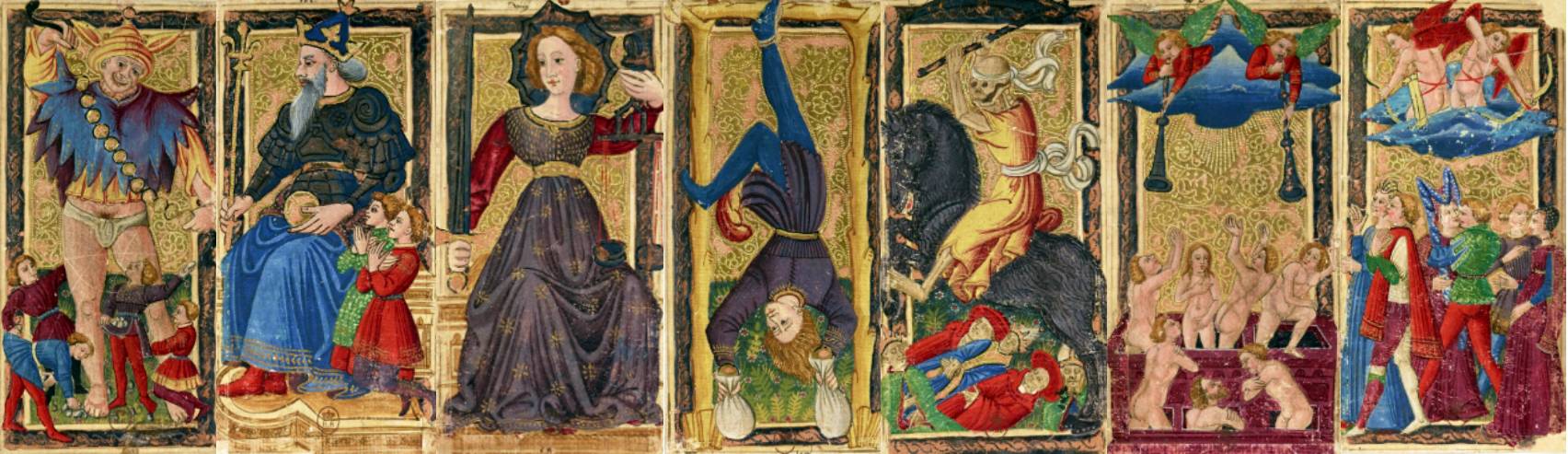
Header Image: Hand-painted Tarocchi cards sometimes known as ‘Charles VI tarot’, North Italy, 1475-1500.Grigonneur deck.




Leave a Reply