
Betwixt God and the Devil
Richard Ward
Ninth Circle Press
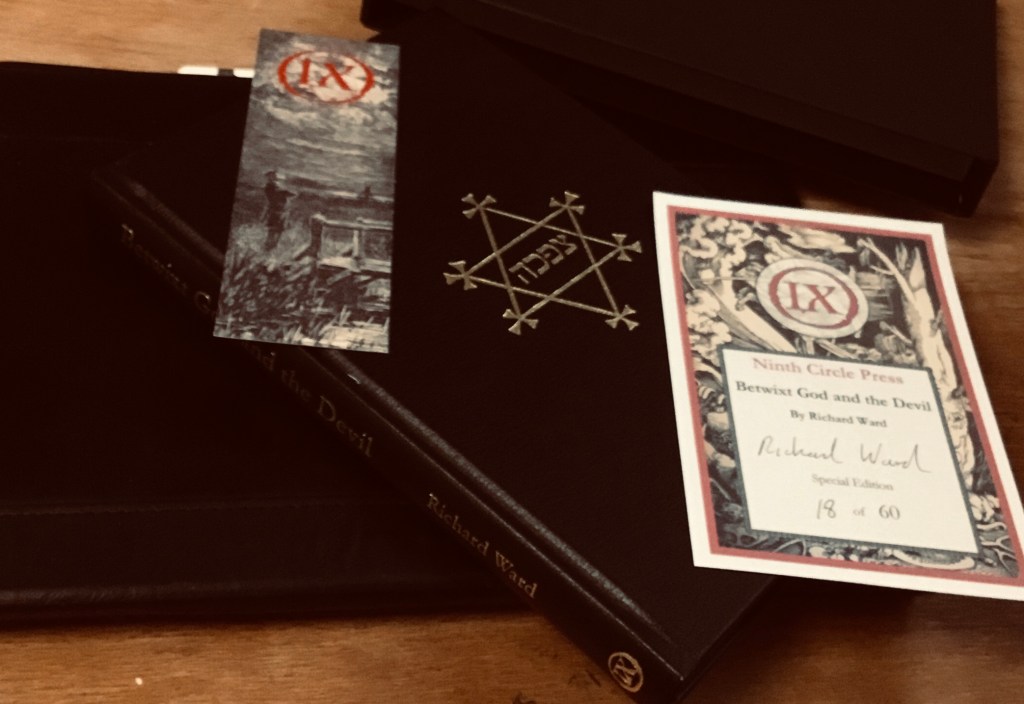
From Ninth Circle Press comes their second offering into the world of occult publishing and also of the peculiar genre’s limited print run issues. A beautiful book that follows near exactly that of its predecessor – Sefer Ha Sitra Achra. This initial hardback variety has a limited print run of 60, the artisanal version even less so, 10, and a cloth bound edition of 250.
Essex- that’s the setting for this book, land of the liminal shore, if England Scotland and Wales were indeed the glyph of a sitting Goddess then Essex lies, literally in her arse-end. The county of the Trinovantes where Colchester became the oldest and arguably most important town in old Albion.
It is of course of great interest to me being as Essex is where I am from- well raised, (Though born in Bow-London was moved to Dagenham, thereafter I lived on Barking’s oppressive Gascoigne estate, before returning to the biggest council estate of Europe- Becontree-Dagenham, thereafter a decade of meandering years spent in Thundersley before become exiled to London W10.)
Any county in Britain has stories that would mark it especial in the eyes of any wayfarer on pursuit of the liminal and peculiar. Essex home to Andrew Chumbley, Kenneth Grant, The Cunning of Canewden et al, and dare I say, any county will throw up similar personages, but, it’s Essex, to me it is familiar. It is my hearth and temple.

The book at once raises a strange quizzical look, the front (special edition of 60) is embossed with a Gold Star of David and the word צפכה- now this -according to Frances Barret ;- (these characters on the one side כיייי, and these on the other צפכה, which are the beginnings and ends of the five first verses of Genesis, and representation of the creation of the world;) However the actual verses of Genesis gives the letters- – בְּוְוְוְוְ and ץםרךְד, and we wonder why magick fails ? Have no idea what the hexagram or the incomprehensible word is used for and can only suggest a loose association with practitioners of the craft to be discussed ~albeit of a Solomonic nature ? This would be ok, as Kenneth Grant (Ilford-Essex) undoubtedly is from that school, somewhat, -( though incorporated other strands into his methods particularly from Vodoun tradition.) Of course it would be doubtful Andrew Chumbley of his own Cultus Sabbati craft would agree, and the cunning men and women of Essex , some with their perhaps old pamphlets of ‘witchcraft grimoires’- mostly crafted by machiavellian monks may well have employed similar Solomonic and psalms in their works…. Who knows…..,im rambling…. it’s an odd start when the symbology of Essex, it’s Three Seax-Swords or Three Crowns (from its city Colchester) is far more symbolic.
Prior to this volume I had read Troy Books Excellent ‘The Liminal Shore’ by Alex Langstone about Essex and more particularly its shoreline creeks and marshes, though the author here decides to give a nod to Troy Books- ‘Of Chalk and Flint’ about Norfolk?
……Well yes!!! I’m nit-picking, hell, it’s Essex! ….of course I’ll be defensive. Works such as this can never full gather the spirit of a place, be it village, town or county. These have to be lived and experienced. There are tales and legends I know from Dagenham alone that would fill a book, not least the characters within that I could recount, but Richard Ward delivers a fine overview of this bedevilled county, and make no mistake every county in these Islands can lay claim to be the habitat of the liminal and the profane.
From Pickinghill to Murdell, Chumbley to Andrew Collins all the players reckoned and noted.
For me, the real story, of course are those unread chapters, the actual oral tradition and the heritage that is learnt and remembered, yet never written. Not because so much it is secret and revealed under oath of death by tongues being ripped out, but simply they are received in the same vain as guidance from parents on how to deal with life. These can be little more than the knowledge a dandelion (being a diuretic) will make you, as we were taught and called them, “Piss the beds”. That plants that survive and stand the danger of its neighbours, in effect will heal the self from those poisonous plants which they stand proudly. Thus the Dock plant relieves the symptoms of a stinging nettle. It could fill a book with each little snippet of folk lore received over the formative years from parents and grandparents regarding plants, herbs, animals, bird song, the change of wind, the tides of the moon, the procession of stars. This, is, hereditary wisdom and hereditary witchcraft and most probably never realised it is so, without the need for oaths and bindings, regalia and constant repetitive order. That I have spoken many times in these blogs of the utilisation of the basic goods a person had, a cup (chalice) a knife (athame/boline) a fork ( a stand or even as a wand- that prods and holds aloft the cooking food), The plate (pantacle) the Cooking pot (the cauldron) the broom (besom and symbol of the phallus to the ‘bush), all these become regalia of a witch, and yet, just as those often dismissed wisdom of generations, we forget our humble self. The wise men and women, the cunning, were simply our ancestors who knew their surrounding, who foraged in the woods, who understood which plants would heal and which would kill, who knew when to prepare for winter and when to plant at spring. They understood the symbiosis of nature. They wasn’t cunning, they just knew by ancestry, oral tradition and experience. Now the cunning, are those who with ulterior motive and reverse psychology bend and manipulate the will of others. The oft mumbled curse to one susceptible to believing in such things, undoubtedly will suffer. Sympathetic magic, the use of poppets and effigies, this gives the ‘cunning’ the confidence to overpower, the will to succeed, and if we are to believe in the subtle inference of quantum energies, that which is inherent in the object- affects the host. So with the knowledge of our herbal garden, and the added bonus of influence, craft and ‘what not’ came forth the witches of renown. It is to the detriment of the familiar path that others, sought to obscure this heritage by incorporating volumes of foreign distraction. Of course, by will and focus if a person from Essex is choosing to cast a song born from the mind of a desert nomad… it may well fruit? so be it, yet it is not the flag under which we kneel.
What is a cunning ‘man’ ? those of cunning are presumed to be wanting something to enrich their lives? most ‘cunning’ men and indeed the humble witch have absolutely no desire to be on the pedestal, no yearning for riches at all. The world is their home and nature their belonging, what more could you want. What is cunning about a person who rejects societies ‘goals’ and the religious ‘order’ ? there’s nothing cunning at all about them, in fact it is society and religion themselves who act so accordingly, they are the cunning, the devious, the manipulators.
The wisdom and knowledge of the ‘cunning‘ and the ‘witch’ are both found and not found in Chumbley’s work, or Grants, I respect Andrew Collins work with regards to “Psychic Questing” – awful name for what is ultimately being in tune with environment, just as a dog can realise odours and scents of emotion perhaps left there from years ago, fear leaves a trace, joy leaves a scent, murder most foul will have them hairs standing on the backs &c.
The torch shone by Richard Ward gives light to the luminaires of a path that we can see, those of us in the shadows can merely eye them with suspicion and yet also appreciate and thanks the lucky stars that we are not ‘found’ or delivered’ that we are silent and unassumed.
So what is the reference to God and the Devil ? Is the Devil Cunning? thereby all in its path its follower? The Cunning (in the context of describing us wayfarers) and the Devil are in fact-free. Free from the glory of a throne, of possession, of domain and territory. You can no more follow the Devil as a means to adopt its ways than you can hold a fistful of ocean and hope to swim in it. The Devil is free, not tied to this or that, and certainly not to you or I, it is wild and progressive, organic and evolving, and everything that evolves of course will destroy. What do the cunning, then worship? It is nature and that which gives us the lessons to learn, the wisdom and the path is nature, and there, is the devil in the detail. Nature herself both beautiful and cruel, allowing and unforgiving and never tamed.
So what is special about Essex ! It has a coastline (the longest I believe of any English county). It has ancient woodland which everywhere would’ve had were it not for Ol’ Henry’s beef with everyone who stood against the contents of his codpieces desire. (He chopped down the woodland to make ships of war) . There is nothing especial about Essex, as there is nothing especial about the cunning men and women of Essex, and that, my friends is what makes it beautiful.
The book ends with discussions of various methods employed from the ‘cunning’ and though there is enough to whet the appetite and warrant further exploration it should’ve been reminded and insisted that each witch or cunning man understands fully the flora and fauna of their local environment. Bees are giving a blinking mention, and by blinking I literally mean a short note. Bees of course alike the cunning man are familiar to their local environment and thereby peculiar to other colonies from afar. This is wisdom that we understand the nature and environment of that which directly affects us, not of some peculiar structure ordained many centuries ago in an unknown land. This is not betwixt the God or the Devil but firmly within our own nature.
We, the cunning stand amidst the crossroads of our dominion.
There is an extensive bibliography though I hasten to add that Alex Langstone’s- The Liminal Shore (Troy books) and Hidden Heritage ~Disc0vering Ancient Essex – Terry Johnson (capall bann publishing) should be included.
I very much enjoyed reading the book, I understand Ninth Circle are to embark on the output of grimoires? Im not sure how many different copies of The Red Dragon or St.Cyprian I’d need and equally not sure I’d purchase them or other publishers following the same pattern, no reflection on ninth circle or others who follow suit, but there’s only so many copies of the same medieval grimoire I can bother with.
Richard Ward knows his stuff and knows his Essex , it is a fine book that I have enjoyed that gives but a glimpse, as ultimately any book can only ever hope to achieve, into those we know as wise, and society and the priest call them cunning.


 The Western Gate
Leave a comment