
Hermeticum Arcanum
by Jean D’Espagnet
Aula Lucis Publishing
The first in a series of books under the umbrella of the Mysterium Hermeticum series from Aula Lucis.
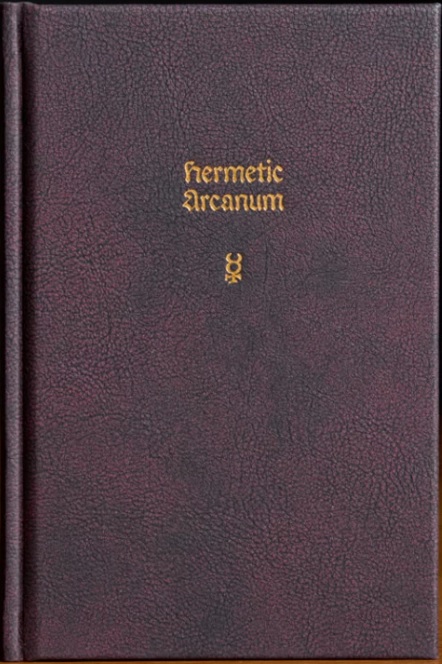
Its certainly a lovely book, the reconstituted leather has a wonderful plum and black tone, the pages are cream and good quality.
One of the most important alchemical texts of the 17th century so the bait entices. Alchemy? in the 21st century, is it curiosity to which we’d venture into this book, with a wry smile, perhaps. It is almost like trying to decipher the poems and songs of an ancient Sanskrit hymn, or the funeral rites from a long forgotten dynasty carved in a humble tomb. Has anything changed from Higgs Boson to that aged search for the essence, the quantifiable and synchronous link to the supreme, that which exists in every being, and element.
D’espagnet talks one moment of dragons and eagles and crows, and the next of Salt and Sulphur and Mercury, and then of Red elements or white, and none the wiser am I…. or am I… is the process and the imagery part of the course, amidst the poetic and scientific ‘twaddle’ deep perhaps in that convoluted mist are shades of the quest, the yearning to end that unquenchable thirst, to wrap in the warmth of a golden fleece. To Know. And I want to build a furnace as directed, and get myself that thick glass beaker with hand span neck, I want to burn metals and see the colours change just as notes ring out and the rainbow is a split white light, I want to see all things disassembled that we may know the nature of each intrinsic part, and that unifying quantity that exists in all of ‘it’.
These are the alchemical quests, the search for the emerald stone. WE can reach for a book of obscure poetry and perhaps not understand it just as we frown at the start of a Shakespeare play, suddenly, somewhere the blinkers are removed and we gain a full picture. It may be our mind that reveals the scene as opposed to Shakespeare or Poetry or Alchemy, but none the less it happens.
It is a strange text, a strange book and yet fascinating as it is obscure to our modern thinking. I look forward to the rest of the series.


 The Western Gate
Leave a comment