Two Headed Arrow
David Chaim Smith
Kardiaplenum
The life of a wandering seeker, begins in earnest and mystery, all things are possible and the self becomes enamoured with its own importance.
Digredi:
As time endures, calamities and mistakes and regret rain hard the self submits and wanders ultimately without want, synchronicities occur and are witnessed without stopping in tracks to marvel, as aversions and desires, to grasp, to wonder, but those moments, in the dance of life are noticed just as a shop front you pass every day on the way to work, a song that remembers moments in time, paths are opened and doors appear without angst, again regarded as absolute and obvious and more, the feet tread onwards absolutely oblivious or caring of the song being played, indifferent to the scenery arising.
I remember a lucid dream with a frequent character that appears who handed me a ring bound manuscript, I recognised it as one I had wrote long ago.
The book was called The Woods Paths Met. A strange compilation of writings that I did at the break of dawn when I was still half asleep, like automatic writing, I didn’t engage the mind too much and allowed whatever to arise. I became the scribe rather than the author.
The texts themselves were obscure and sometimes cynical and often abstract. Some of them were naive and littered with contradiction.
The front of the book was two crossed arrows.
This image was presented to me again recently as I was researching an old Britonian Goddess and, again, I stumbled upon the Egyptian Goddess Neith, whose symbol was a shield and two crossed arrows .
Adgredi:
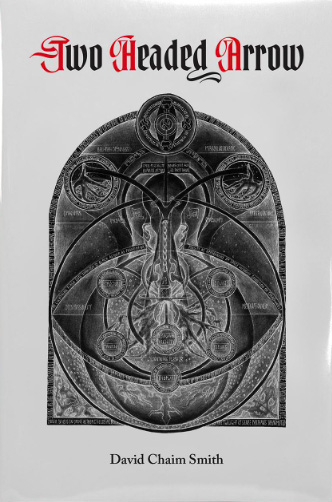
So I bought two headed arrow, of course I did.
I’ve actually bought quite a few of David Chaim Smith’s works since my first foray ~Metatron’s Ladder.
At the outset this book seems to be the most accessible of those I have read, maybe I’m used to his writing style. I should hasten to add a fairly good working knowledge of Kabbalah would definitely help the journey.
David suggested reading quickly and then re-reading, this is the way I read anyway, firing through a book spending only fifteen minutes rushing through the pages and trying not to engage on paragraphs that leap out and demand attention, regardless of whether the book is large or pamphlet, just a quarter of an hour… an observer speed walking through an art gallery without reading the labels or staring and merging into the heart of the matter.
Once done, I then absorb and fully (hope to) engage with its content, deviating to research, make notes, stop and think, stop and not think.
The problem with reviewing this work is we may all differ from what we get out of it, our perception is different.
When first reading Chaim Smith’s work I had a toe in the camp that the writing was complicated, highbrow and sometimes obfuscated. I whinged that I couldn’t see the drawings clearly, and they are magnificent images.
In other discussions with people, they were of the same opinion. We are a peculiar bunch of scoffers, the same perhaps dismissing Banksy’s work now we know who he is.
So what is it about his work, images aside.
It disorientates, in a good way. The ego fights and swears objections, and seeks other avenues of consideration, it purposefully upsets attention. Other works where this happened to me in the past were studying the Buddhist and Advaita Vedanta tradition, where we step in liminal space, not knowing where of if we should be here, the ego says turn back, let’s read something else instead, but we persevere with a frown and a tear in the eye.
It would easier for me to go through the points made in this book, summarise and comment, but…,
I could write what its like to walk the rising ground of Scaffel Pike, that you would, in your mind, travel the path with me. But what if it’s raining when you actually walked the same ground, what if you’re fitter than me and speed up that ridge with little effort, what if you slipped, what if.
We are the universe. We are subject because there is an object.
I found myself replacing Smith’s Hebrew words with Sanskrit. Not to simplify, how could it, but to clarify.
What is the measure of our present? It is what we are, and yet doesn’t exist at all.
We like order, and dare not tread or consider the path of Isfet, listen to the serpent whose gnosis is born from the eternal sea of wisdom that belongs to itself and not from the threshold of self.
Digredi:
“Badru,” said Rumi to me, ” take this pail of water, it is your soul, throw it into the ocean and row to the other side where the ocean meets a distant shore, and when your pail of water reaches that shore, collect it back into the pail and show me. Show me again your soul.”
“You confuse me deliberately”, I objected, ” perhaps,” I said in a moment of clarity “I am in fact the pail.”
“Then , thou art indeed that “, he said, somewhat mockingly.
Agredi:
You don’t need to know Hebrew to get to the heart of Chaim Smith’s work (though it does help), nor to clarify with the poetry of Sanskrit song (and that serves no help except to reflect what is staring at you) if Hebrew is the music . I did, in many respects to bolster the heft of the pat on back, what a clever boy am I! The fool wears not the crown but a Fool’s cap ‘n bells. To read and understand and congratulate yourself that the task is complete is to stand on the summit of Scaffel Pike, “I’ve done it”, complete. Is the task the aim?
The work has only begun. It’s is always only begun. The Summit, The walker, the task, are one event.
We could say, Yichud (ייחוד), unity~ one event. we could say Advaita (अद्वैत)~ non-duality. We can label and determine, tick that level of understanding as complete but as we move on to the next distraction, already we have lost the point.
Understanding is that concept we can define, we know it, by our reasoning, here it is bordered and collected. Yet still the sea of wisdom awaits for us to pour those ideas into its infinite bosom, laughing.
You might not like Chaim Smith’s work, though I should repeat, this particular book does read more accessibly than his others and apologies if it is because I have read quite a few now, you might bemoan not understanding the array of glyphs and flow charts and abundance of Hebrew words to consider, you wont get a medal for absorbing it first attempt.
It is difficult to review Chaim Smith’s work, which is why I haven’t reviewed the half a dozen or so I have read since Metatron’s Ladder, they stand attested in their own right.
So what is the aim of this work?
A scientist where I work was telling me, and in many ways gloating, the expected outcome of their experiment worked, until they sought to observe another outcome, which happened. And both experiments contradicted each other. They needed to ensure absolute zero temperature was correct, that the acoustics of the room, vibrations and external influences, however infinitesimally small were not interfering. The same conditions of each experiment had to be exact, surely that was the answer?
We all know the story, the observer creates the outcome. We’ve bitseized our idiots guide to Quantum theory and been astounded by entanglement and the Future affecting the Past.
We can look to Aleister Crowley, his mammoth work and experience who at death said, apparently, “I am perplexed”, we can take heed of Socrates who said, ” I know that I know nothing”.
Feeling you are none the wiser, does not mean this is out of your understanding parameter, let alone comfort zone, it just means you stand on the shoulders of giants, equal to them.
Observe, and perhaps without want of outcome, riches or desire, the nature of the universe has to cede.


 The Western Gate
Leave a comment