The Horn of Evenwood
Robin Arlisson
Pendring Books
After reading ‘A Deed without a Name’, I was reminded of a book I had previously called~ The Horn of Evenwood, and though I cannot remember exactly how it fared with me, it did strike a similar cord to ‘Deed without a Name’… as I recalled. Of course, my copy of the book long since departed/stolen/loaned so I bought another one to read, cheap, second hand from World of Books.
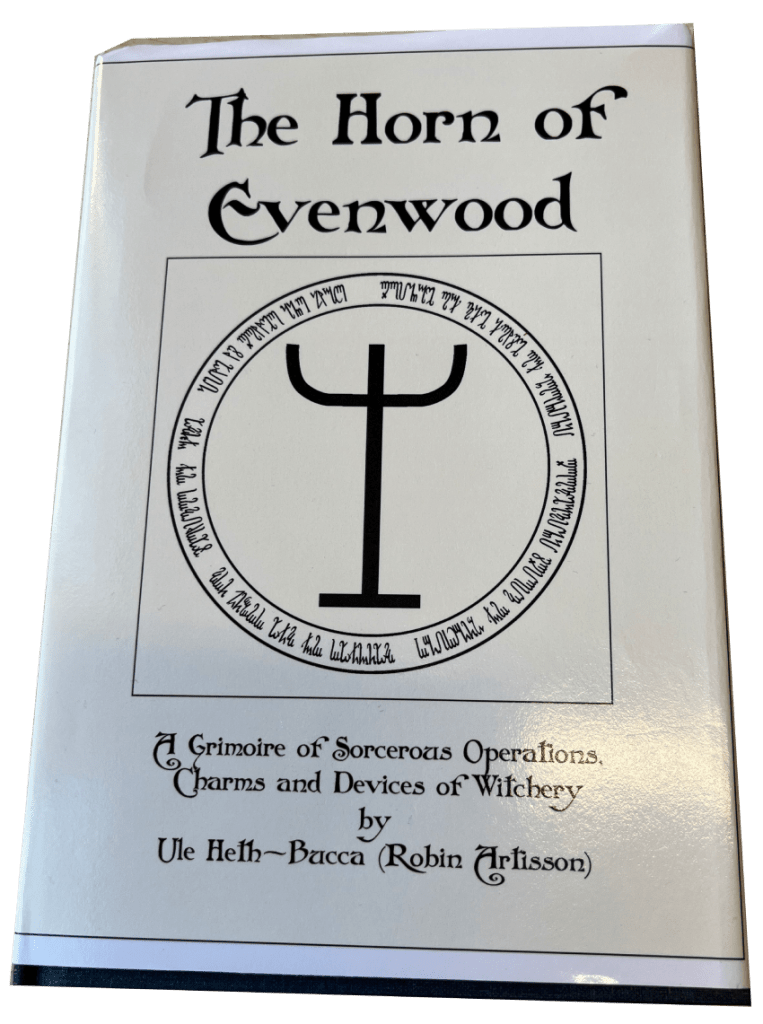
Ah yes, as I nitrous-oxide fuelled speed read through, I remember this. It warranted a more thorough read and study to exact a commentary and ‘review’.
This book comes, post Chumbley in the path of “Traditional Witchcraft”, that which is not aligned to Wicca and which also suggests and promotes self-discovery and self-gnosis. In as far as using this book or others like its ilk…. take all the literature, adapt it to how it fits you and work with it as your experience determines.
There are a few moments of frustration in reading this book, certain words or new deities not being fully explained, or explained at all. Who is Milia, Achilia and Sybilia, they just pop up in one of the incantations to ‘the West’.
They were, to fill that gap, first mooted in Reginald Scott’s Discovery of Witchcraft. As I recall they were not specifically designated as being from ‘the west’, but were of the Fae and could, upon charge gift the budding witch the ring of invisibility. No idea where the names come from, I don’t think ol Reggie great Scott gave us that knowledge either.
Anyway I’m not going to list all peculiar names and words that popped up without reference or footnote in the book, read as you will and understand as you may.
The Horn of Evenwood states in quite a few places observations or ‘rules’ as if they are sacred cows, in the craft, which of course they are not….I.e.;- “it should be mentioned that the only two colours of ink or paint to be used in works of sorcery are black and red” (?)
In the main there is truth in this, namely the conjurations should be written in black and the names of the angels and Gods used, in red, dragons blood red. This however is not the rule as there are many grimoires that utilise a myriad of colours, well, perhaps a touch of blue and green, in sigil work and magic circle formation. It, the black and red, is a general rule though, as Cpt Barbossa from pirates of the Caribbean states, “them’s is guidelines than actual rules.”
The master? Reference is made, many times, by Arlisson that all works are done in homage to and as a servitor of ‘the master’. As a theoretical anarchist this is obviously a cause for concern for me. We are slaves to our ignorance of course, and this prejudice is built from experience and influence by our peers. The occultist of course accepts nothing blindly. We hope. But we are not perfect. Arlisson submits all to the ‘master’. It should therefore be questioned. This master being the adversary we can safely assume it to be opposite to the established, and therefore this master not only refuses adoration, but sees itself in equal, parallel and at one with all whom it meets in discourse and theatre?
The opposite of course to the jealous wrathful spiteful demanding narcissistic God, is one who surely throws away the crown and wanders as a free spirit with wisdom as its guide. The master, after all, is wisdom.
Our Sophia. ‘Philosophy= philo-love and Sophia- wisdom.’
The master in Arlisson’s case however is that (seems to be ) shadowy deity, of which without a name or image. Which is handy if you are the master, and it is stated of the slippery dodger that ‘he’ is a shapeshifter, or as Arlisson states a ‘Turn-Skin’.
Are we inherently at the behest of those deemed greater? It is as subjective as also perhaps I am in hubris and naive
Let me concede therefore, I have in my workings certain ‘characters’ which demonstrate that I am not some free-for-all renegade I’d love to believe I am.
In ‘astral vision’ work, ie scrying or even a full blown out of body astral flight if I venture somewhere I am not really supposed to go, I.e. the privacy of someone living, trespassing into an area coveted by the inhabitants, I am barred by a lady who says nothing except, ‘you shouldn’t be here’. I am, despite my hollering of , no borders, no frontiers! Prevented from trespassing farther.
I call her, the nemesis, and though she looks intimidating and ‘scarey’ is more the sentinel of the threshold between my desire and my will to do as I please of which, regardless of my insistence of wayfaring where’e’er I go am limited in accordance with others ‘wishes’, the invisible barrier set up by them knowingly or built purely by their emotional protection and governance. She is familiar to me I hasten to add as no-one I have ever questioned on guardians, overseers etc have a similar occurrence. Many say they feel invisible hands pushing them away from ‘protected’ areas, or that they are physically repelled at once.
Further I have discourse with certain personalities in dream;- Rumi, Jerome who says nothing and Thoth who speaks in a language I don’t understand and yet know what is being said.
These entities I willingly, conjure’ in lucid dream. Rumi in a secluded and gated garden, Jerome in a ‘fascinating’ library and Thoth in a tall tower whose floor is marked with a sacred circle in which is a labyrinth.
With the exception of the nemesis my only other source of an entity who could fit the bill as ‘master’, is one I have come to know as Shemzu, this name eluded me for years and I drew reference from the compound of Shem;-name and the ancient deity Zu, who stole the sacred tablets. Or so I thought.
However, Shemsu is a name I have since found, Egyptian in origin that denotes a deity ‘that follows’, indeed as a watcher.
Shemsu, I often called the joker as nothing was clear, riddled, rhetoric and deliberate digressing. He appears androgynous and wears an archetypal battered top hat, a deliberate parody of the posh and elite and yet battered to mock.
I Have likewise digressed myself. Let it be said in summary that the author dedicates his whole work, reason and meaning to the “master”. As I can, I can huff and puff at this, but alike others protected by their outward circles, it will not fall down. Who are we to judge?
The Horn of Evenwood lists what it calls ten pillars of witching or sorcery; the keys to the recondite art. Now you can search and browse all you want, you may find faintly veiled links and associations, but let it be remembered the traditional path is and always will be one of the personal gnosis of an individual . As such these ten pillars are familiar to Robin Arlisson and peculiar to perhaps us. However the list is quite an effective and nod-worthy resource.
1/ Rightly prepared materials of art
2/ Symbolic actions and vessels of symbolism
3/ The power of the word used concisely and repeatedly
4/ The activity and power of the familiar
5/ The transfer of hand, word and deed.
6/ Rightly gathered and aligned herbs ,proper days, and observed moons.
7/ The laws of sympathy and contagion
8/ The triangle of manifestation
9/ The secret fire
10/ The law of silence
Robin informs us that though all ten are not necessary in work numbers 3, 4 and 9 are essential for any spell, conjuration etc to be successful.
It would be wrong to comment on all the ‘pillars’ as these seem to be Robin Arlisson’s methods of note and he should be consulted via this book, on what he considers their worth and reason.
The secret fire however he suggests is composed of belief, emotion and imagination. These are fine until repetition and structure interferes, it is known by actors that in order to keep each performance fresh they must “experience the role” each time, not merely “represent” it. This means the performance should feel new, alive, and immediate, as if the actor is discovering the moments for the first time. It is known and referenced in Elsewise Magazine as-The Christmas Effect, the entire article is printed below.
Of other reference not included in Arlissons work I am reminded of, The Ten Forms of Witchcraft (Sorcery) in the Old Testament, Based on Deuteronomy 18:10-11, some religious interpretations identify ten forms of sorcery:
- Kosem (Divination)
- Me’onen (Observer of Times, or fortune-telling using times/seasons)
- Menachesh (Enchanter, or fortune-telling using signs)
- Mekhashef (Witch/Sorcerer, or one who performs magic)
- Chover Chaver (Binder of Spells)
- Shoel Ov (Seeker of the Dead, or consulting a ghost/spirit)
- Yid’oni (Familiar Spirits, or a “knowing” spirit)
- Doresh El HaMetim (Consulting the Dead)
- Ma’avir B’no U’vito Ba’Esh (Passing Children Through Fire, generally associated with child sacrifice)
- Nachash (Snake Charming, or general enchantment)
Each of these, if studied as symbolic of their true nature gives clues to a much higher understanding than the base and gross suggestion formed when reading the line verbatim.
As a foundation study in traditional witchcraft, Horn of Evenwood is a competent guide, as is A Deed Without A Name. As is Call of the Horned Piper and Chumbley’s grimoires, Azoetia and The Dragon Book of Essex and the unpublished Crossroads, but all these, ultimately, are guides, how you traverse the map hither and yon is of course your freewill.
The inclusion of spells and rituals, should always be taken as examples. Just as a painting is good reference material in order to see a benchmark.
Robin Arlisson states, The master says , “I will show you the light if you will look”.
But the reader is The blind. To look is the light.
The Christmas Effect : Taken from Elsewise Magazine Issue 1
Remember that time when you first delved into a book of the occult? The real deal, a book whose opening lines read something like;- herein are secrets that should be treated with utmost respect
… Woe to thee….
Were we naive to believe that what we held in our hands could be real secrets… Never before revealed, knowledge of arcane cults lost in the midst of time… Until now.
Stepping into the first ritual even if it be a hastily made candle rite… The anticipation and excitement.
It was like the first sexual encounter, the first trip to a bar or club when under drinking age, the first concert.
The unfamiliar.
Many interpret this excitement as though, the path is their true calling. Like coming home. The Christmas effect.
The child within arises. We approached hitherto unknown lands. Rebelling against the normal ,diverting from the trends.
At the porch way to the temple we leave behind our identity, that adult moulded by years of subjective moulding.
As we walk into the temple, energized, new. Reborn.
These feelings are not illusory to dismiss. They should be embraced.
Each ritual should and must ignite that Christmas effect.
The excitement and ignition of spirit for new initiates has always been known to rekindle an otherwise stagnant coven.
The initiate becomes the new cook restoring the broth that had lain idle, separating into component parts. Bland.
The initiate brings with them new ideas, new impetus, new enquiry that probes our contented minds.
Old established covens rot,refusing to accept new initiates they whither, dull as a Christian sermon where the congregation listen to a priest talking in a monotone voice and they do all they can to stop themselves falling asleep.
The initiate is the child mind, questioning, full of eagerness and anticipation. An hermetic order with closed doors becomes claustrophobic. The new initiate questions, accuses, adjusts and
restores those fading embers.
Ritual becomes repetitive, repeating, the will becomes fixed not so much on the outcome but the desire for all the usual preliminary drama to hurry up and be gone. The will is already negative.
The rituals then suffer and of course, don’t achieve their purpose. The whole coven becomes an enactment of a tired old play where once there was an eager rehearsal.
All that has changed, is attitude. The excitement needs fuelling, if the mind is wondering how long the boring bits will go on, destroy the boring bits, or don’t do rituals.
All ritual must be approached with wonderment and celebration. You can dance, rehearsed, rigid, methodical or… Become the dance.
The Christmas effect is the fire that keeps the child inside alive.
That child is the awakening of nature, the onset of spring, the waxing moon
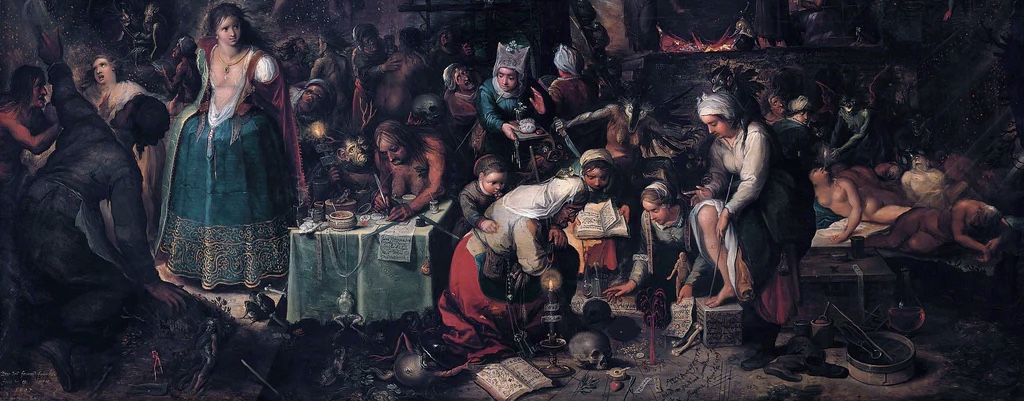
Header Image : Witches Sabbath | Frans Francken the Younger | 1649


 The Western Gate
Leave a comment