

My first name David, is Hebrew for beloved. Researching ancestry and it seemed to be the middle name for my dad, grandad, great grandad etc, which is strange being as I don’t have a middle name at all. I was born premature, an Irish nurse apparently watched over me and prayed all night according to my mum, then, as I was about to die I was, at the request of the nurse, given a baptism. I’m the only one in our family, and extended family to have been baptised. It was in St Andrews Hospital -Bow, in the land of St.George given the name from the saint of Wales. Thus I can say, three wisemen were present at my birth.
I survived, obviously! from that old hospital on Devas Street.
My surname is old English. It comes from the area my family were first – recorded- settled, near Wadhurst in Sussex. Wadhurst is made of the name, Wada’s settlement in the Woods. Wada, is an old Nordic God, born of a king and a mermaid. My surname derives from that area, and means ‘Winding Stream’ – Wen-Waenna (from where to wende comes from- to move slowly and not directly) and Burne- this means stream and gives birth to the word, born, viz, A stream being the start, from the spring.
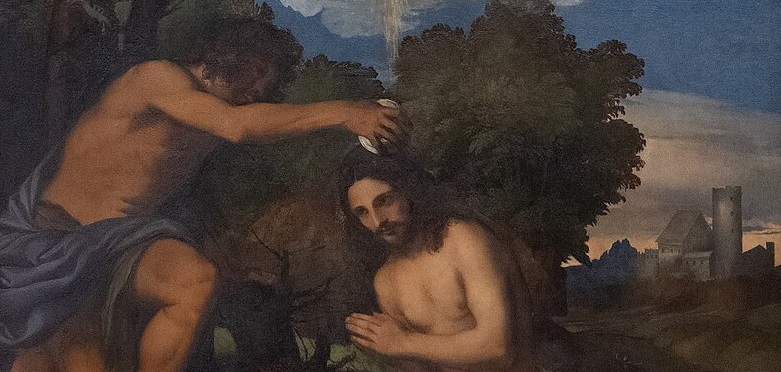
Header imager ;- Baptism of Christ ~ Titian (1512)
Addendum –The Story of Wada.
Wada, the Sea-Walker
Once Upon a Time, that was not a time nor a place that can be fathomed, when the seas were black with storms and the forests stood like dark sentinels against the sky, ruled King Vilkin, a man of proud bearing but haunted by dreams of the water’s edge.
One Autumn dusk, when the waves were whispering like conspirators and the sky bled copper, and by his dreams was told to stray into a grove where no birds sang. So he did. Ventured forth with no fear in his heart.
There, beneath the knot of twisted trees, he found her.
She rose from reeds in the pool, and it were he, that bequeathed her his sword, to show no threat. She came near to him, like a shadow—skin the pale green of drowned things, hair dripping with brine, and legs that ended in coils of glistening scale. Her eyes reflected the moon, cold and watchful.
The king spoke to her, though the words turned bitter on his tongue. She did not answer—but beckoned near the King, and whether it were witchcraft or the last harvest of lust in Autumn seduced him, in manners and ways the like of which the King had never, nor ever, known.
Three seasons later, Past Winter, Spring and t’wards the end of summer, a storm rolled from the sea, tearing at the kingdom’s cliffs, alike that scene the King had known before, and through the rain she came again, cloak trailing seaweed, a child pressed to her breast.
“This is Wada,” she said, her voice like the undertow. “He belongs to the deep, as much as he does to you.”
By dawn she was gone, leaving only the child and a salt-stained stone where she had stood.
Wada grew with unnatural haste. His limbs were long, his shoulders broad, and his eyes held the same glint as the storm moon. One Blue for the sea, and the other Green for the land.
The villagers marked him with charms, whispering of omens and ill tides. His father, fearing him, cast him to distant lands with little inheritance.
Yet the sea does not forget its own.
Years passed, and Wada took a wife, and a son was born—Wayland, a boy with clever hands and a mind that thirsted for more than plough and hearth. When Wayland begged to learn the secrets of the forge, Wada agreed.
They travelled by night, through frost and fog, until they reached a channel choked with ice. Wada stepped into the black waters, his breath steaming, the tide rising to his chest. He bore the boy on his shoulders as the moon stared down, cold and pitiless.
Beyond the channel lay a mountain, its mouth gaping like a grave. There dwelt two dwarves, pale as ash and old as the roots of the world. They promised to teach Wayland their craft if Wada left him there a year and a day.
He did.
But when the year waned, the winds turned strange. The night smelt of iron and rain. Wada returned, climbing the mountain as a storm festered in the valley below. The earth shuddered, and from the mist came a roar—trees cracked, boulders groaned, and the mountainside folded in on itself.
By the time the storm passed, Wada was gone—buried under soil, timber, and black water. Some say the sea took him back; others whisper he still walks the drowned paths, a shadow with the tide in his veins.
On nights when the fog lies heavy upon the cliffs, fishermen leave their nets untouched. They have seen him: a figure half-lit by the moon, wading where no man should tread, his gaze turned forever to the shore he cannot find.


 The Western Gate
Leave a comment