The First Female Pharaoh ~ Sobekneferu, Goddess of the Seven Stars.
Andrew Collins.
Bear & Company Books.

After a brief Introduction allowing us to reflect on the famous female pharaoh’s of Egypt, Nefertiti, Hatheshput, Cleopatra, Andrew Collins invites us to learn of the ‘first’ Female Pharaoh>
At the outset of this viz.chapter 2, Andrew Collins delivers a walkthrough experience of his visit to the British Museum to see the ‘seal of Sobekneferu’, it’s a format he’s used before and one I enjoy. It’s like we follow his footsteps and quest, we see his wonder and feel his emotions on this task, we come by the running dialogue to see how he arrives at situations and can feel his hunches, notions and theories arise. But, alas, after this chapter he resorts to the methods of giving us the bare bones of data and facts as known. Well, I say, as known, as much reliance is had by being “sensible”, that facts jig-sawed together must make sense, however ambiguous and guesswork that maybe. That’s not shoddy research, but piecing together the little facts we have to arrive at a possible, and logical conclusion.
SobekNeferu means “beauty of Sobek” ~ Sobek being the Egyptian ‘crocodile’ God ~ a deity representative of fertility and abundance, particularly as a ward of the Nile, which was vital for the agriculture of Egypt.
I am at odds with the concept of beauty. In vain terms it is subjective but philosophically, beauty means, That which is perfect for the senses, i.e. everything that is formed that it can be known. Synonymous with the Kabbalistic ‘Tiphareth’~ it is the design of balance, symmetry and order, the hieroglyph for Nefer (beauty) being the heart and windpipe, that are central to the body, lungs for instance are divided, as the left side of the body to the right is reflective, but the heart and windpipe are the central column of life. This is Tiphareth, where above (air) is internalised to below (body). Beauty is in essence divine perfection, balance (Maat) and cosmic order.
It may well be however that the Egyptians definition of Beauty is just;- something that we personally, for whatever reason, find desirable. Such is conjecture and possibility. We just don’t know.
Likewise, there is the notion that the statues that have survived of SobekNeferu, many or all of which were mutilated, had their noses destroyed because the ancients believed this would prevent them from breathing? This has got to be nonsense. The ritual of the dead~ prominent is the opening of the mouth, that the deceased may speak and breathe! The Egyptians weren’t stupid, they could craft a bloody good headdress and jewellery and carve statues into granite, I’m sure they had the inclination to pinch their noses and realise they could still breathe through their mouth, but again, maybe this act was symbolic.
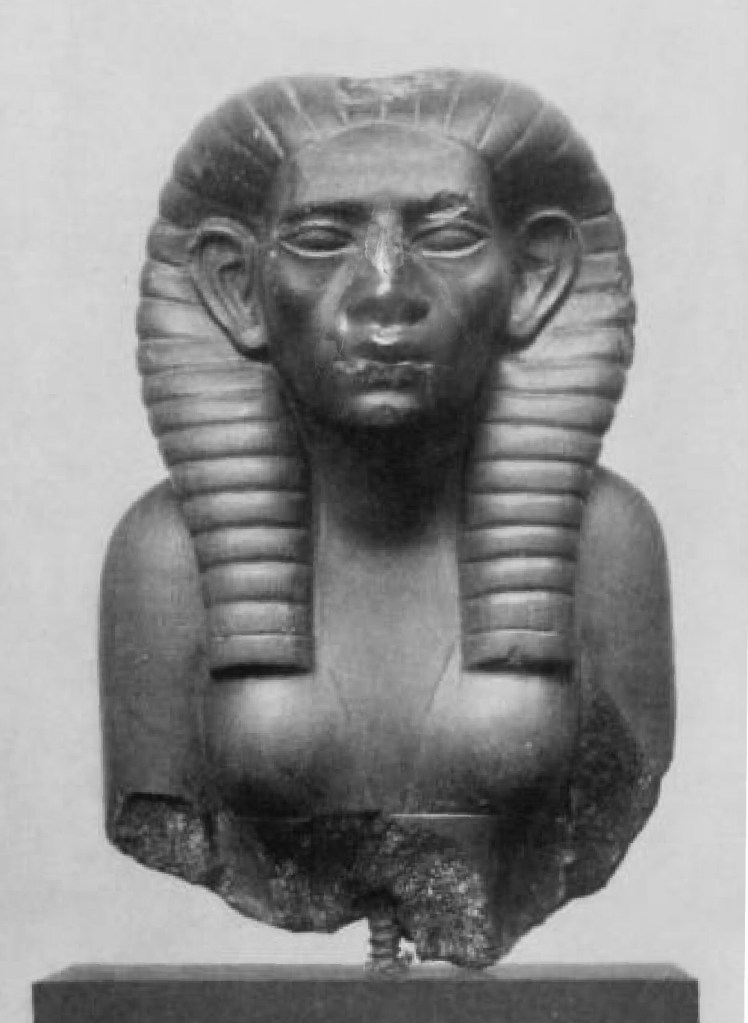
Andrew Collins recreates with a 3d digital software what Sobekneferu would look like, and gives her nose befitting of someone from the Middle East. However if, using a cheap art app I cut and Paste a nose of what I think it looks like, desaturate both images and merge them, you will see, She’s African, Nubian. Culturally different to the arising dissent to follow her reign, who’d smash off her nose so their was no clue as to her racial heritage, again… this is guesswork bordering on conspiracy.
I do think a broader African nose suits the bust better, but again, this is subjective and we should dismiss enquiry until we actually get an intact statue, one day.
What can be said was statues were defaced by people who didn’t like them. Usually the next lot of power hungry merchants and slaves.
Most stories from Ancient Egypt are full of intrigue and scandal. Brothers marrying sisters (to keep the power and wealth in the family) Fathers marrying daughters, murderous plots and coups, so we approach any story concerning any murky and difficult character from those antiquarian times with equal prejudice.
The seal of Sobekneferu, shows her with the ‘five’ titles of Kingship. viz, her personal name- Sobekneferu;- Her Horus Name~ beloved of Ra; Her Nebty Name;- SatSekemNebetTawy ~ Daughter of power, over Upper and Lower Egypt. Golden Horus NAme ~ Stable (is she) in rites of Kingship and her ‘Throne Name ~ Sobek Ka RA. Thus we KNOW, Sobekneferu was a female Pharaoh. Albeit only for a couple of months short of Four years.
We are taken on a mysterious wander into whether Sobekneferu is actually ‘Nicotris’, its all speculative really from here but with enough insight and thought prodding to keep on keeping on. Sobekneferu historically is of the 12th dynasty and Nicotris, allegedly the 6th is mentioned in hearsay historical accounts, though no actual evidence exists, its like comparing King Richard the Lionheart to King Arthur, one is historic, the other ‘legendary’.
Likewise we are told of the possible liaison between Sobekneferu and Joseph. Yes dream coat boy. The less said the better, less conjecture and more wishful thinking. Again, there are no actual historical leads let alone evidence about the existence of Joseph nor a Semitic vizier to the pharaoh that read the dreams and saved the day. Except of course in the Abrahamic Saga.
For the most part, the book is captivating, even if we are no nearer to finding the truth than when we started. Her final whereabouts a mystery, though Mr.Collins puts forward very good and plausible possibles.
Her legacy as finally pointed out, being the first female, known, in power, who wore the apparel of a king, complete with stick-on beard, who is paired with the ever popular Draconian and Typhonian currents in occult circles. Though her statues may be vandalised, the pedestal is set for her in contemporary circles.
For me, it’s a case of watching Valerie Leon in Blood from the Mummies Tomb because I’m so shallow, oh and the following, loosely based apparently on the lost Pharaoh~ SobekNeferu, which I’ve never seen before…
—
Header Image~ The Death of Cleopatra ~ Juan Luna (1881)


 The Western Gate
Leave a comment