
The Faceless God ~ ( Second Edition)
Tomas Vincente
Theion Press
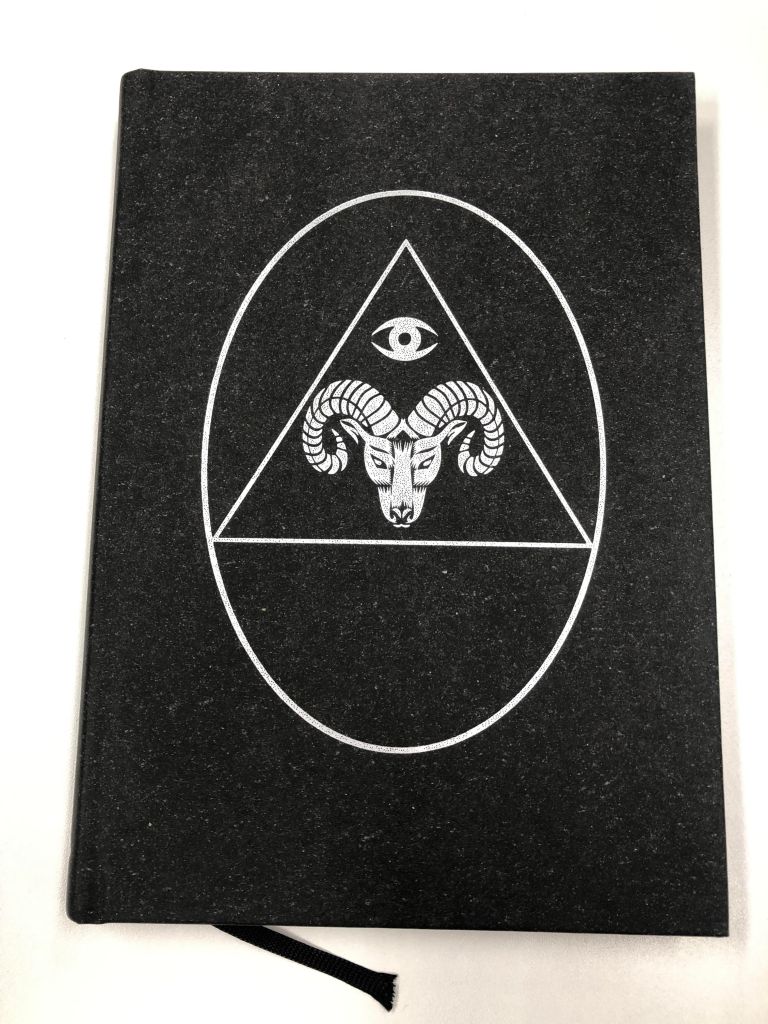
No I didn’t get this when it first came out, I bought this ‘updated’ version, what difference there is, is therefore only known to those that have its predecessor.
The Faceless God draws on concepts derived from the Egyptian Netherworld, a sprinkling of European folk witchcraft and a healthy wodge of Lovecraftian wyrd Ontology, or Cosmic Horror. The book raises , for me, more questions and argument than answers and obedient head nodding, but, that is a good thing, and the greater it makes me think and question, the better the book.
Lovecraft? We all know the Necronomicon was a concept from fiction, although fiction will have been influenced by experience and fact, but fiction none the less it is. From fiction, we could say facts arise, we create a scenario, and it happens, we have a vision of the future or a conspiracy of events, and they occur, perhaps we create for ourselves our own personal demon/god, feed it with prayer, oblations and sacrifices and lo! we become known to it, the questions answered, the Golem arises.
The faceless. Egoless. The concept that we are ultimately and absolutely non-dual. In order to know this of course one must first destroy the borders and scaffolding about our self that we have by experience and reason created. The Ego must be dismantled, and wherever there is a doctrine or order or cult that promotes this, the question is, are we selfless, or is it replaced by that culty group hive mind. If we are truly selfless and at equanimity with universal consciousness, there is of course no doubt. If our teachers and gurus continually barrage us with mind games and cruel limitations then all we do is submit, for want of peace.
Vincente draws parallels between Lovecraft’s menacing messengers straddling the abyss, to lure as inwards just as Anubis becomes the psychopomp to wade our soul to the other side and into unity.
He uses the framework of Qabalah, and a grounding in Qabalah is therefore prerequisite I would suggest. And so it begins;-
Ayin ע, as depicted by Kenneth Grant and used in The Faceless God by Vincente, between Hod and Tiphareth, bearing in mind others have it placed between Binah and Tiphareth, what is the correct path? These are subjective. This is the problem with Grant et al, those paths/tunnels are to the authors set in stone, there is no deviation, even though every number as every tarot trump can, subjectively, cross that path~ because in chaos evrything is possible, however whether it is Crowley or Grant or Vincente, the path between Hod and Tipharet is ע~ the Devil, and therein endeth the lesson.
Expanding this view, and wandering off the beaten track~ Place between Yesod and Malkuth~ Tau ת, the final letter, and both systems (western tradition and Ari) here agree, that Tau is the Hebrew letter synonymous with the path between Malkuth and Yesod. We can write a thesis on the relationship between Yesod and Malkuth via Tau. Its Tarot card after all is~ The world, of course.
But what if we place there some random card ? I shuffle the deck and instead place Justice in between the kingdom and the foundation, this is wrong! ?? or is it, that balance and justice is in equilibrium, that the manifest is in form evolving by the light of the progressive Yesod. That Malkuth cannot exist without this concept. The Kingdom exists because it is balanced and true despite what the ebbing and waning of Yesod does.
Or perhaps another shuffle and now … the Emperor, by which we could read the Kingdom is governed, for the Emperor here is also the symbol of foundation, the bedrock of society, surely symbolically he must be placed between Yesod and Malkuth… etc.
In meditative exercise I placed every major arcana tarot between two Sephiras- The Fool between Kether and Chokmah, then The Magician, then the High Priestess etc, then repeated the whole process using the path that lay between Kether and Binah , and contemplated them, as an exercise, purely symbolically, purely subjectively it works every time. Even in ambiguity a story can be told. This is 484 (22×22) paths to compute and analyze, and that’s before analysing the balance of other ‘random’ cards upon the other paths if we filled them with the remaining cards by chance. The computation of the array of differing Tarot on the 22 paths would give a computation so high (1.124 × 10²¹) if we managed to compare every random spread in every possible permutation it would take c.36 trillion years if we were able to analyse each of the permutations of 22cards over 22 random paths in one second . (Which is older than the current estimate of the universe.) What we see here is possibilities, permutation, to near infinite and inexhaustible paths, and therefore, in effect chaos.
Now I’ve rambled on, deviated, on purpose.
This is what many of these books do, and that’s not inherently wrong, they grab a bit of the coat tails of one God here, and skirt from that Goddess, maybe elaborate by comparing the gematria of a word to accentuate the argument. This word has the number 156, and so does this, therefore they are symbolically linked, Eureka !
Though, and let me wander off again, if we take words like United and Untied, surely they are the same? but aren’t they opposite? The nit-picker will say, ah! but they create the concept of polarity, that they can either be together or apart of the same fundamental concept?
Listen and Silent? same letters in each word and what will our nitpicker say? ah! but they represent the abject and distinct, the complimentary forces of the same sense, the yin and yang…The active and passive, Silent or Listen?
Ok then, Perhaps Funeral and ‘Real Fun’ ? … thus the fun begins leading to its death.
We create our truth.
Kenneth Grant bombards the reader with gematria, using the Greek method or the Hebrew, whatever, to suit his purpose. We are expected to sit in awe at the tangled weave he unfolds before us, and yes, it can be interesting, as it is also distracting.
There are some strange and fascinating coincidences and some computations raise wonderful concepts, just as placing a random Tarot Card between two Sephira does.
However, moving on. The arte true in The Faceless God is of the Bornless, the Headless, the annihilation of self.
These concepts drawing parallels with Lovecraftian and Egyptian themes as well as the Sabbatical Witchcraft. It is nice to see, somewhat, that the true sabbats, the Equinoxes and Solstices are in fact given a nod that they are greater than the so called “Great Sabbaths” as espoused by Gardner. I believe the actual mid point between the Winter Solstice and Autumn Equinox last year was Nov 4th, or thereabouts, but Gardeners flock still dance around on Samhain -Oct 31st religiously, declaring it the greatest and true Sabbath. Its not even naturally correct old boy.
Lovecraft uses the shadowy and sinister form of Nyarlathotep, the messiah that walks between the threshold of the Outer Gods, and this world. Emerging from Chaos. Chaos is the realm of possibilities of endless permutations, viz;- ” infinite and inexhaustible”, and our world that we live is but the form in being, the perfected nature from one of those endless possibilities. By our sense, it is the Apotheosis (The highest or perfect form of something; the culmination of a process, such as evolution, into an ideal, untouchable state.) and our ego works in the present here and now with that.
We see our existence for instance, just as a purist only sees ע between Hod and Tiphareth, It is not so however upon the path of chaos. It has been said the Outer Gods no more cares for the pursuits of man as the sea does to the rock on the shoreline. It means nothing and holds no expectation nor does it demand gratitude, and yet, by praxis, ritual, they that call to an archetypal form, in this case Nyarlathotep, gain its recognition because we are dancing to the same tune. We can only be acknowledged~ by synchronicity, and this can only be correct if we have no resistance which is rooted in our ego. This is not taught by A.N.other but resides within. Vincente does give us rituals, easy and effective by which to work.
Can we actually live Egoless, and more importantly, do we want to? Can we equally wander through life throwing the dice of possibilities at every corner when our life maybe content?
If you take this pill, your life will never ever be the same again, your whole thought process will change, your contentment and yes even, conceited outlook will be shattered. Or do you wish to remain, safe, comfy and unafraid.
We can besmirch and laugh at the fiction HP Lovecraft gave us in the form of Nyarlathotep, because it’s different, it is not rooted in fact nor accepted. Perhaps, Nyarlathotep is laughing at us because we’re all the same.
Afterword : Fiction writing, alike poetry and prose, rhetoric, we open our mind and let the content free, perhaps behind the pulp fiction there is meaning, perhaps behind the drama there is being and truth, and perhaps the chaos of fiction arises from the same seat of wisdom, but is revealed to us in imagination. HP Lovecraft, The Necronomicon, appeared first, I believe, in the magazine below, and as it’s over 100 years old, I have included here because it’s copyright free.

The Hound
By H. P. Lovecraft
| 1. In my tortured ears there sounds unceasingly a nightmare whirring and flapping, and a faint, distant baying as of some gigantic hound. It is not dream—it is not, I fear, even madness—for too much has already happened to give me these merciful doubts. St. John is a mangled corpse; I alone know why, and such is my knowledge that I am about to blow out my brains for fear I shall be mangled in the same way. Down unlit and illimitable corridors of eldritch phantasy sweeps the black, shapeless Nemesis that drives me to self-annihilation. May heaven forgive the folly and morbidity which led us both to so monstrous a fate! Wearied with the commonplaces of a prosaic world, where even the joys of romance and adventure soon grow stale, St. John and I had followed enthusiastically every aesthetic and intellectual movement which promised respite from our devastating ennui. The enigmas of the Symbolists and the ecstasies of the pre-Raphaelites all were ours in their time, but each new mood was drained too soon of its diverting novelty and appeal. Only the sombre philosophy of the Decadents could hold us, and this we found potent only by increasing gradually the depth and diabolism of our penetrations. Baudelaire and Huysmans were soon exhausted of thrills, till finally there remained for us only the more direct stimuli of unnatural personal experiences and adventures. It was this frightful emotional need which led us eventually to that detestable course which even in my present fear I mention with shame and timidity—that hideous extremity of human outrage, the abhorred practice of grave-robbing. I cannot reveal the details of our shocking expeditions, or catalogue even partly the worst of the trophies adorning the nameless museum we prepared in the great stone house where we jointly dwelt, alone and servantless. Our museum was a blasphemous, unthinkable place, where with the satanic taste of neurotic virtuosi we had assembled an universe of terror and decay to excite our jaded sensibilities. It was a secret room, far, far underground; where huge winged daemons carven of basalt and onyx vomited from wide grinning mouths weird green and orange light, and hidden pneumatic pipes ruffled into kaleidoscopic dances of death the lines of red charnel things hand in hand woven in voluminous black hangings. Through these pipes came at will the odours our moods most craved; sometimes the scent of pale funeral lilies, sometimes the narcotic incense of imagined Eastern shrines of the kingly dead, and sometimes—how I shudder to recall it!—the frightful, soul-upheaving stenches of the uncovered grave. Around the walls of this repellent chamber were cases of antique mummies alternating with comely, life-like bodies perfectly stuffed and cured by the taxidermist’s art, and with headstones snatched from the oldest churchyards of the world. Niches here and there contained skulls of all shapes, and heads preserved in various stages of dissolution. There one might find the rotting, bald pates of famous noblemen, and the fresh and radiantly golden heads of new-buried children. Statues and paintings there were, all of fiendish subjects and some executed by St. John and myself. A locked portfolio, bound in tanned human skin, held certain unknown and unnamable drawings which it was rumoured Goya had perpetrated but dared not acknowledge. There were nauseous musical instruments, stringed, brass, and wood-wind, on which St. John and I sometimes produced dissonances of exquisite morbidity and cacodaemoniacal ghastliness; whilst in a multitude of inlaid ebony cabinets reposed the most incredible and unimaginable variety of tomb-loot ever assembled by human madness and perversity. It is of this loot in particular that I must not speak—thank God I had the courage to destroy it long before I thought of destroying myself. The predatory excursions on which we collected our unmentionable treasures were always artistically memorable events. We were no vulgar ghouls, but worked only under certain conditions of mood, landscape, environment, weather, season, and moonlight. These pastimes were to us the most exquisite form of aesthetic expression, and we gave their details a fastidious technical care. An inappropriate hour, a jarring lighting effect, or a clumsy manipulation of the damp sod, would almost totally destroy for us that ecstatic titillation which followed the exhumation of some ominous, grinning secret of the earth. Our quest for novel scenes and piquant conditions was feverish and insatiate—St. John was always the leader, and he it was who led the way at last to that mocking, that accursed spot which brought us our hideous and inevitable doom. By what malign fatality were we lured to that terrible Holland churchyard? I think it was the dark rumour and legendry, the tales of one buried for five centuries, who had himself been a ghoul in his time and had stolen a potent thing from a mighty sepulchre. I can recall the scene in these final moments—the pale autumnal moon over the graves, casting long horrible shadows; the grotesque trees, drooping sullenly to meet the neglected grass and the crumbling slabs; the vast legions of strangely colossal bats that flew against the moon; the antique ivied church pointing a huge spectral finger at the livid sky; the phosphorescent insects that danced like death-fires under the yews in a distant corner; the odours of mould, vegetation, and less explicable things that mingled feebly with the night-wind from over far swamps and seas; and worst of all, the faint deep-toned baying of some gigantic hound which we could neither see nor definitely place. As we heard this suggestion of baying we shuddered, remembering the tales of the peasantry; for he whom we sought had centuries before been found in this selfsame spot, torn and mangled by the claws and teeth of some unspeakable beast. I remembered how we delved in this ghoul’s grave with our spades, and how we thrilled at the picture of ourselves, the grave, the pale watching moon, the horrible shadows, the grotesque trees, the titanic bats, the antique church, the dancing death-fires, the sickening odours, the gently moaning night-wind, and the strange, half-heard, directionless baying, of whose objective existence we could scarcely be sure. Then we struck a substance harder than the damp mould, and beheld a rotting oblong box crusted with mineral deposits from the long undisturbed ground. It was incredibly tough and thick, but so old that we finally pried it open and feasted our eyes on what it held. Much—amazingly much—was left of the object despite the lapse of five hundred years. The skeleton, though crushed in places by the jaws of the thing that had killed it, held together with surprising firmness, and we gloated over the clean white skull and its long, firm teeth and its eyeless sockets that once had glowed with a charnel fever like our own. In the coffin lay an amulet of curious and exotic design, which had apparently been worn around the sleeper’s neck. It was the oddly conventionalised figure of a crouching winged hound, or sphinx with a semi-canine face, and was exquisitely carved in antique Oriental fashion from a small piece of green jade. The expression on its features was repellent in the extreme, savouring at once of death, bestiality, and malevolence. Around the base was an inscription in characters which neither St. John nor I could identify; and on the bottom, like a maker’s seal, was graven a grotesque and formidable skull. Immediately upon beholding this amulet we knew that we must possess it; that this treasure alone was our logical pelf from the centuried grave. Even had its outlines been unfamiliar we would have desired it, but as we looked more closely we saw that it was not wholly unfamiliar. Alien it indeed was to all art and literature which sane and balanced readers know, but we recognised it as the thing hinted of in the forbidden Necronomicon of the mad Arab Abdul Alhazred; the ghastly soul-symbol of the corpse-eating cult of inaccessible Leng, in Central Asia. All too well did we trace the sinister lineaments described by the old Arab daemonologist; lineaments, he wrote, drawn from some obscure supernatural manifestation of the souls of those who vexed and gnawed at the dead. Seizing the green jade object, we gave a last glance at the bleached and cavern-eyed face of its owner and closed up the grave as we found it. As we hastened from that abhorrent spot, the stolen amulet in St. John’s pocket, we thought we saw the bats descend in a body to the earth we had so lately rifled, as if seeking for some cursed and unholy nourishment. But the autumn moon shone weak and pale, and we could not be sure. So, too, as we sailed the next day away from Holland to our home, we thought we heard the faint distant baying of some gigantic hound in the background. But the autumn wind moaned sad and wan, and we could not be sure. II. Less than a week after our return to England, strange things began to happen. We lived as recluses; devoid of friends, alone, and without servants in a few rooms of an ancient manor-house on a bleak and unfrequented moor; so that our doors were seldom disturbed by the knock of the visitor. Now, however, we were troubled by what seemed to be frequent fumblings in the night, not only around the doors but around the windows also, upper as well as lower. Once we fancied that a large, opaque body darkened the library window when the moon was shining against it, and another time we thought we heard a whirring or flapping sound not far off. On each occasion investigation revealed nothing, and we began to ascribe the occurrences to imagination alone—that same curiously disturbed imagination which still prolonged in our ears the faint far baying we thought we had heard in the Holland churchyard. The jade amulet now reposed in a niche in our museum, and sometimes we burned strangely scented candles before it. We read much in Alhazred’s Necronomicon about its properties, and about the relation of ghouls’ souls to the objects it symbolised; and were disturbed by what we read. Then terror came. On the night of September 24, 19––, I heard a knock at my chamber door. Fancying it St. John’s, I bade the knocker enter, but was answered only by a shrill laugh. There was no one in the corridor. When I aroused St. John from his sleep, he professed entire ignorance of the event, and became as worried as I. It was that night that the faint, distant baying over the moor became to us a certain and dreaded reality. Four days later, whilst we were both in the hidden museum, there came a low, cautious scratching at the single door which led to the secret library staircase. Our alarm was now divided, for besides our fear of the unknown, we had always entertained a dread that our grisly collection might be discovered. Extinguishing all lights, we proceeded to the door and threw it suddenly open; whereupon we felt an unaccountable rush of air, and heard as if receding far away a queer combination of rustling, tittering, and articulate chatter. Whether we were mad, dreaming, or in our senses, we did not try to determine. We only realised, with the blackest of apprehensions, that the apparently disembodied chatter was beyond a doubt in the Dutch language. After that we lived in growing horror and fascination. Mostly we held to the theory that we were jointly going mad from our life of unnatural excitements, but sometimes it pleased us more to dramatise ourselves as the victims of some creeping and appalling doom. Bizarre manifestations were now too frequent to count. Our lonely house was seemingly alive with the presence of some malign being whose nature we could not guess, and every night that daemoniac baying rolled over the windswept moor, always louder and louder. On October 29 we found in the soft earth underneath the library window a series of footprints utterly impossible to describe. They were as baffling as the hordes of great bats which haunted the old manor-house in unprecedented and increasing numbers. The horror reached a culmination on November 18, when St. John, walking home after dark from the distant railway station, was seized by some frightful carnivorous thing and torn to ribbons. His screams had reached the house, and I had hastened to the terrible scene in time to hear a whir of wings and see a vague black cloudy thing silhouetted against the rising moon. My friend was dying when I spoke to him, and he could not answer coherently. All he could do was to whisper, “The amulet—that damned thing—.” Then he collapsed, an inert mass of mangled flesh. I buried him the next midnight in one of our neglected gardens, and mumbled over his body one of the devilish rituals he had loved in life. And as I pronounced the last daemoniac sentence I heard afar on the moor the faint baying of some gigantic hound. The moon was up, but I dared not look at it. And when I saw on the dim-litten moor a wide nebulous shadow sweeping from mound to mound, I shut my eyes and threw myself face down upon the ground. When I arose trembling, I know not how much later, I staggered into the house and made shocking obeisances before the enshrined amulet of green jade. Being now afraid to live alone in the ancient house on the moor, I departed on the following day for London, taking with me the amulet after destroying by fire and burial the rest of the impious collection in the museum. But after three nights I heard the baying again, and before a week was over felt strange eyes upon me whenever it was dark. One evening as I strolled on Victoria Embankment for some needed air, I saw a black shape obscure one of the reflections of the lamps in the water. A wind stronger than the night-wind rushed by, and I knew that what had befallen St. John must soon befall me. The next day I carefully wrapped the green jade amulet and sailed for Holland. What mercy I might gain by returning the thing to its silent, sleeping owner I knew not; but I felt that I must at least try any step conceivably logical. What the hound was, and why it pursued me, were questions still vague; but I had first heard the baying in that ancient churchyard, and every subsequent event including St. John’s dying whisper had served to connect the curse with the stealing of the amulet. Accordingly I sank into the nethermost abysses of despair when, at an inn in Rotterdam, I discovered that thieves had despoiled me of this sole means of salvation. The baying was loud that evening, and in the morning I read of a nameless deed in the vilest quarter of the city. The rabble were in terror, for upon an evil tenement had fallen a red death beyond the foulest previous crime of the neighbourhood. In a squalid thieves’ den an entire family had been torn to shreds by an unknown thing which left no trace, and those around had heard all night above the usual clamour of drunken voices a faint, deep, insistent note as of a gigantic hound. So at last I stood again in that unwholesome churchyard where a pale winter moon cast hideous shadows, and leafless trees drooped sullenly to meet the withered, frosty grass and cracking slabs, and the ivied church pointed a jeering finger at the unfriendly sky, and the night-wind howled maniacally from over frozen swamps and frigid seas. The baying was very faint now, and it ceased altogether as I approached the ancient grave I had once violated, and frightened away an abnormally large horde of bats which had been hovering curiously around it. I know not why I went thither unless to pray, or gibber out insane pleas and apologies to the calm white thing that lay within; but, whatever my reason, I attacked the half-frozen sod with a desperation partly mine and partly that of a dominating will outside myself. Excavation was much easier than I expected, though at one point I encountered a queer interruption; when a lean vulture darted down out of the cold sky and pecked frantically at the grave-earth until I killed him with a blow of my spade. Finally I reached the rotting oblong box and removed the damp nitrous cover. This is the last rational act I ever performed. For crouched within that centuried coffin, embraced by a close-packed nightmare retinue of huge, sinewy, sleeping bats, was the bony thing my friend and I had robbed; not clean and placid as we had seen it then, but covered with caked blood and shreds of alien flesh and hair, and leering sentiently at me with phosphorescent sockets and sharp ensanguined fangs yawning twistedly in mockery of my inevitable doom. And when it gave from those grinning jaws a deep, sardonic bay as of some gigantic hound, and I saw that it held in its gory, filthy claw the lost and fateful amulet of green jade, I merely screamed and ran away idiotically, my screams soon dissolving into peals of hysterical laughter. Madness rides the star-wind . . . claws and teeth sharpened on centuries of corpses . . . dripping death astride a Bacchanale of bats from night-black ruins of buried temples of Belial. . . . Now, as the baying of that dead, fleshless monstrosity grows louder and louder, and the stealthy whirring and flapping of those accursed web-wings circles closer and closer, I shall seek with my revolver the oblivion which is my only refuge from the unnamed and unnamable. |


 The Western Gate
Leave a comment