
Summa Sacre Magice: the Compendium of Sacred Magic
Dr Stephen Skinner & Daniel Clark
Golden Horde Press
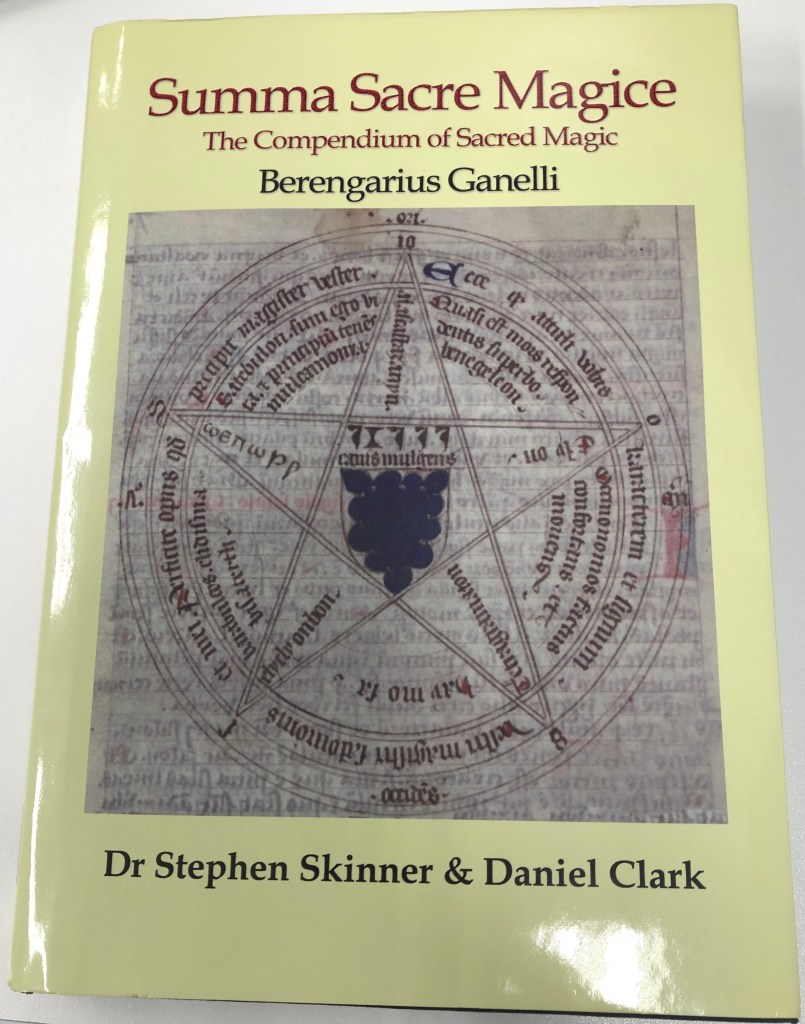
The Fifteenth book in Golden Hordes Source works of Ceremonial Magic series. 15 being the devil card in Tarot, is it significant? You know what you’re getting when Skinner is involved. A comprehensive facsimile or translation of a museum/library text. All painstakingly adapted for the English reader, essential to any bookshelf of the curious and the querent, the occultist-speculative and operative.
The Summa’ is a grimoire written in 1346 AD by Berengarius Ganelli, cited as being the best source work of many grimoires that followed, It is not the first grimoire, merely perhaps one of the most concise in terms of the extent and framework, we could look as foundations to;-
The Cyranides 4th century: A collection of magical knowledge focusing on the properties of animals, plants, and stones.( in Greek but Chrome browser does a fairly good job at ‘translate to English’)
Sefer HaRazim (circa 3rd–6th century): A Jewish mystical text containing instructions for invoking angels and divine forces.
Picatrix (Ghayat al-Hakim, 10th century): An Arabic text on astral magic, widely influential in Europe after being translated into Latin in the 12th century.
The Key of Solomon (Clavicula Salomonis, circa 13th century): One of the most well-known grimoires, filled with instructions for summoning spirits and performing rituals.
Liber Juratus Honorii (The Sworn Book of Honorius, 13th century): A grimoire claiming to grant divine visions and angelic communication.
The Summa’ here presented offers the first two books of its exhaustive work. The following three being translated from the earliest available copy, I believe there are pieces missing or damaged and need to be cross referenced, it’s a mammoth task for Skinner and the translator.
This book is a veritable hoarders house of sacred and infernal names. At a quick glance one feels that anybody who did follow this rigid performance is bound to summon the object desired by virtue of the mind being sponged of all resistance, whipped into shape by the onslaught of recital and chanting, droning. It would be like a mind trap method of playing a constant discordant frequency over and over with pulsing flashing lights, at last it all stops and hallelujah the spirit appears.
The literature, the concise notes, the methods are all fascinating. There must be a simple method I feel, Some flow chart (Yes the dread laser pointer diagram so loved by human resources) by which manner we can determine how best to proceed.
The book is daunting, It is akin to describing each dozen steps taken whilst running a marathon. This is not being negative to the method and certainly not the book. This is the rituale ~ Summa Sacre Magice~ in all its pomp and grand pageantry, the art of gilding the lily.
Which of the winds to summon, which names upon which season, which day, which hour, which moontide. No-one can truley say whether this is heresy or fiction, as who? really, who? has actually carried out this rite in all its content. Its elaborate yes, its a 21 gun salute when a nod would do? perhaps. But again, I hasten to add, it’s fascinating and in no way am I criticising the work Skinner and Clark have accomplished.
To fully work these methods would be to formulate everything in one logical way, to analyse the particulars of day, season, wind et al, and then the names! the names ! Here I must confess I am always questioning. It is easy to say a name. But what does it mean? To translate/etymology each of the names here given, and there are thousands, would yield a book so mammoth as to be impracticable, and perhaps ultimately pointless. Once the reverence is known, whether you understand the name or not doesn’t matter, what does is the power exhumed by saying the name. Well, I guess that’s the theory. I have listed some assorted names in the appendix at the end of this review, as a guide and example of the enormous task entailed to understand each unknown name. Bearing in mind, the list below is pitiful and slim compared to the ticker tape tantrum of names that rain like a blizzard from the Summa’.
I would love to see a book where somebody actually describes the procedure, how they came to arrive at the ritual, by which names to call, and, what happened ! It’s always amiss that there are few, if any, books that actually show what happened with regards to certain grimoire texts , the conclusions, the revelation. And, what ultimately, is it, that the magician seeks and requires, what is their aim? Even if such a book were written as a fiction piece, that didn’t deviate from the grimoire in question nor fill the story with ‘dramatic licence’. What exactly drives a magician to such a lengthy ordeal and theatre? What is so important that somebody needs to prepare months and months in order to gain insight into a particular enquiry, when the rest of the population merely use instinct and carefree abandon, spending the rest of their experience on this short blink by wholesome drinking, dancing and debauchery.
As someone who primarily works via the lucid dream, My temple is crafted in the dreamworld and there I perform my ritual. Subjective/illusory or what (sic) knot), it would be impossible for me even to craft a simplified version. There are far too many factors and concerns. My main factor in work, though admittedly in parallel, is what season is it, and what moon tide are we in, though these are factors by which I determine what sort of work to do best. The actual hour is also not so irrelevant as it coincides with the natural dream cycle, usually in periods ebbing at every third hour of sleep, which fluctuates depending on which time I burnt the midnight oil.
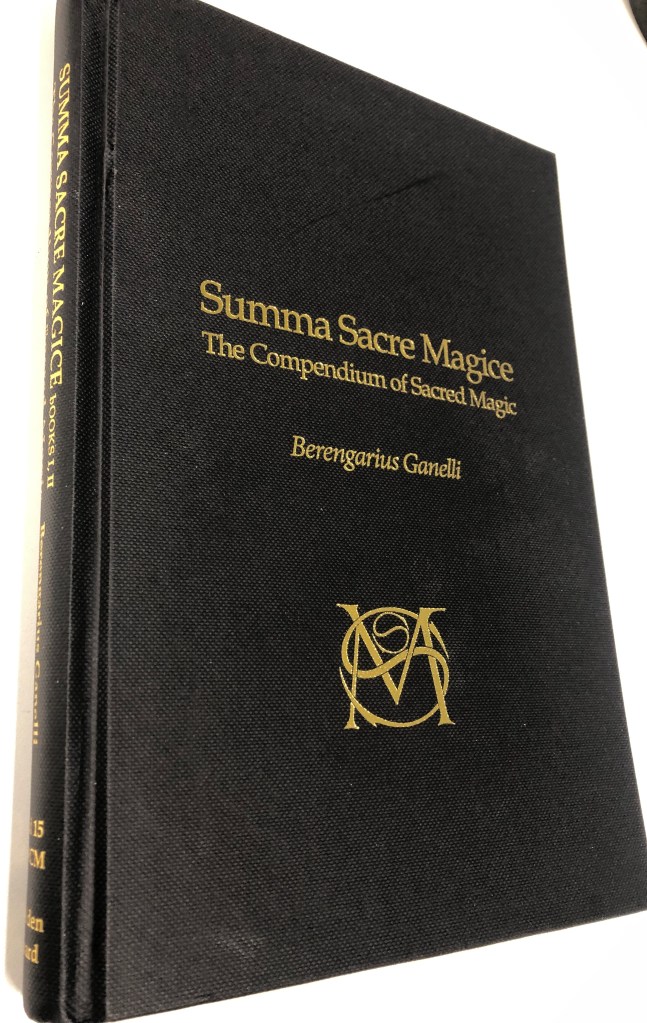
I have many of the Source work series, as well as the ‘Complete Magicians Tables’ , in the main, they are reference material, you could study each one for many moons, you could practice each one a you so wish, They are perhaps at times a little overly scholarly. The first thing I do is remove the dust cover, because I love the look of them, all black and gold embossed on the bookshelf.
Skinner has been known to omit ! yes Omit! any references to practical uses, even if it explicitly written in the original grimoires, of any substance likely to create, let’s say a reverie in the users mind. Bear that in mind… they’re (many of the translated grimoires from the ‘source work’ collection) not unabridged !!
I won’t show plates and lists and diag. from the books, Skinner/Clark deserve to have wallets emptied for the task they have embarked upon, but here is the facsimile from which, I believe, the book was worked,~ Summa Sacre Magice and take a sharp intake of breathe at the length the authors have endured to gift us this translation.

Artwork:David Teniers the Younger – The Alchemist c.1647
Appendix
As example of names ( taken from Elsewise Magazine Issue no.2~ for which I have full rights and permissions to use);-
Note: apologies for formatting errors, it really was a cut and paste job, if the formatting’s ok then I did rework them, if not, then I couldn’t be bothered
Abba–Father–the Aramaic word, Abba,
appeared three times–Mark 14:36; Galatians
4:1-7; Romans 8:15
Adon–lord, master, owner–Joshua 3:11, 13;
Nehemiah 7:61; Psalms 12:5; 97:5; 105:21; 114:7;
Jeremiah 22:18; 34:5; Zechariah 4:14; 6:5
Adon Adonai Tseva’ot–The Lord God of hosts-
-Isaiah 1:24; 3:1; 10:16, 33; 19:4; Malachi 3:1
Adon kol-ha’arets--Lord of all the earth–Joshua
3:11, 13; Psalms 97:5; Zechariah 4:14; 6:5
Adonai–Lord/Master/Owner and represents
the Lord YHVH/Lord God–as a substitute for
the four letters of the sacred Tetragrammaton:
JHVH, YHWH, IHVH–Genesis 15:2, 8; Deuteronomy 3:24; 9:26; Joshua 7:7; Judges 6:22; 16:28;
2 Samuel 7:18, 22, 28; 1 Kings 2:26; 8:53; Psalms
69:7; 71:5, 16; Isaiah 3:15; 7:7; Amos 1:8, 11, 13;
4:2, 5; 5:3; 6:8; 8:1, 3, 9, 11; 9:8; Obadiah1:1;
Micah 1:2; Zechariah 1:7
Adonei ha’adonim–Lord of lords–Deuteronomy 10:17; Psalm 136:3
Adonai ha’elohim hakkadosh--Lord, the Holy
God–1 Sam. 6:20
Adonai Jehobah–Lord Jehovah translated in
the KJV as LORD GOD–Genesis 15:2
Adoni--My Lord–Psalm 110:1
Adoneinu–Our Lord–1 Samuel,16:16
25:14, 17; 1 Kings 1:43, 47; Nehemiah 10:30;
Psalms 8:2, 10
Avi–Father–Psalm 68:5; Malachi 2:10
Avir Ya’akov–Mighty One of Jacob–Isaiah
60:16
Avinu–Our Father–Isaiah 63:16
Ehyeh Asher Ehyeh–I am that I am–Exodus
3:14
El–God–dervies from a root word meaning
Might/Strength/Power and probably is related
to the Ugaritic/Cannanite name, Ilu or El, which
also means God. (The ancient Ugaritic language
is classified as a Northwest Semitic language and
thus related to the laguages: Aramaic, Phoenician, and Hebrew.) The Hebrew name, El,
appears over 200 times in the Hebrew biblical
scriptures–usually with some attribute or epithet attached. See below.
El Bethel–God of the House of God–Genesis
35:7
El Elyon--The Most High God–Genesis
14:18, Daniel 3:26, Psalms 78:56
El Emunah–The Faithful God–Deuteronomy 7:9
El Gibbor--Mighty God–Isaiah 9:6
El Kanna–Jealous God–Exodus 20:5
El Kanno–Jealous God–Joshua 24:19
El Hakabodh–God of Glory–Psalms 29:3
El Hay–The Living God–Joshua 3:10, Jeremiah 23:36, Daniel 3:26
El Hayyay–God of My Life–Psalms 42:8
El Marom–God Most High–Micah 6:6
El Nekamoth–God that Avengeth–Psalms
18:47
El Nose--God that Forgave–Psalms 99:8
El Simchath Gili–God My Exceeding Joy–
Psalms 43:4
El Rai--God Seest Me–Genesis 16:13
El Shaddai–Almighty God–Genesis 17:1,2,
Ezekiel 10:5
Elah–Aramaic name for God, similar to
the Arabic Allah–Deuteronomy 32:15; 2
Chronicles 32:15; Nehemiah 9:17; Ezrah 5:1,
11; 6:14; 7:12, 19, 21, 23; Daniel 2:18, 23, 28,
37, 44, 47; 3:15, 28; 6:8, 13.
Elah Avahati–God of my fathers–Daniel
2:23
Elah Elahin–God of gods–Daniel 2:47
Elah Yerushelem–God of Jerusalem–Ezra
7:19
Elah Yisrael–God of Israel–Ezekiel 5:1
Elah Shemaiya–God of Heaven–Ezra 7:23
Eli Maelekhi--God My King–Psalms 68:24
Elohe Chaseddi–God of My Mercy–Psalms
59:10
Elohe Yisrael–God, the God of Israel–Genesis 33:20
Elohe Mauzi–God of My Strength–Psalms
43:2
Elohe Tishuathi–God of My Salvation–Psalms 18:46, 51:14
Elohe Tsadeki–God of My Righteousness–Psalms 4:1
Elohe Yakob–God of Jacob–Psalms 20:1
Elohe Yisrael–God of Israel–Psalms 59:5
Elohei Avotenu--God of our fathers–Deuteronomy 26:7; 1 Chronicles 12:17
Elohei Avraham--God of Abraham–Exodus
3:15
Elohei Avraham elohei Yitschak velohei
Ya’akov–God of Abraham, Issac, and Jacob–Exodus 3:15
Elohei Chasdi–God of my Kindness–Psalms
59:17
Elohei Haelohim–God of Gods–Deuteronomy 10:17; Joshua 22:22; Psalms 136:2
Elohei Ma’uzzi–God of my Strength–2 Samuel 22:33; Psalms 31:5; 43:2
Elohei Mikkarov–God who is near–Jeremiah 23:23
Elohei Merachok–God who is far–Jeremiah
23:23
Elohei Marom–God of Heights–Micah 6:6
Elohei Mishpat–God of Justice–Isaiah 30:18
Elohei Tseva’ot–God of hosts or God of
armies–2 Samuel 5:10
Elohei Tzur–God of Rock–2 Samuel 22:47
Elohei Kedem–God of the beginning; Eternal God–Deuteronomy 33:27
Elohei Tehillati–God of my Praise–Psalms
109:1
Elohei HaChayim–God of the Living–Mark
12:27
Elohei haruchot l’chol-basar–God of the
spirits of all flesh–Numbers 16:22; 27:16
Eloheynu–Our God–Exodus 3:18
Elohim--God [plural of El or possibly of
Eloah]–Genesis 1:1
Elohim Bashamayim–God in heaven 2
Chronicles 20:6
Elohim Chayim-– Living God–Deuteronomy
5:26; Joshua 3:10; 1 Samuel 17:26, 36; 2 Kings
19:4, 16; Psalms 42:2; 84:2; Isaiah 37:4, 17;
Jeremiah 10:10; 23:36; Daniel 6:20, 26; Hosea
1:10; Matthew 16:16; 26:63; John 6:69; Acts
14:15; Romans 9:26
Elohim Emet (Emeth)–God of Truth–Jeremiah 10:10
Elohim Ozer Li--God My Helper–Psalms
54:4
Elohim Bashamayim--God in Heaven–Joshua
2:11
Elohim Kedoshim–Holy God–Joshua 24:19
Elohim Machase Lanu–God Our Refuge–
Psalms 62:8
Elohim Shophtim Ba-arets–God that Judgeth
in the Earth–Psalms 58:11
Elohim Tsebaoth–God of Hosts–Psalms 80:7,
Jeremiah 35:17, 38:17
Elohenu Olam–Our Everlasting God–Psalms
48:14
Elsali–God , My Rock–Psalms 42:9
Emmanuel–God is with us–Matthew 1:23
Even Yisrael--Rock/Stone of Israel–Genesis
49:24
Ha’adon Adonai--The Lord God–Exodus 23:17,
Exodus 34:23
Hamelekh Hagoel–Redeeming Angel–Genesis
48:16
Immanuel--God is with us–Isaiah 7:14; Isaiah
8:8
Ischyros–strong, mighty–Revelation 18:8
Jah–Jah is the shortened form of the divine
name Jehovah, spelled JHVH, YHWH, or IHVH–Psalm 68:4
Machseh–Fortress; Refuge; Shelter–Psalm 91:2
Ma’on–Refuge/Dwelling place–Psalm 90:1
Melekh HaKavod–King of Glory–Psalm
24:7,8,9,10
Melekh Yisrael–King of Israel–2 Samuel 24:23;
Psalm 98:6; Isaiah 6:5; Jeremiah 46:18; 48:15;
51:57
‘Or Goyim–Light of the nations–Isaiah 42:6
‘Or Yisrael--Light of Israel–Isaiah 10:17; Psalm
27:1
Peleh Yo’etz–Wonderful, Counselor–Isaiah 9:6
Roeh–Shepherd–Genesis 49:24; Psalm 23:1;
Psalm 80:1
Sanctus, Sanctus, Sanctus Dominus Deus omnipotens, qui erat, et qui est, et qui venturus
est–Holy, holy, holy, Lord God Almighty, which
was, and is, and is to come–Revelation 4:8
Sar Shalom–Prince of Peace–Isaiah 9:6
Shiloh–alternate for the Messiah–Genesis 49:10
Shofet–Judge–Psalm 50:6
Yashar–Just One–Isaiah 26:7
MORE NAMES OF POWER
AGLA–Kabbalistic acronym for “Athah
Gabor Leolah, Adonai,” used as a name of
God–You, Lord, Are Mighty Forever.
Adonay–Lord–alternate spelling of Adonai–
Hebrew spelled in 18th century German.
Agape–Love–Greek.
Agios, O Theos, Ahenatos–Holy God, Holy
Strong, Holy Immortal–Greek from the
opening line, “Agios o Theos, Agios ischyros,
Agios athanatos,” in the Trisagion.
Agnus Dei--Lamb of God–Latin.
Alithos Anesti–”Indeed He (Christ) Has
Risen “ or “Truly He is Risen!”–Greek
Alhim–Alhim is an alternate spelling of
Elohim.
Aleph and Tau–the Beginning and the End-
-the Hebrew alphabet starts with the letter
aleph and ends with the letter tau–Hebrew.
Alpha et Omega–the Beginning and the
End–the Greek alphabet starts with the letter
alpha and ends with the letter omega–Greek
Anaphenaton–Kabbalistic substitute of
Adoni.
Beatus Salvator–Blessed Savior–Latin.
Christos–the Anointed One who is the Son
of God–Greek.
Christos Aneste–Christ is Risen–Greek.
Christus--Jesus Christ–Latin.
Corpus Christi--Body of Christ–Latin.
Dei Patris, Deus Filius, Deus Spiritu Sanctus–God the Father, God the Son, God the Holy Spirit–Latin.
Deus–God–Latin.
Deus Pater--God the Father–Latin.
Dominus Deus Sabbaoth–Lord God of
Hosts (Multitudes)–Latin.
Domine Iesu Christe–Lord Jesus Christ–
Latin.
Dominus–Lord–Latin.
Eel–God, alternate spelling of El–Hebrew
spelled in 18th century German.
Eleison Imas–Holy, Immortal, have mercy
on us–Greek
Elohim Avinu–God our Father–Hebrew.
Emt, Emeth–Truth–Hebrew.
Flos–Flower, Splendor, Crown–Latin
GAOTU–God the Father as creator of the
universe, acromym for Great Architect of the
Universe–English.
HaShem--The Name–Hebrew.
Ia or Iao–Ia is the shortened form of the divine
name Ieova, spelled IHVH, YHWH, or JHVH.
Ia is found in the Greek word Alleluia which is
the Greek form of the Hebrew, Hallelujah. Alleluia, meaning “Praise, Ia,” is found in Revelation
19: 1, 3, 4, 6.
Iao or Io–an alternative spelling of Iah, Jah, or
Yah, a shortened form of the divine name Ieoba.
Ichtus–alternate spelling of IXTYS–Greek.
Ieova–a Greek form of the divine name Yahweh or Jehovah, spelled IHVH, YHWH, or JHVH.
Iesous Christos Theou Yios Soter–Jesus Christ, Son of God, Savior–Greek.
Iesu–alternate spelling of Jesus used in the KJV
1611-6129.
Iesu Christ–Jesus Christ–In William Shakespeare’s King Richard II (Quarto 1, 1597) in line 2012 is the phrase “For Iesu Christ…” indicating
that this spelling was commonly used in Elizabethan England. Shakespeare’s King Richard II was penned and performed during the reign of Queen Elizabeth I (1533-1603), maybe in 1595.
Iesus Hominum Salvator–Jesus Savior of Men-
—Latin.
Iesus Nazaraeus Rex Iudaeorum–Jesus of
Nazareth, King of the Jews–Latin.
Imanu’el–God is with us–alternate spelling of
Immanuel–Hebrew.
INRI–Latin acronym for “Iesus Nazaraeus Rex
Iudaeorum”–Jesus of Nazareth, King of the
Jews.
Iota-Eta-Sigma-Omicron-Upsilon–Greek
letters spelling the name Iesous or Jesus–Greek.
Isa al-Masih–Jesus the Messiah–Arabic.
IXTYS–The Greek word for Fish is an amagram for Iesous Christos Theou Yios Soter
meaning Jesus Christ, Son of God, Savior–
Greek.
JHVH, YHWH, or IHVH–the Ineffable Name
of God or Unpronounceable name of God. In certain Jewish esoteric traditions of the Kabbalah, the “true” name of God is deemed so sacred that it is unpronounceable. This name occurs over 5000 times in the Hebrew biblical scriptures.
Jah–Jah is the shortened form of the divine
name Jehovah, spelled JHVH, YHWH, or
IHVH–This name, Jah, is found in Psalm
68:4 but it is in part of the word Hallelujah
or “Hallelu-Jah” from the Praise Psalms
where it often translated as “Praise ye the
LORD.” Hallelujah is found 24 times in the
Psalms.
Janua–Door, Gate, or Entry way–Latin.
Kyrie Eleison–Lord, have mercy–Greek.
Kyrios–Lord–Greek.
Lux–Light–Latin.
Mashiach–God’s annointed one, a Jewish
king who will rule during the messianic age.
Mashiach ben David–messiah, son of the
line of David.
Melekh Mashiah–King Messiah–Hebrew.
Messiah–the Anointed One–anglicized
Late Latin.
Messias–in Christianity, Jesus–Late Latin.
Moshiah–Savior–Hebrew.
Omnipotent–All Powerful–Latin.
Omnipotenti–Almighty–Latin.
Otheos–O God–a rendering of O Theos–
Greek.
Panis–Bread–Latin.
Pater–father–Latin.
Pater Omnipotens–Father Almighty–Latin.
Patris et Filii et Spritus Santi–Father, Son,
and Holy Spirit–Latin.
Pentagna–probably a shortented or garbled
spelling of the Greek Pentagrammou aka
Pentagrama or Pentagram–possibly meaning a name of Jesus with five letters or a five point figure.
Petra–Rock–Latin.
Primeumaton–Thou who art the First and
the Last–Primeumaton is likely a distorted
compound involving the Latin “primus,”
(first) and “grammaton” (letters) and is
a Kabbalistic substitute for Ehyeh Asher
Ehyeh.
Primematum–first (in existence) or made first-
-Latin
Qadosch–Holy–Hebrew.
Rex Omipotente–Almighty King–Latin.
Ruarch Eolhim–Spirit of God–Hebrew.
Sanctus Deus, Sanctus Fortis, Sanctus Immortalis–Holy God, Holy Strong, Holy Immortal–Latin opening line of the Trisagion.
Schaddey–Almighty, alternate spelling of Shaddai–Hebrew spelled in 18th century
German.
Spiritu Sancto–Holy Spirit–Latin.
Theos–God–Greek.
Theos Pantodynamos–God Almighty–Greek.
Te Deum–You God–Latin.
Tetragrammaton–the four Hebrew letters usually transliterated as JHVH, YHWH, or IHVH– that form the secret name of God–from the
Greek literally meaning “Four Letters.”
Trinitas–Trinity, meaning Father, Son, and
Holy Spirit–Latin.
Via, Veritas, Vita–the Way, the Truth, and the
Life–Latin.
Yahshua–Jesus–alternate spelling of Yeshua–Hebrew.
Yahu–apparently a Gnostic rendering of Iao.
Yahweh–a name of the Hebrew God from the four letters Yod He Vau He, YHWH, another spelling of Jehovah. See Jehovah’s Names.
Yeho–the divine name Ievoa–alternate spelling of Yahu which is an alternate spelling of Iao or Io–Greek spelled in 18th century German.
Yehoshua--alternate spelling of Yeshua–Hebrew.
Yeshua–meaning “Yahweh [YHVH] saves,”
Jesus–Hebrew.
Yesu–Jesus–alternate spelling of Yeshua or
Iesu.
Yod He Vau He–the four Hebrew letters of the
most secret and sublime Hebrew name of God.
Yod Nun Resh Yod–the four Hebrew letters for
INRI.
Zebaoth–Hosts (Multitudes) alternate spelling
of Tsebaoth, meaming El Tsebaoth–Hebrew
spelled in 18th century German.


 The Western Gate
Leave a comment