
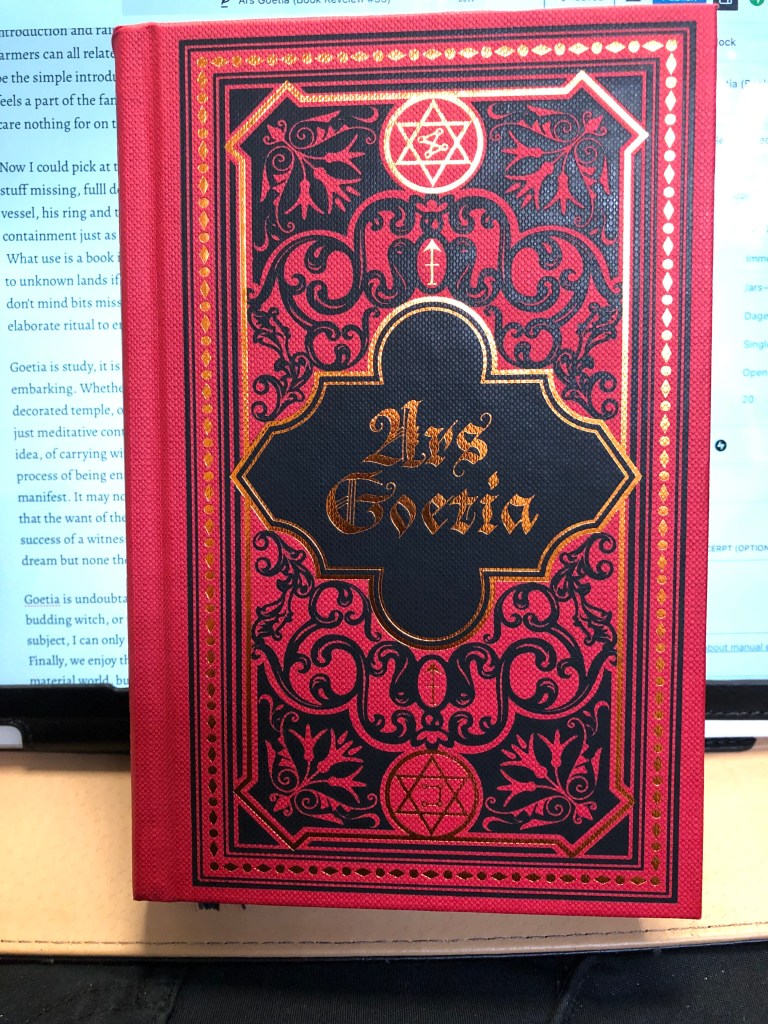
Ars Goetia
Edited and Introduced by Paul Summers Young
Layout and Design Alice Rocchetti
Black letter press
How many books of the same subject would you want? I’m not exactly sure how many I have now of the ‘Goetia.’ The first I bought- the famous/infamous Crowley/Mathers (with those drawings lifted from DePlancey), I then treated myself to a costly Teitan Press version, There’s Pandemonium by Jake Stratton Kent, the chapter within the excellent Practical Foundations of Sorcery by Gary. St. M. Nottingham, Lesser key of Solomon (Peterson) the list will go on….
Essentially the Goetia is a part of what is known as The Lemegeton- A series of Five Books attributed, of course, to King Solomon
Ars Goetia – Describes the evocation of 72 demons and how to summon and control them.
Ars Theurgia-Goetia – Focuses on spirits associated with specific regions and directions.
Ars Paulina – Covers the summoning of angels and celestial spirits tied to the planets and time.
Ars Almadel – Provides instructions for working with angelic hierarchies through the use of a wax tablet.
Ars Notoria – Deals with prayers and meditative practices for gaining wisdom and mastery of the arts.
(There are vast and more detailed descriptions of each of these on the internet which will be much better than any attempt I could be bothered with, peruse at your leisure)
however, let me digress and ramble on,
Now the 72 Daemons accordingly are assigned to the starry heavens, being five degrees each, specific to either night or day and to the constellations and therefore planetary association with the respective ‘star sign. Each spirit has its own virtues and its own area of expertise (for want of an analogy to Trump Cards- which one will serve me better, which is better at this or that)
Each Daemon is usually a product of some elder God or ancient and lost archaic entity and here in this system is revived? … I would assume, here we meet some concerns, not just in this new book, but in most books.
There is no clear reference or explanation as to the etymology of a Daemons name nor its origin, even if it is assumed and speculated. Even if we take the name, in Hebrew, there are no conclusions via Gematria (the numerical value of a word, and words associated therefore by having the same number) as to its probable psyche. IT is written, this is its name, this is what it does, this is its sigil. Now shut up and don’t think.
Likewise there is no clear reference as to the association with Solomon, certainly not referenced in the Bible or Apocrypha and nor in history. We could just as easily assign this whole field of knowledge as being that gifted by Sheba to Ol’ King Sol’, and who are anyone to object to my conclusion if they accept that which in itself is ambiguous.
Yah, The Queen of Sheba herself gifted a brazen vessel of 72 herbs, each assigned to a specific concern and the collective hive of them all encompassing the whole body of the logos. Each herb thus burnt as an offering conjured in itself the manifestation of the entity born from the Deva (The spirit of nature). Now, no doubt anyone can wag their finger at this statement and condemn it as they may whilst at the same time waving the banner of the peculiar frontier they seek from, namely Goetia. You cannot condemn someone else’s ‘other’ God if you yourself have not stood foursquare in your Gods presence.
At the outset then we are on an anomalous step towards the temple, it has no foundation and no strength in the validity of its being. But. It is a system that is verified by the meek and the worldly, the naive and the studious. It fits an agenda, it is symbolic that represents by its imagery/association and correspondence with a ‘thing’, that ‘thing is tangible by means of our giving life to it, we summon it, we contain and constrain it, we demand of it. Am I saying that it is us, who creates the daemons, well that can’t be so, as they are already created, we in fact strengthen the image, we add to its allure, we promote it and adorn it.
The Goetia, as a part of the Lesser Key of Solomon, is known as Low Magic. Also perhaps Left Hand. It is works committed to resolving wants that we have. The want of love, riches, fame. Adversely, high magic would be the negation of want itself.
for instance;-The sorcerer commands a daemon to bring them wealth, perhaps a person they love most subsequently dies and there by inheritance is the wealth !
Ironically, the sorcerer who asks for nought but a clear path to enable them to ‘know’ that which should be ‘known’ may find themselves enamoured with opportunities, wealth and more importantly contentment, that their work can progress unhindered by external pressures.
Be careful what you wish for.
Black letter Press have given us a book that references various translations of the same, it a lovely book that serves its purpose well. Whether it is the ‘best’ book on the Goetia is purely subjective. The best book, always! is that written in your own hand. Draw references from this book, copy and adapt and by experiment, dabbling, failure and success add to those pages you craft. That said, here is a very readable account with lovely introduction and raisin d’etre from the author with thoughts that we wayward wayfarers (isn’t that a double negative?) can all relate to. Throughout, the book feels ‘connected’ it may well be the simple introduction that offered us a friendly handshake, but it feels a part of the family as opposed to a lofty and impersonal book we care nothing for on the shelf from some elitist would be bohemian.
Now I could pick at the bones, is it exhaustive and complete? No. There’s stuff missing, fulll decript’s of the words surrounding ‘Solomon’s’ brazen vessel, his ring and the full arte of the sorcery circle and the triangle of containment just as a few examples.
What use is a book if we don’t have to think? What reason is there to travel to unknown lands if they are fully explained and revealed beforehand. I don’t mind bits missing, all arte is preparation and none more so than the elaborate ritual to enable the conjuration of a daemon. Surely.
Goetia is study, it is a requirement to analyse and assess before embarking. Whether the ritual is performed in a humble place or a richly decorated temple, or indeed whether it is a construct of a lucid dream or just meditative contemplation, the more we ‘obsess’ the mind with the idea, of carrying with us the sigil of the required demon, of the whole process of being enamoured with the ritual of the Goetia the more it will manifest. It may not manifest as a physical tangible aspect, it maybe that that the want of the sorcerer itself begins to become apparent without the success of a witnessed ritual, perhaps the subconscious mind has lost the dream but none the less steers the ship to the goal.
Goetia is undoubtably the most infamous and prelevant agenda on any budding witch, or wand waving wanderer, there are many books on the subject, I can only recommend absorbing as many as is possible.
Finally, we enjoy the pleasures of the flesh and the trappings of the material world, but we are not truly free unless we understand these as mere distractions, temporal. The absence of want is freedom. The golden calf is no substitute for nature, and nature is herself free, evolving, nurturing, sustaining and also cruel and destroying.


 The Western Gate
Leave a comment