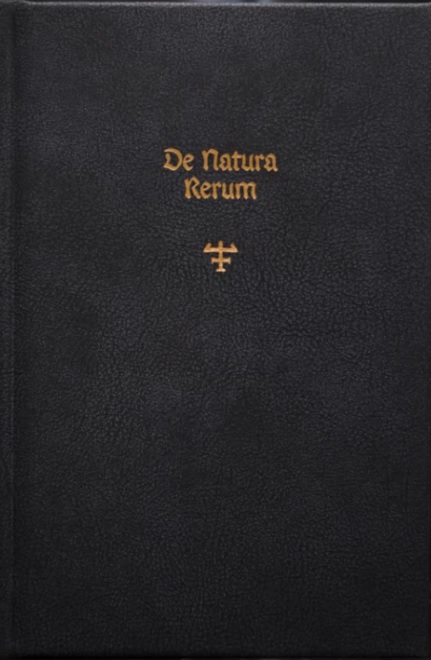
De Natura Rerum
Or, Nine books on the nature of things.
Paracelsus.
Translated by John French
Aula Lucis
If belief that all nature is created solely as mankind’s plaything then the works of Paracelsus will be for your enjoyment also, likewise notions that menstruating women will spoil wine and cause gold to lose colour and perfumes to be weakened, and if the philosophical mind still sways in favour of Paracelsus because , he must be truly great, then let us remind ourselves how through his methods homunculus (a living being) is created by pouring a blob of menses into a gourd glass and swirling into it some droplets of sperm, then applying the requisite heat by means of burying the flask in horse dung, for a moons tide or thereabouts. Heat and moisture after all creates the momentum of life. The creature will, assuredly be created, though such a monster Paracelsus admits is doomed to short life.
It would of course be wrong to regard this work as worthy of nothing more than means for ridicule, for within it we garner those great alchemists and philosophers outlook. It is not patronising or belittling when we see our responses to the ideas put forward by those, considered, great men and thinkers, and all new avenues of thought begin from the uneven dirt track created first of course by the vision and curiosity of that maverick wanderer.
Paracelsus as with other alchemists talk in terms of the three great principles being Salt, Mercury and Sulphur. Paracelsus quotes Hermes as saying “from these three the seven metals are bought into being.” The three principles being spirit (mercury), soul (sulphur) and body (salt).
The seven metals alludes to the seven planetary combinations, being Saturn-Lead, Jupiter- Tin, Mars-Iron, Sun-Gold, Venus-copper, mercury-mercury, Moon-silver.
“ Of the three all seven be.” Although not covered by Paracelsus and the translations from Hermes he derives this from, fundamentally we must presume of course it is the permutation of those three principles thus being
1) Sulphur
2) Mercury
3) Salt
4) Sulphur and Mercury
5) Sulphur and Salt
6) Mercury and Salt
7) Mercury, Sulphur and Salt.
These combinations bringing into being by contemplation and study the seven pure ‘metals’.
In the ancient times it was the blacksmith with his knowledge of metallurgy and craft that gave him great status, as did the herbalist with knowledge of the medicinal properties of plants. These avenues of knowledge of course became codified by those in authority, jealous, as always of any mantle the commoner may hold.
The philosophers and wise men of the counsels and in the privileged palaces relied if only on their instinct , on their observations and experiments to gain an understanding of the principles of life. That we can study books of this nature with mockery is testament only to the knowledge we have been given by an education system, in itself limited by knowledge of the time. Where once we studied the proton, neutron and the electron, we now study quanta, where once it were a limited universe to which we as humans on this planet were quite formidable and important, it is now so vast that we, on this little grain of dust in an insignificant measure of time don’t mathematically exist.
But, is it any excuse for a learned man in history to be congratulated for having ideas that the best preservative for steel and iron is the lard of a castrated pig, that milk can be preserved with oil of almonds and if a little rye bread falls into honey it is turned into ants (?) and spoiled.
We can mock as we may but given that we as humans at that time probably assumed the sun was kidnapped every evening and the stars were pinholes in the canopy of heaven we should be humble.
Within all occult knowledge allegorical or otherwise we seek to find imagery to enable us to obtain a hidden answer. It maybe obscure to us on the first footing, e.g. the tree of the kabbalists -but a myriad of complexity that defies perception, or the folk and Fae tales so naïve and innocent can surely hold no wisdom for us to behold. However, persevere with the jabberwocky and the beast will arise. Within the Nine essays tehre is much that could be discussed here, suffice to say it is worthy of the curious to indulge in the text as is and draw their own picture.
Paracelsus gave us the ideas to draw out the pure form of substance. Even if the terms of sulphur, salt and mercury confound, and yet in parallel the Gunas (Sattva,Rajas,Tammas) of the Hindus is an allegory we wouldn’t dismiss so quickly (Sattva – Pure, Rajas– polarising,dynamic and motion, Tammas: decayed to its immobile and spent force.) To draw out the pure essence of things we distil in alcohol, the alcohol absorbs the essence of the matter and thus when filtered and the alcohol naturally dissolves, what is left being the pure essence of the matter. It is here we can liken our quest for our true nature, and what is the alcohol which we absorb? but knowledge and when that knowledge has gone, what should only be left is wisdom.
This is the second in the series by Aula Lucis, we can call them quaint and pat ourselves on the back as to how far we have come, but like symbolism in modern art, there is still behind the abstractions wisdom to behold. They are to be read without question, even though our ego wants to spit and fume at the nonsense we perceive, and when finished, there is clarity. Without the thinkers, there is no action but stagnation.
Included in the book of Paracelsus’ Nine Treatises of the spagyric art is a handy “Chymical Dictionary”, compiled by John French. Its got olde words and other notions with which to confound eavesdroppers and the police.


 The Western Gate
Leave a comment