IAO : Ophite Iconography
José Gabriel Alegría Sabogal
Anathema PublishingLanguage
Iota Alpha Omega!
Imagine if you will that the saviour of the religion upheld by the majority of the world were in fact the descendent of the original tempter, the serpent. That the religion which in itself destroyed the cultures, and therefore murdered millions upon millions of people, of North and South America, Africa, Most of Europe, was in itself the spawn of that great serpent- Apophis, by Chaos its order came. It is is a scenario played out by the sect known as the OPhites-itself an etymology “Of the Serpent”. It was that ‘serpent’ that defied the law of Jeohvah and gave wisdom to the first mortals, that gave them the knowledge of ‘Good and Evil’ and that declared and showed after this wisdom was recieved, they would not, and did not die as warned by Jeohvah.
All religion has its opposition, yet also paradoxically sometimes that opposition decries the throne , challenging its knowledge and wisdom, and therefore power and glory, and declares that it, itself is not only the true reflection of wisdom, but is suppressed and veiled by that religion it is deemed to be in opposition to. All structure and each kingdom of course is known only because it is Victorious, viz. history is known to us only by the winners, those whom raised the banner of glory.
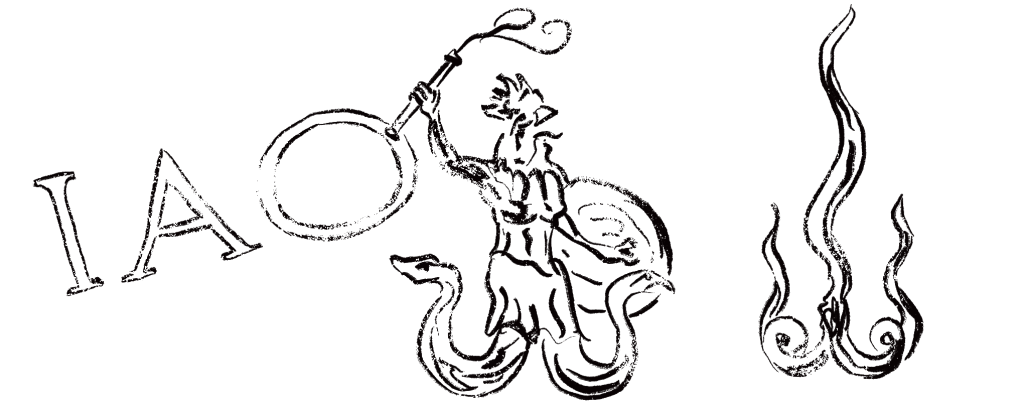
IAO, seeks to illuminate us on this message, that of the path of the Ophites, and therefore of the wisdom of the ‘Gods’. The serpent upon the crown of priests and emporers, Pharoahs and queens, the straight staff that alike the spine speaks wisdom to the mind. We tread the realm of rhetoric and prose in order that a message can be seen.
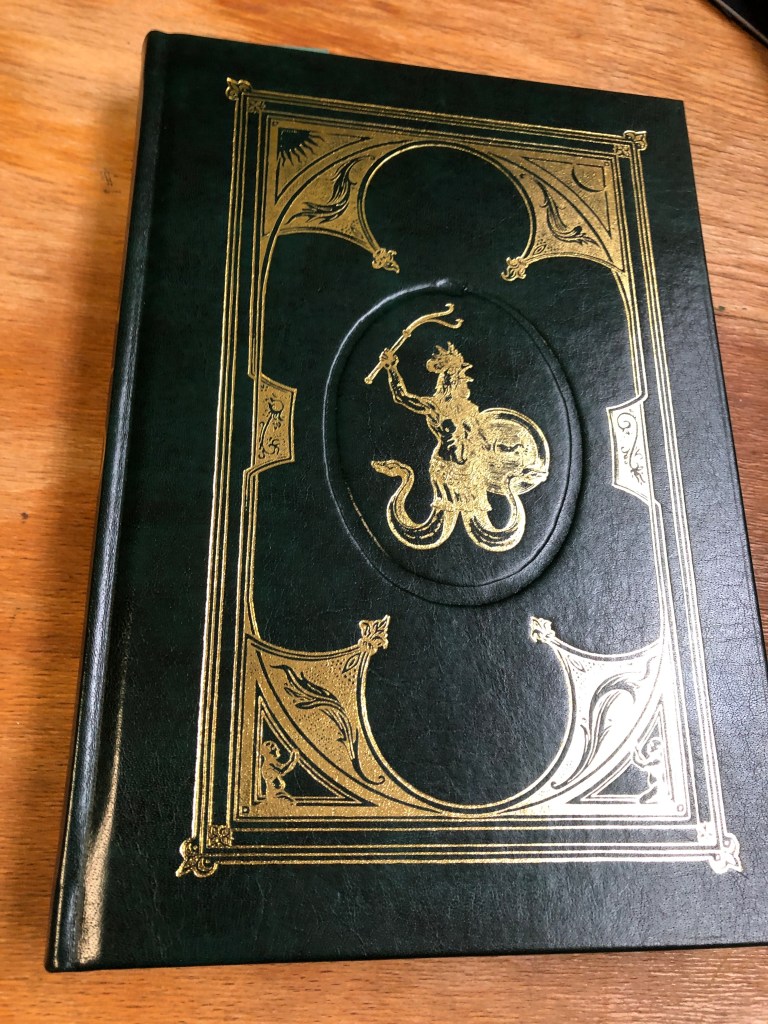
The, IAO, book itself, lauded by many as the most beautiful, or even best, book of its year 2022 ( A reprint in paperback is imminent- sept ’24). Fabulous artwork. Is it pretence? all fur coat and no knickers? There are many paths to wisdom, some choose devout and cloistered restriction, that the whole mind and body is focused on and directed to the supreme as in the ascetics who by their beliefs act as though life itself is punishment and abhorrence at the point of creation. This would conflict with Jeohvah declaring all that was made was ‘Good’, up until of course perhaps the point when that serpent decided to enlighten the mortals in their blissful ignorance within Eden.
Others serve the path towards the supreme by morals and ethics, dharma, and obeying laws as laid down by religion or by simple common sense, that to do unto others as you would have done to you. These, the flock, the sheep that make up the vast majority of most who call themselves religious, where the book, the word although testament and the bastion of their faith, it is by their life’s work, path and actions that would serve them to be judged as ‘true’ and as ‘proper’ and hope that any salvation or knowing of ‘God’ comes to them by virtue of their deeds.
There are those who seek the knowledge of God, not by study of the book, or of obedience to laws and structure but in the wisdom beheld by creation, in art, in music, in poetry and song, in mathematics or rhetoric, for surely all things that are, must reflect that which is?
This book is beautifully illustrated by perhaps the master of modern occult illustration after all by its very nature it is an illumination of iconography, and as such follows in the footsteps of those past books of divine imagery, that sought to reflect the supreme not just by the words written, the laws and commentaries, but by being itself beautiful, breath-taking, it is as a wanderer who enters a cathedral, regardless of beliefs causing that self to literally wonder at the scene before them and know that they stand in the presence of the majestic. The overwhelming obliteration of all doubt when confronted immediately by the glorious sights, the abundance of incense, the sound of choirs from within, what hope for the doubter when every sense is silenced into subservience regardless of whatever God the cathedral or temple is devoted to, surely, the whole scene reflects that which is divine?
Speculum Humanae Salvationis and Contra Celsum;- works dedicated to the themes of both the Old testament and the New, texts that sought to illuminate the wisdom held with the Bible. By the nature of both their beauty, poetry, artistry, rhetoric they was to reflect the supreme and lead to salvation. They are works referenced by IAO in the pursuit of Gnostic accomplishment, and Gnosticism here is known by (quote) Understanding The demiurge (and his relation to the manifested world), the myth of Sophia (and the female aspects of the divine), and the ophite Christology, or the saviour as a serpent.
Speculum Humanae Salvationis is – a complete standard version has 52 leaves, or 104 pages, and 192 illustrations shows that even in its format it seeks to reflect and emulate the divine, and this is the construct behind works such as IAO. Even as an atheist or as an opponent to ‘a’ religion the methods employed here seek to show the path is visible towards what is undoubted truth. This is the salvation, the resurrection, regardless of whether Jesus lived or Adam and Eve or whatever laws were laid down, it is to see that by its nature it reflects the supreme. The Analogy becomes the Understanding. In Gnosticism, the demiurge, that creator of the manifest isn’t seen as the supreme, in fact by nature of creation, alike Buddhism, existence itself is the root cause of suffering although IAO seeks to questions this somewhat. For true enlightenment would otherwise then follow that we seek not the trappings of beauty, but the nature behind it all. It would seem paradoxical then to illuminate beautiful books with the temptations thereof to bring us to a love of the supreme, when in fact the beauty in itself is but an illusion of existence. However,
The path of the gnostic is such that our wayfarer traverses through the forests and fields and beholds beauty in ways that they have never seen or known, and after bemoaning that they are separate from this come to realise in a epiphany that they themselves are actually a part of this…. and then go home and rest with a ‘nice cup of tea’ and continue as before? What’s changed? World view has changed, the epiphany, the crisis point of our psych which breaks the ego and leaves only that which senses and becomes the observer, although participating the illuminated self is in effect not engaging with the futile pursuit and endeavour of life. Likened somewhat to those who have had near death experiences, or have been to ‘space’, observing the world in a completely different way. All these are ways in which the seeker no longer seeks nor is sought but is blissfully content and at an equanimity to the nature of existence, that existence and the manifest now are indifferent to them. The suffering thus ceases and through second death, the resurrection.
By imagery and illustration, text and prose, poetry and song are all these things achieved, we wonder, we bow down and submit, we give up at that point, are released and freed. It is finished.
That God and the Devil are both as the illuminated and the illuminating, That God is the light and the Devil reflects it. That one is the ultimate reality, the other is the path by which to know it, and there is wisdom.
Pagans et al decry the speech Christ gave, that “only by me can thou reach heaven.” We regard therefore Christ as this personae with authority and with demand for obedience. In fact, the reverse is true, for Christ is not a person, but the embodiment of the divine in opposition to the manifest and creation…. if we are to behold the wisdom of the Gnostic faith. Why else, or how else could such a figure lead the path away from the restriction and bondage of suffering which is at the heart of creation. It is not so much to reason why Christ said, “only through me”, but to understand What Christ represents. Many naysayers of course will point that the words, “only by me” are plagiarised from earlier teachings of say, Horus, yet again, it is not to see the figures of Christ or Horus as separate or as individuals, for they are not. It is to see what they represent, their archetypal form.
IAO seeks to show the path is not just one of rejecting creation, of pointing fingers at a demiurge for creating the cause of suffering, for life and the senses are there to be enjoyed, it is whether we stress over wants unbecoming that chooses whether we suffer or are content. He that has nothing and is content beholds the universe as their own.
It would be easy for me to summarise chapters in the book, to briefly dispel or champion anything said in IAO, but this would distract from the whole point and purpose of a book like IAO whose iconography and meditative contemplation on its themes requires the self to unravel. It is a book that requires less study and more to absorb its beauty and see the wood for the trees just as the pilgrim in “Circle of Iron1” undergoes task after trial after task before being presented with the book of knowledge that is no more than a mirror.

Afterword.
Gnosticism and the awkward distraction of being duality or non-duality of being inherently evil or that all that made was “Good” distracts somewhat from our knowing. The Indian Goddess- Lakshmi is often cited as the Goddess of wealth, in fact she is also the Goddess of desire, and also of Dharma and ultimatley of Moksha-liberation of the self, by these four ways, that her four depicted arms display, is the spiritual wanderer blessed. It is the balance of duality and non-duality that a mere peasant such as I stands with the Goddess of Justice-Maat- holding together the pillars of Wisdom and Understanding, of being Merciful and Discipline- to knight or behead, of enjoying the permutations of the creative abundance and also the rules and parameters of the logic (Where Rumi the creative was born to live so Jerome the Methodical is bound to die), of knowing that our time though measured by the Earths revolution around the Sun, is also with the dance of the Moon around the Earth, and all are each in equilibrium.
Είμαστε Άλφα και Ωμέγα
The Review of Foolish Fish drooling over IAO , and who can blame him, a beautiful book whose body matches its soul;-
1/ Circle of Iron – Film – 1978


 The Western Gate
Leave a comment