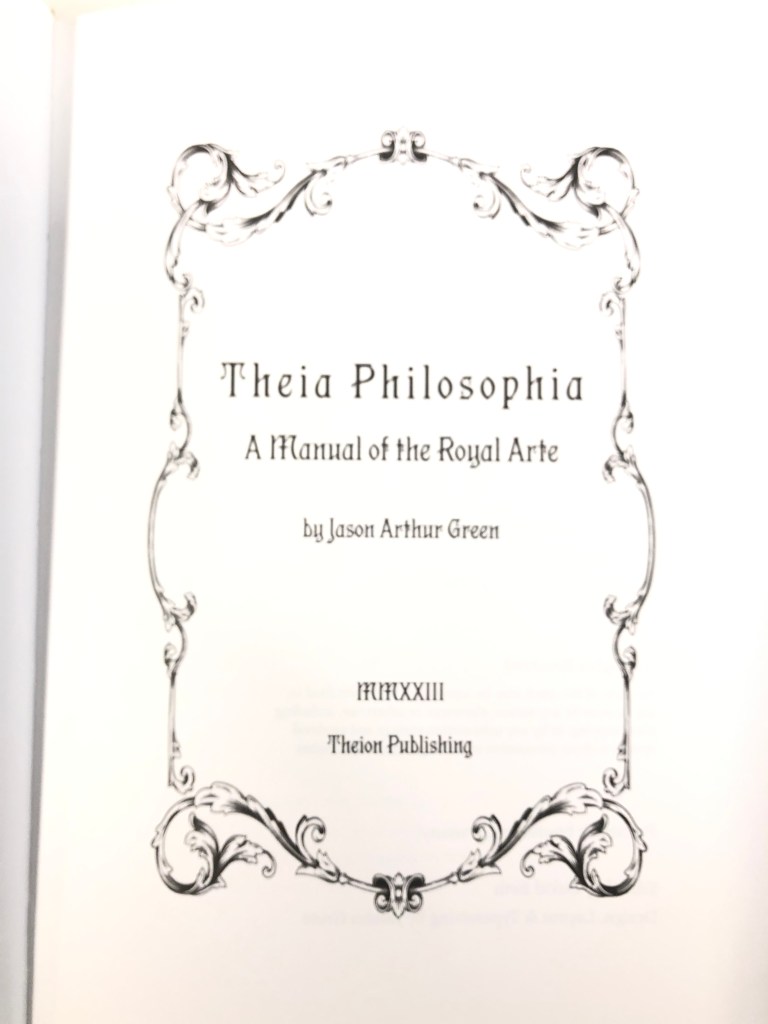
Theia Philosophia ~A Manual of the Royal Arte
by J.A. Green
Theion Publishing
“A theurgic system intent on establishing unity with the divine, Henosis“, so the blurb says, a new word, and new words will certainly crop up in this work, Henosis (Ancient Greek: ἕνωσις) is the classical Greek word for mystical “oneness”, “union” or “unity”. In Neoplatonism, henosis is unification with what is fundamental in reality: the One (Τὸ Ἕν), the Source, or Monad.

In the first instance it is a book that I was looking forward to, I liked the sound of it, Theion produce good quality books, and it certainly is that.
A review by Game of Saturn Author Peter Mark Adams gave me a slight eyebrow raising concern;- Rendered in prose more redolent, at times, of sacred texts, the author’s writing style facilitates introspection and a re-consideration of our own spiritual path within the larger framework provided by the notion of a Prisca Theologia. I don’t know why many contemporary writers offer us this bombastic style. I hoped that Theia Philosophia wouldn’t follow that garrulous, loquacious, verbose, and grandiloquent language, (we can all do it !) that more often than not, rather than impressing us and exciting us sends us to sleep. Anyway I hoped it wouldn’t follow this pattern. It did. Oh, by Jove and Jeeves it did, in spades. However ! I trudged on.
The book aims to embrace all models that seek unity with the universal, and this is Prisca Theologia, Primal Theology if you will, the source of the stream, for want of a much better analogy. Herein becomes the problem with using Latin/Greek/(insert your own opulent language) because we dont readily use those words, we dont cling on to them, or remember them. Its been a few weeks since reading the book, and can I remember much of it? No. If we are to talk in terms of unification why choose to write in a language or use terms deviant from the rest of the book? Why use arcane words when modern equivalents will not only do, but actually are much easier to comprehend, retain, help us learn and grow….
This is one of those books that requires study, and I add, perhaps deserves study. But. You will have to learn lots of new words, words you’ll never use anywhere else. Can you be bothered?
I remember finishing the book and was feeling quite empowered and illuminated (!) by it. Was that the mind in jubilation that I managed to finish the trawl? Yes and No to be honest.
Excerpt and example, just one line ;- “What is uncommon knowledge is the ethereal cthonicism of such: Gaia-rooted, ouranus-vaulted, Theia-sighted Eros Ekstatikos!” make any sense? hows about instead if we wrote;- The rare wisdom lies in the mystical connection to the Earth, sky, and cosmic forces, embodying a divine ecstatic love? Same, but not the same isn’t it?
I did, at the end of the book glean some admiration for the work, even the practices. It is a lovely looking book and I will, because curiosity demands, refer to it or redip my toes in its turbulent waters again.
Is it Royal Arte? are the means to synchronicity with the ‘Monad’- that fundamental source of reality and existence within?
Is the path only for those eloquent and elaborate, does royal mean – not for peasants, not for the common (isnt common a source of unity?) – certainly the language and text demands a more discernible customer, though am I myself being an inverted snob for saying that, that only the intelligesia can access this, the Oxbridge, the perfumed ponces and bohemians?…at the very least it appears the author is seeking that audience. If we were to go to a pub, or over lunch with a friend who spoke in the same manner as this book, we’d never invite that friend out again, “what a laborious bore!” we’d say in parody.
However ! The enigma, the quandry and the strange conclusion, it is a good book! but be prepared to have empathy with the loneliness of the long distance runner.


 The Western Gate
Leave a comment